For years, my family told me they loved me.
I believed them.
I paid their bills.
I covered their emergencies.
I sent my mother, Linda, $30,000 every month without being asked.
Not because she demanded it.
Because I thought that was what family did.
When my younger brother needed a new car, I helped.
When my parents wanted to renovate their house, I paid.
When my mother said the mortgage was becoming difficult, I quietly increased the amount I sent.
I never kept track.
I never asked for receipts.
I never expected anything in return.
I thought I was helping the people who had loved me before I had money.
Then one afternoon, I discovered something that changed everything.
It started with a document.
I had gone to my parents’ house to pick up some old family photographs.
My mother wasn’t home.
She had told me where the photographs were kept.
Inside the study was an old safe.
I knew the combination because my father had once given it to me.
I opened it.
Inside were property documents, insurance papers, bank records, and several envelopes.
Then I saw a familiar word.
Will.
I wasn’t planning to read it.
But my name was written across the top.
I opened the document.
And within minutes, I realized something was terribly wrong.
My parents’ current will didn’t say what I had always believed.
It didn’t describe me as the person they trusted most.
It didn’t even describe my brother as an equal.
Instead, there were pages discussing my financial contributions.
Every payment.
Every property.
Every account.
Every asset I had helped acquire.
And beside several of them were handwritten notes.
“Keep him comfortable.”
“Don’t upset him.”
“He’ll continue helping as long as he feels needed.”
I stared at those words.
My hands went cold.
Then I found another note.
It was written by my mother.
“Never let him think we don’t need him.”
I read it again.
And again.
Suddenly, the last several years looked completely different.
Every phone call.
Every emergency.
Every “I love you.”
Every time my mother told me how proud she was.
I remembered how quickly the conversations changed whenever I said I couldn’t send money immediately.
I remembered my brother’s jokes about how generous I was.
I remembered my mother’s tears whenever the family needed something.
But I had never questioned it.
Because I wanted to believe they loved me.
Then I found a second document.
It was a financial plan.
My family had calculated how much money they expected me to provide over the next ten years.
The total was more than $3.6 million.
I sat alone in that room and finally understood.
They hadn’t built a family around me.
They had built a financial plan around me.
I closed the folder.
I didn’t call my mother.
I didn’t confront my brother.
I didn’t send angry messages.
I didn’t even cry.
I simply put everything back exactly where I had found it.
Then I closed the safe.
And I walked away.
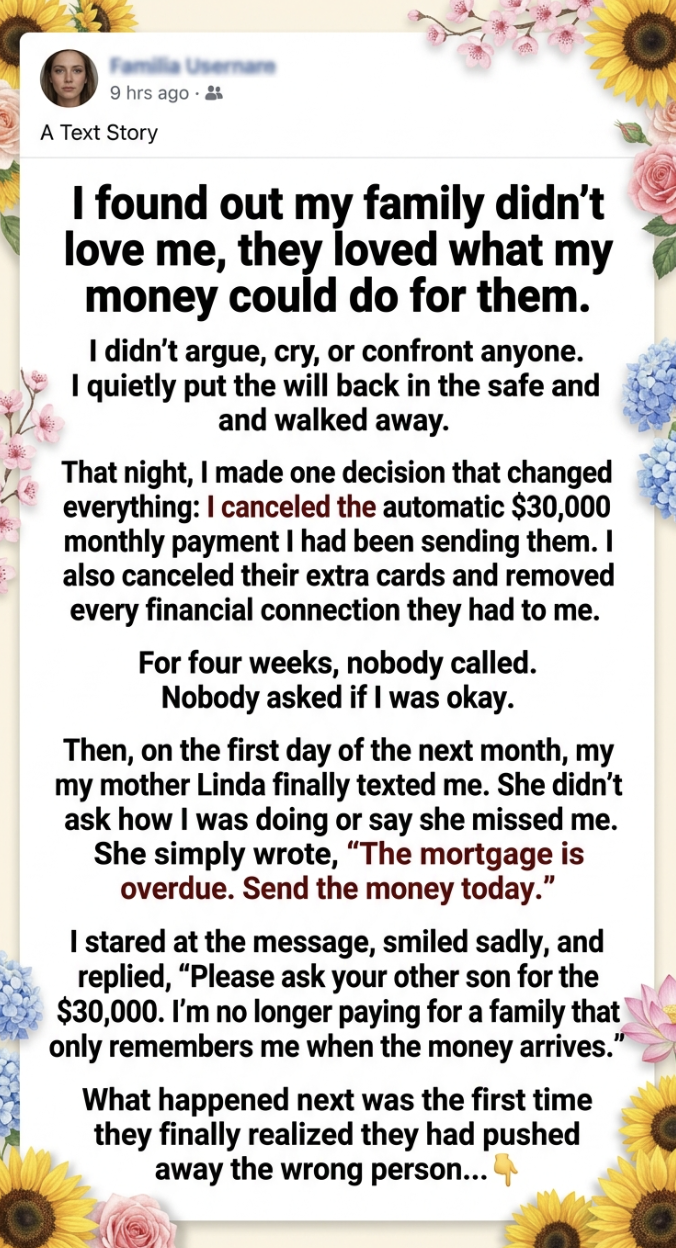
That night, I opened my banking app.
The first thing I saw was the automatic transfer.
$30,000 — FAMILY SUPPORT.
I stared at it for a long time.
Then I canceled it.
Next, I reviewed every account connected to my family.
My mother’s additional card.
Canceled.
My brother’s authorized card.
Canceled.
Automatic utility payments.
Removed.
Car insurance.
Removed.
Mortgage assistance.
Removed.
Private expenses.
Removed.
One by one, I disconnected every financial connection.
It took less than an hour.
But emotionally, it felt like I was closing a door that had been open my entire life.
When I finished, I put my phone down.
For the first time in years, I didn’t feel responsible for what happened next.
The next morning, I expected my phone to explode.
It didn’t.
Monday passed.
Nothing.
Tuesday.
Nothing.
Wednesday.
Still nothing.
A week passed.
Nobody called.
Nobody asked why the money hadn’t arrived.
Nobody asked if I was okay.
Nobody asked whether something had happened.
Two weeks.
Still silence.
Three weeks.
Nothing.
By the fourth week, I finally understood the truth.
They weren’t waiting for me.
They were waiting for the money.
On the first day of the next month, my phone finally buzzed.
It was my mother.
I opened the message.
There was no greeting.
No “How are you?”
No “We miss you.”
No “Is everything okay?”
Just:
“The mortgage is overdue. Send the money today.”
I stared at the screen.
For a moment, I almost laughed.
Not because it was funny.
Because it was the clearest answer she could have given me.
I typed:
“Please ask your other son for the $30,000. I’m no longer paying for a family that only remembers me when the money arrives.”
Then I put my phone down.
This time, I didn’t wait for her response.
It came twelve minutes later.
“What are you talking about?”
Then:
“This is your family.”
Then:
“You can’t just abandon us.”
I didn’t respond.
My brother called.
I ignored it.
He called again.
I ignored it again.
Then he left a voicemail.
His voice sounded completely different.
He wasn’t joking.
He wasn’t confident.
He wasn’t angry.
He was scared.
“Please call me back. We need to talk.”
I finally called.
He answered immediately.
“What happened?”
I said nothing.
He continued.
“Mom says you’re refusing to help.”
“I am.”
“But why?”
I paused.
“Because I found the will.”
Silence.
My brother stopped breathing for a second.
“What will?”
“You know which one.”
Another silence.
Then he said quietly:
“Listen to me. You don’t understand.”
“I understand perfectly.”
“No, you don’t.”
He sounded nervous now.
“The document wasn’t supposed to be there.”
I felt something tighten in my chest.
“What do you mean?”
He didn’t answer.
“Who wrote those notes?”
Still nothing.
Then he said:
“Mom did.”
That hurt more than I expected.
I already knew.
But hearing him confirm it made everything real.
I asked:
“Did you know about it?”
He hesitated.
“Yes.”
That one word changed everything.
I ended the call.
For the next several days, my family tried everything.
My mother called relatives.
My brother sent messages.
An aunt contacted me.
A cousin asked me to “think about what family means.”
But nobody asked the most important question.
Why had I stopped helping?
They were only asking how to make me start again.
Then something unexpected happened.
My father called.
He had barely spoken to me since I discovered the will.
His voice was quiet.
“I owe you an apology.”
I didn’t say anything.
He continued.
“Your mother and your brother made plans without me.”
I was surprised.
“You knew about the money?”
“Yes.”
“You knew they expected me to keep paying?”
“Yes.”
“Then why didn’t you stop them?”
He sighed.
“Because I was afraid.”
“Of what?”
“Of losing the lifestyle your money gave us.”
That sentence hurt.
But it was honest.
For the first time, someone in my family wasn’t pretending.
My father admitted that my financial support had changed their lives.
They had become dependent on it.
Instead of adjusting their lives, they had adjusted their expectations.
And somewhere along the way, they stopped seeing me as their son.
They started seeing me as their solution.
Months passed.
My family had to sell things they didn’t need.
My brother returned the expensive car I had helped finance.
My parents downsized their house.
They stopped taking expensive vacations.
They learned to live within their own means.
It wasn’t easy.
But slowly, something changed.
My mother began sending messages that weren’t about money.
The first one simply said:
“I hope you’re doing okay.”
I didn’t respond.
A month later:
“I miss talking to you.”
Still, I didn’t respond.
Then one evening, I received a longer message.
She wrote:
“I thought losing your financial help was the hardest thing that happened to us. I was wrong. The hardest thing was realizing why you stopped giving it.”
I read the message several times.
Then she wrote:
“We confused what you gave us with who you were.”
That sentence stayed with me.
Eventually, I agreed to meet her.
Not at the family house.
Not at a restaurant.
Just a quiet park.
She arrived alone.
She looked older.
Not physically.
Emotionally.
She sat beside me.
“I don’t expect you to forgive me,” she said.
I looked at her.
“Then why did you ask me to come?”
“Because I want to know if I can become your mother again.”
That broke something inside me.
Not because I suddenly forgot everything.
But because, for the first time, she wasn’t asking me for anything.
Not money.
Not help.
Not another chance to pay a bill.
Just a chance to rebuild a relationship.
I didn’t promise her everything would return to the way it was.
I simply said:
“We can start with honesty.”
She nodded.
And that was where we began.
I still help my family sometimes.
But now, I choose when and how.
There are boundaries.
There are no automatic payments.
No shared cards.
No financial expectations.
And most importantly, there is no price attached to love.
My family eventually learned something I had to learn the hard way:
When you constantly rescue people, they may eventually forget that you were the one saving them.
And when I finally stopped giving them money, I discovered something even more important.
I hadn’t lost my family.
I had finally discovered which members of my family wanted me—and which ones only wanted what I could provide.
Sometimes walking away isn’t revenge.
Sometimes it’s the first step toward being respected.
And sometimes the people who say you’ve changed are simply upset because you finally stopped letting them use the old version of you.