My mother died peacefully in her sleep on a quiet Tuesday morning.
There was no warning.
No dramatic final conversation.
Just one phone call that changed our family forever.
Her funeral was held that Friday.
By the time we returned home, I was still struggling to accept that I would never hear her voice again.
My brother, Ethajik, seemed to have already moved on.
Not emotionally.
Financially.
On Monday morning, while I was sitting alone in my mother’s kitchen, staring at the teacup she had used every morning for years, my phone buzzed.
It was Ethajik.
His message contained only one sentence:
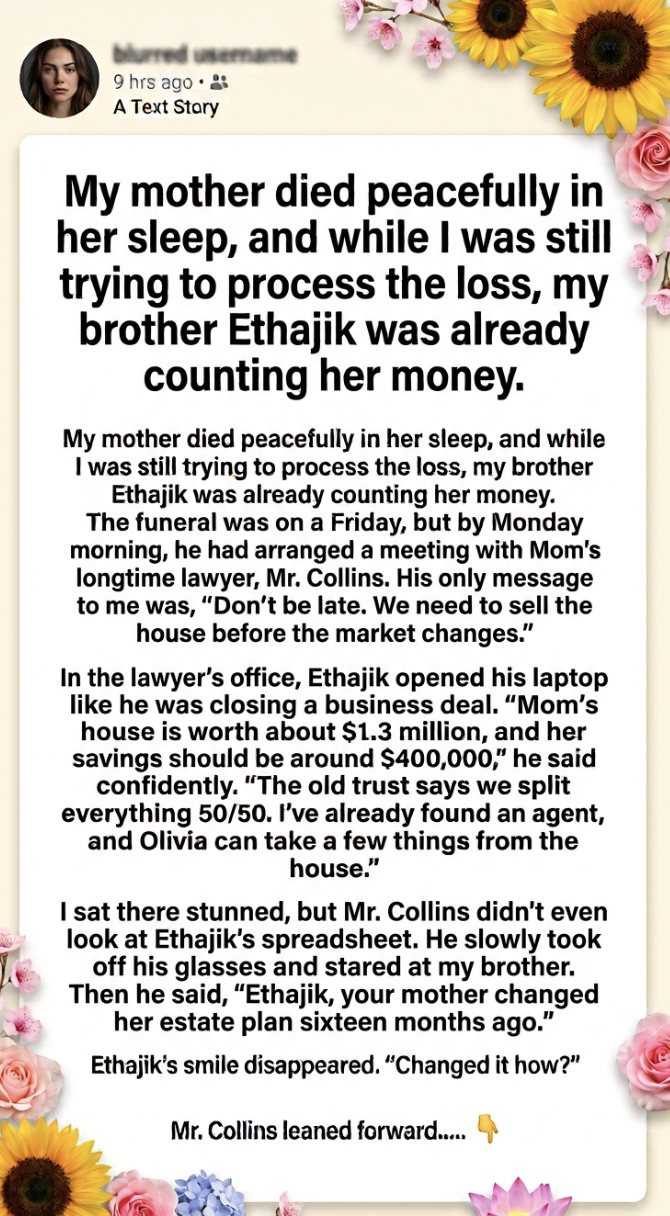
“Don’t be late. We need to sell the house before the market changes.”
I read it three times.
Sell the house?
Already?
Our mother had been dead for only three days.
I called him.
“What are you talking about?”
“The house, Olivia,” he said impatiently. “We can’t just leave a $1.3 million property sitting there. I’ve already spoken to an agent.”
I couldn’t believe what I was hearing.
“What about Mom?”
There was a pause.
Then he sighed.
“She’s gone, Olivia. We have to deal with what comes next.”
What came next, apparently, was money.
He told me to meet him at our mother’s longtime lawyer’s office.
Mr. Collins had handled Mom’s legal affairs for more than twenty years.
I remembered him from when I was young.
He had always treated my mother with enormous respect.
So I went.
When I entered the conference room, Ethajik was already sitting at the table with his laptop open.
He didn’t look like a grieving son.
He looked like a businessman preparing for a meeting.
He turned the laptop toward me.
“I made a preliminary breakdown.”
On the screen was a spreadsheet.
House: approximately $1.3 million.
Savings and investments: approximately $400,000.
Other assets: to be determined.
Ethajik tapped the screen.
“The old trust says we split everything fifty-fifty. I’ve already found a real estate agent. If we move quickly, we can probably close within a few months.”
I stared at him.
“You’ve already found an agent?”
“Yes.”
“You’ve already contacted someone about selling Mom’s house?”
“Yes.”
“You haven’t even waited until after the funeral arrangements were completely finished.”
He frowned.
“Olivia, being emotional isn’t going to change anything.”
I looked across the table at Mr. Collins.
He hadn’t said a word.
He was holding a folder in front of him.
Ethajik continued.
“Also, Olivia can take a few personal things from the house. Mom’s jewelry, photographs, whatever sentimental stuff she wants.”
I slowly turned toward him.
“Sentimental stuff?”
He shrugged.
“The valuable things should be appraised.”
That was the moment something inside me broke.
My mother had spent her entire life building that home.
Every room contained memories.
The scratches on the hallway wall where we had measured our height as children.
The blue chair where Mom used to read.
The little garden she maintained even when her hands became too weak to do the work herself.
And Ethajik was already dividing it into dollar amounts.
Then Mr. Collins finally moved.
He placed his pen on the table.
Slowly, he removed his glasses.
And he looked directly at my brother.
“Ethajik.”
My brother smiled.
“Yes?”
“I think you should close your laptop.”
His smile faded slightly.
“Why?”
“Because the information you’re working from is no longer accurate.”
Ethajik leaned back.
“What do you mean?”
Mr. Collins opened the folder.
“I mean your mother’s estate plan changed sixteen months ago.”
The room went completely silent.
Ethajik stared at him.
“Changed?”
“Yes.”
“How?”
Mr. Collins didn’t answer immediately.
He pulled out several documents.
Then he said quietly:
“Your mother came to see me sixteen months ago.”
Ethajik’s face changed.
“Why didn’t I know about this?”
“Because she specifically instructed me not to tell you.”
My brother’s expression hardened.
“Not tell me what?”
Mr. Collins looked at me.
Then back at Ethajik.
“Your mother was very clear about what she wanted.”
Ethajik leaned forward.
“You’re saying the old trust isn’t valid?”
“No.”
“Then what does it say?”
Mr. Collins took a breath.
“Your mother created an entirely new estate plan.”
Ethajik looked at me.
I could see the calculation happening behind his eyes.
“Did Olivia know about this?”
“No,” Mr. Collins said.
That surprised both of us.
“Then who knew?” Ethajik asked.
Mr. Collins closed the folder.
“Your mother wanted it that way.”
Ethajik’s voice became sharper.
“So you’re telling me that she changed everything behind my back?”
“I am telling you,” Mr. Collins replied calmly, “that your mother had the legal right to decide what happened to her property.”
Ethajik leaned back.
“How much did she leave me?”
Mr. Collins didn’t answer.
Instead, he looked at me.
“Olivia, your mother left you a letter.”
My heart stopped.
“A letter?”
Mr. Collins nodded.
“She asked me to give it to you only after both of you were present for the reading.”
He handed me a sealed envelope.
My mother’s handwriting was on the front.
To Olivia.
My hands began shaking.
I opened it.
Inside was only one page.
The first line made my eyes fill with tears.
“My dear Olivia, if you’re reading this, then I couldn’t tell you everything while I was still here.”
I kept reading.
Mom explained that she had noticed something over the previous two years.
She had begun to worry that Ethajik wasn’t interested in preserving the family she had built.
He was interested in what he could take from it.
She had watched him pressure her about the house.
She had heard him repeatedly ask about her savings.
And she had noticed something else.
Money had been disappearing from an account she had created years earlier.
Not enormous amounts at first.
A few thousand dollars.
Then more.
Mom had quietly investigated.
She discovered that Ethajik had borrowed money from the family account without telling her.
He had promised himself he would replace it.
But he hadn’t.
By the time Mom changed her estate plan, the amount had grown to more than $180,000.
Ethajik immediately interrupted.
“That isn’t true.”
Mr. Collins raised a hand.
“Let her finish.”
I continued reading.
Mom wrote that she didn’t want to punish her son.
She wanted him to learn something.
“Money can reveal character, but it can also destroy it.”
Then came the part none of us expected.
Mom hadn’t left the house to either of us.
She had placed it into a family foundation.
The foundation would preserve the property and use part of its income to support local students who couldn’t afford college.
Her savings and investments were divided differently.
A portion went to the foundation.
A portion went to several charities she had quietly supported for years.
And the remaining family assets were placed into accounts for specific purposes.
My brother received one modest trust.
But he couldn’t access it immediately.
The conditions required him to repay the money he had taken from Mom’s account.
Until then, the trust would be managed independently.
Ethajik stared at the documents.
“You’re joking.”
Mr. Collins shook his head.
“No.”
“What about the house?”
“It isn’t being sold.”
Ethajik stood up.
“You can’t do this.”
Mr. Collins remained calm.
“Your mother already did.”
My brother turned toward me.
“So she chose you.”
I shook my head.
“No.”
“She gave you everything!”
“She didn’t.”
“She gave you the house!”
“No,” I said quietly. “She gave the house to people who need it.”
He looked confused.
I pointed toward the letter.
“Mom didn’t choose me over you.”
I paused.
“She chose what she believed was right.”
For the first time since the funeral, Ethajik looked genuinely broken.
Not because he had lost our mother.
But because he had lost the money he had already counted.
Mr. Collins then handed me another envelope.
“This one is for both of you.”
Inside was a photograph.
It showed Mom standing in the garden when she was much younger.
On the back she had written:
“A home is not valuable because of what it can be sold for. It is valuable because of what happens inside it.”
Neither of us spoke.
A month later, the house was opened as a small scholarship and community center.
The garden stayed exactly as Mom had wanted.
Her blue chair remained by the window.
Her books stayed on the shelves.
And every year, students who had never met her would walk through those doors and receive help pursuing their education.
Ethajik eventually repaid the money.
It took him years.
But he did.
And slowly, he changed.
We didn’t become close again overnight.
There was too much hurt between us.
But one afternoon, he came to the house and stood quietly in the garden.
He looked at the old blue chair.
Then he said:
“I thought Mom was taking something away from me.”
I didn’t answer.
He looked at me.
“Now I understand.”
“What?”
“She wasn’t taking anything away.”
He looked around the garden.
“She was teaching us what it was worth.”
I smiled sadly.
My mother had left behind more than a house.
She had left behind a lesson.
The greatest inheritance isn’t always the money someone leaves you. Sometimes, it’s the values they refuse to let money destroy.
And that was the inheritance my brother and I needed most.