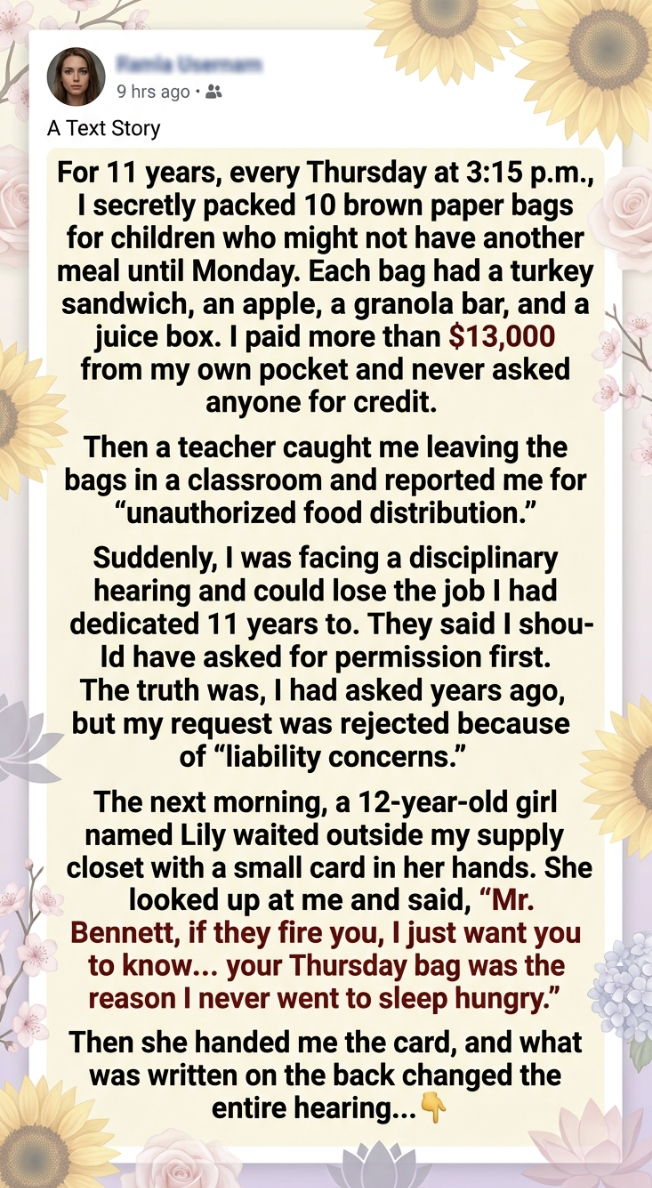
For eleven years, every Thursday at exactly 3:15 p.m., I locked my office door and packed ten brown paper bags.
No announcement.
No photographs.
No social-media posts.
No thank-you notes.
Just ten bags.
Each contained the same simple meal:
A turkey sandwich.
An apple.
A granola bar.
And a juice box.
I paid for everything myself.
Over eleven years, I spent more than $13,000.
I never asked the school to reimburse me.
I never put my name on the bags.
And I never told anyone why.
My name is Daniel Bennett, and I worked at the same elementary school for eleven years.
My official job was managing supplies and helping teachers with whatever they needed.
But over time, I started noticing something.
Some children were always unusually quiet on Fridays.
Some rushed toward the cafeteria line as if they were afraid the food might disappear.
And some would carefully put half their lunch into their backpacks instead of eating it.
At first, I didn’t understand.
Then one Friday afternoon, I saw a little boy standing near the cafeteria trash can.
He was pretending to look for something.
But he wasn’t looking for anything.
He was waiting.
I watched him quietly.
When the cafeteria emptied, he picked up an unopened carton of milk that someone had thrown away.
That moment stayed with me.
The following week, I packed two extra lunches.
I left them anonymously in a classroom where I knew children could take them without being embarrassed.
The next Thursday, I packed four.
Then six.
Eventually, I settled on ten.
Ten bags.
Every Thursday.
For eleven years.
I called them “Thursday bags.”
I never knew exactly who would receive them.
Sometimes a teacher would quietly take two.
Sometimes a counselor would take three.
Sometimes a child would simply walk into the supply room because they knew there would be something waiting.
I didn’t ask questions.
I didn’t want them to feel like they owed me an explanation.
I just wanted them to have something to eat.
Because hunger doesn’t care whether you’re seven or twelve.
And children shouldn’t have to explain why they’re hungry.
Years earlier, I had actually tried to make the program official.
I wrote a proposal to the administration.
I explained what I wanted to do.
The response came three days later.
Rejected due to liability concerns.
So I stopped asking.
And started doing it quietly.
For years, nobody seemed to notice.
Until one Thursday afternoon.
I was carrying ten brown paper bags down the hallway when a teacher stepped out of a classroom.
She stared at me.
“What are those?”
“Food.”
“For students?”
“Yes.”
“Are you authorized to distribute that?”
I paused.
“No.”
She frowned.
“Then you need to stop.”
I thought she was joking.
She wasn’t.
The next morning, I was called into the principal’s office.
There were three people sitting around the table.
The principal.
A district administrator.
And someone from human resources.
A folder was sitting in front of them.
The administrator opened it.
“Mr. Bennett, you’re being placed on administrative leave pending a disciplinary hearing.”
I stared at her.
“For what?”
“Unauthorized food distribution.”
I almost laughed.
Instead, I asked,
“Unauthorized food distribution?”
She nodded.
“You distributed food to students without formal approval.”
“I bought it myself.”
“That doesn’t change the policy.”
“I’ve been doing it for eleven years.”
“That makes it more serious.”
I looked at the principal.
“You knew.”
He didn’t answer.
I continued.
“I asked permission eleven years ago.”
The administrator flipped through the folder.
“Your request was denied.”
“Exactly.”
“Then you should have followed the decision.”
I sat there silently.
After eleven years of showing up early, staying late, fixing broken equipment, helping teachers, and quietly feeding children, I was suddenly being treated like I had committed some terrible offense.
The administrator pushed a document toward me.
“You could lose your position.”
My hands tightened around the edge of the table.
Eleven years.
Gone because I bought sandwiches.
I went back to my supply closet that afternoon.
There were still empty paper bags on the shelf.
I stared at them.
For the first time, I wondered whether I should have stopped years ago.
Then I heard a small voice behind me.
“Mr. Bennett?”
I turned around.
Lily was standing there.
She was twelve years old.
She was holding a small folded card with both hands.
“Can I talk to you?”
I nodded.
She stepped closer.
Her eyes were already wet.
“If they fire you…”
She stopped.
Then looked down at the card.
“I just want you to know something.”
“What?”
She looked up.
“Your Thursday bag was the reason I never went to sleep hungry.”
I couldn’t speak.
She handed me the card.
I opened it.
On the front, written in colored pencil, were four words:
THANK YOU FOR THURSDAYS.
I smiled sadly.
“Lily…”
She shook her head.
“Please read the back.”
I turned the card over.
And froze.
On the back was a list.
Not names.
Not accusations.
Numbers.
Dates.
And short sentences.
Lily had written down every Thursday she remembered receiving a bag.
Then, beneath the list, she had written:
“I asked my mom if I could write this because I don’t want them to think Mr. Bennett was doing something wrong.”
Below that were several signatures.
I recognized some of them.
Students.
Parents.
Teachers.
And former students who had already graduated.
I stared at the signatures.
“Where did you get these?”
Lily smiled through her tears.
“We talked.”
“To who?”
“Everyone.”
That evening, Lily had done something I hadn’t thought of doing.
She had told people.
Not about me.
About the food.
About the children.
About what happened on Fridays.
And by Monday morning, the school had received dozens of letters.
Parents wrote about children who had once hidden their hunger.
Former students wrote about the Thursday bags.
Teachers admitted they had quietly taken them for children in their classrooms.
One former student wrote:
“I am twenty-three now. I have a job and my own apartment. But when I was eight, that brown paper bag was the only food I knew I would have over the weekend.”
Another wrote:
“I never knew who packed those lunches. I thought someone just cared enough to make sure kids like me weren’t forgotten.”
Then came the letter that changed everything.
It was from Lily’s mother.
She explained that Lily had often pretended she wasn’t hungry because she knew there wasn’t enough food at home.
She wrote:
“Your employee didn’t just give my daughter a sandwich. He gave her dignity. She never had to ask for it.”
The disciplinary hearing was scheduled for Wednesday.
I walked into the room expecting to defend myself.
Instead, the room was packed.
Teachers.
Parents.
Former students.
Community members.
Even several district employees.
Lily was sitting in the front row.
The hearing officer looked at me.
“Mr. Bennett, do you understand why you’re here?”
“Yes.”
“Did you distribute food without authorization?”
“Yes.”
“Did you know your request had previously been denied?”
“Yes.”
“Why did you continue?”
I took a breath.
“Because children were hungry.”
The administrator interrupted.
“That doesn’t excuse violating policy.”
“No,” I said.
“But perhaps the policy needs to explain what we’re supposed to do when following it means a child goes hungry.”
The room went silent.
Then the hearing officer looked toward Lily.
“Did you write this card?”
“Yes.”
“Why?”
Lily stood.
Her voice shook, but she kept speaking.
“Because everyone keeps talking about rules.”
She looked at the administrators.
“But nobody is talking about why he did it.”
The hearing officer glanced at the card.
“Did Mr. Bennett ever ask you for anything in return?”
“No.”
“Did he embarrass you?”
“No.”
“Did he make you feel different from other students?”
“No.”
“What did he do?”
Lily swallowed.
“He made Thursday feel safe.”
Nobody spoke.
Then she turned the card around.
“I wrote something else on the back.”
The hearing officer took the card.
Lily said,
“It’s a list of students who received the bags.”
The officer looked at the signatures.
Then looked at the administrator.
“How many students?”
Lily answered.
“More than eighty.”
The room erupted in whispers.
The administrator looked uncomfortable.
The principal stared at the floor.
Then the hearing officer asked the question nobody expected.
“Mr. Bennett, how much money did you personally spend?”
“About thirteen thousand dollars.”
“You were never reimbursed?”
“No.”
“You never accepted donations?”
“No.”
“You never charged anyone?”
“No.”
The officer closed the file.
Then said,
“I’ve reviewed the original proposal you submitted eleven years ago.”
My heart sank.
The officer continued.
“It was rejected because of liability concerns.”
“Yes.”
“But the district never offered an alternative program.”
I said nothing.
The officer looked around the room.
“So for eleven years, this district knew there was a problem.”
Nobody answered.
“And instead of solving the problem, we are disciplining the person who quietly tried to fill the gap.”
The administrator started to object.
The officer raised a hand.
“No.”
She looked directly at the district representatives.
“I think we’re asking the wrong question.”
The hearing was suspended.
Two weeks later, I was called back to the district office.
I expected another disciplinary meeting.
Instead, there was a new proposal on the table.
A formal weekend food program.
School-funded.
Community-supported.
Professionally managed.
And there was one more document.
My original proposal from eleven years earlier.
This time, it had been approved.
At the bottom was a note:
“Mr. Bennett, would you be willing to help us build this program?”
I looked at it for a long time.
Then I smiled.
“Yes.”
The new program eventually served hundreds of students.
But something unexpected happened.
We stopped calling them “Thursday bags.”
Lily suggested a new name.
“The Weekend Table.”
Because, as she put it,
“It’s not about one person giving food to another person.”
“It’s about making sure nobody has to wonder where their next meal is coming from.”
Years passed.
Lily graduated from elementary school.
Then middle school.
Then high school.
On the day she graduated, she came to see me.
She was carrying something.
The same card.
It was worn around the edges now.
She handed it back to me.
“I think you should keep this.”
I smiled.
“I thought it belonged to you.”
“It does.”
She pointed to the back.
“But you need to remember something.”
“What?”
“You thought you were packing food.”
She smiled.
“But you were really packing hope.”
I looked at the old brown-paper-bag program sign hanging on the wall behind her.
Then at the card.
For eleven years, I had believed I was simply making ten lunches every Thursday.
I never expected anyone to notice.
I certainly never expected a disciplinary hearing.
And I never imagined a twelve-year-old girl would be the one to change the outcome.
But Lily taught me something I should have understood from the beginning:
Sometimes the smallest act of kindness becomes enormous when someone desperately needs it.
And sometimes, when the people in power are busy protecting the rules,
the person quietly helping others becomes the one who reminds everyone what the rules were supposed to protect in the first place.