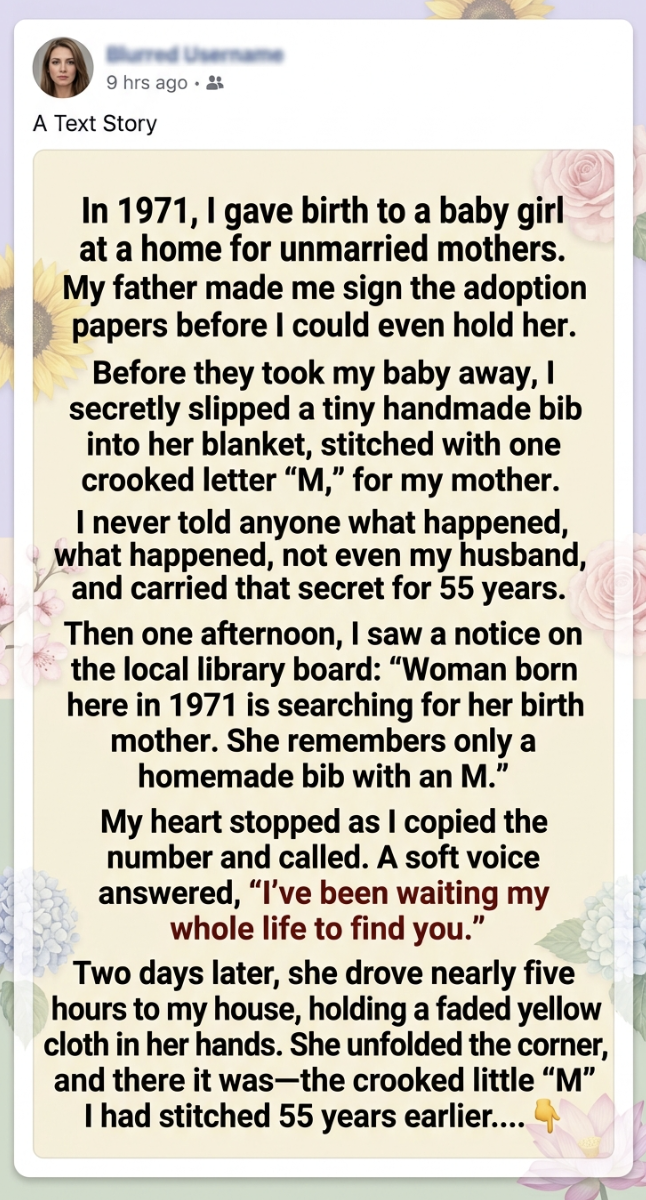
In 1971, I was seventeen years old when I gave birth to a baby girl.
I wasn’t allowed to hold her.
I wasn’t allowed to name her.
And I certainly wasn’t allowed to keep her.
My father had already decided what would happen before I even went into labor.
“You made a mistake,” he told me. “Now you will fix it.”
I was sent to a home for unmarried mothers several towns away, where girls like me were expected to disappear for a few months and return home as if nothing had happened.
The day my daughter was born, I remember staring at her tiny face from across the room.
She had dark hair.
A little button nose.
And the smallest fingers I had ever seen.
I begged the nurse to let me hold her.
Just once.
But my father was standing outside the door.
He had already arranged the adoption.
He placed the papers in front of me and told me to sign.
My hands were shaking so badly that I could barely hold the pen.
“Sign them,” he said.
So I did.
But before they carried my daughter away, I found a tiny piece of yellow cloth in the sewing basket beside the bed.
I had been making little things for the baby during the weeks I stayed there.
With trembling hands, I stitched one crooked letter into the corner.
M.
It stood for my mother’s name.
My mother had died when I was young, and I wanted my daughter to carry at least one piece of the woman who would have loved her.
I slipped the tiny handmade bib beneath my baby’s blanket.
It was the only thing I could give her.
Then they took her away.
And my life continued.
At least, that’s what everyone thought.
I returned home.
Years later, I married a kind man named Thomas.
We had children.
We built a house.
We celebrated birthdays and holidays.
We grew older.
I became a wife, a mother, and eventually a grandmother.
But there was always one room inside my heart that nobody entered.
The room where I kept the memory of a baby girl I had never been allowed to hold.
I never told Thomas.
I never told my children.
I never told anyone.
For fifty-five years, I carried the secret alone.
Sometimes, I wondered where she was.
Whether she was happy.
Whether she had kind parents.
Whether she ever wondered why her birth mother had abandoned her.
The truth was worse.
I hadn’t abandoned her.
I had been forced to give her up.
But how do you explain that to someone who grew up believing something else?
So I stayed silent.
Until one ordinary Tuesday afternoon.
I had gone to the local library to return some books when I noticed a handwritten notice pinned to the community board.
I almost walked past it.
Then I saw the year.
1971.
I stopped.
The notice read:
“Woman born here in 1971 is searching for her birth mother. She remembers only a homemade yellow bib marked with the letter M.”
My hands went cold.
I read it again.
And again.
There are moments in life when the world seems to become completely silent.
That was one of them.
I copied the phone number onto the back of my library receipt.
Then I stood there for nearly ten minutes, terrified to make the call.
What if it wasn’t her?
What if it was?
What would I even say?
Finally, I stepped outside.
I sat on a bench.
And dialed.
The phone rang three times.
Then a woman answered.
“Hello?”
I couldn’t speak.
“Hello?”
My voice finally came out as a whisper.
“I’m calling about the notice at the library.”
There was silence.
Then she asked,
“Are you…?”
I closed my eyes.
“I had a baby girl in 1971.”
The woman on the other end stopped breathing for a moment.
Then I heard her voice break.
“I’ve been waiting my whole life to find you.”
I covered my mouth.
Neither of us spoke for several seconds.
Then she asked the question I had secretly feared for fifty-five years.
“Why did you give me away?”
Tears ran down my face.
“I didn’t.”
Silence.
“My father made me sign the papers before I could even hold you.”
The woman began crying.
“I always wondered.”
“I thought you hated me,” she whispered.
“No,” I said.
“I loved you before I even knew how to be your mother.”
We agreed to meet.
Two days later, I was sitting in my living room when a car pulled into the driveway.
A woman stepped out.
She was nearly my age now.
But when she looked toward the house, something inside me recognized her before my mind could understand why.
She walked to the door carrying a small box.
Her hands were trembling.
So were mine.
When I opened the door, we stared at each other.
Neither of us knew what to do.
Finally, she said,
“Mom?”
I broke down.
I pulled her into my arms.
For the first time in fifty-five years, I was holding my daughter.
The baby I had lost in 1971 was now a grown woman standing in my home.
We cried.
We laughed.
We sat at the kitchen table for hours talking about everything we had missed.
Her name was Margaret.
She told me her adoptive parents had loved her deeply.
She had grown up believing her birth mother had willingly given her away.
But when she became a mother herself, she couldn’t stop wondering about me.
She began searching.
Eventually, she discovered the home where she had been born.
Then she found an old reference to the local library.
And finally, she found the notice.
“I almost didn’t put the bib in the notice,” Margaret said.
I looked at her.
“Why?”
She opened the little box.
Inside was a faded piece of yellow cloth.
My heart stopped.
She unfolded it carefully.
And there it was.
The crooked little M.
The same letter I had stitched fifty-five years earlier.
I touched it with trembling fingers.
“You kept it.”
Margaret smiled through her tears.
“I don’t remember you.”
She paused.
“But I always had this.”
Then she looked directly into my eyes.
And that’s when she said something that changed everything.
“I didn’t come here only to find my birth mother.”
I frowned.
“What do you mean?”
She reached into her bag and pulled out a folder.
“I came because I found something else.”
She opened it.
Inside were copies of old adoption records, letters, and documents.
I recognized my father’s handwriting immediately.
Margaret looked at me.
“He didn’t tell you the whole truth.”
My heart began pounding.
“What truth?”
She turned one page toward me.
“The adoption wasn’t arranged because you were an unmarried teenager.”
I stared at the document.
“What are you saying?”
“He knew the family who adopted me.”
I couldn’t breathe.
“He chose them.”
I looked at the papers again.
Then Margaret said,
“And there’s something else.”
She handed me another document.
It showed that the family who adopted her had continued sending money through an arrangement connected to my father.
I stared at the page in disbelief.
For fifty-five years, I had believed my father had been protecting the family’s reputation.
But according to the records, he had been protecting something else.
A financial arrangement.
A secret that had been buried along with the truth about my daughter.
I looked at Margaret.
“Why didn’t you tell me this on the phone?”
“Because I wanted to tell you face-to-face.”
She reached across the table and took my hand.
“But there’s one more thing.”
“What?”
She smiled gently.
“I didn’t come here to make you angry.”
She opened the final folder.
Inside was a letter.
It had been written by my mother before she died.
I recognized her handwriting immediately.
My hands shook as I unfolded it.
It was addressed to me.
She had apparently discovered what my father planned to do.
And she had written one sentence that made me cry harder than anything else that day:
“If they ever take your baby from you, never let them convince you that loving her was your mistake.”
I pressed the letter against my chest.
For fifty-five years, I had carried shame that never belonged to me.
That day, I finally put it down.
Margaret stayed for three days.
We discovered little similarities between us.
The same laugh.
The same habit of tapping our fingers when nervous.
The same stubbornness.
The same love of old books.
But the strangest discovery came on her final evening.
She was looking through an old photograph album when she suddenly stopped.
She pointed to a picture of my mother.
“That’s her.”
I smiled sadly.
“Yes. That’s my mother.”
Margaret touched the photograph.
“She looks like me.”
I looked closer.
And she was right.
For the first time, I could see it.
The eyes.
The expression.
The shape of the smile.
It was as if the woman I had lost had somehow left part of herself in the baby I had been forced to surrender.
Before Margaret left, she hugged me.
“I spent my whole life thinking I had been abandoned.”
I held her tightly.
“And I spent mine thinking I had failed you.”
She pulled away and looked at me.
“Neither of us was responsible for what happened.”
I nodded.
Then she smiled.
“So let’s stop letting 1971 decide what happens in 2026.”
I laughed through my tears.
That sentence became the beginning of our new life.
Not a replacement for the years we lost.
Nothing could replace those.
But a beginning.
We started having Sunday dinners together.
We met each other’s families.
We filled in the missing pieces of our histories.
And eventually, Margaret brought her children to my house.
My grandchildren.
The family I never knew I had.
One evening, I found the old yellow bib sitting in a frame on her bookshelf.
The crooked M was still visible.
I asked her why she had framed it.
She smiled.
“Because you thought you were giving me one tiny piece of yourself.”
She touched the glass.
“But Mom, you gave me something much bigger.”
“What?”
“The proof that someone loved me before the world even knew my name.”
I cried.
Because after fifty-five years, I finally understood something.
That little crooked letter hadn’t been a goodbye.
It had been a message.
A message that survived adoption papers.
Family secrets.
Decades of silence.
And an entire lifetime apart.
I had stitched one letter into a piece of cloth in 1971.
I thought I was leaving my daughter a tiny reminder of her mother.
Instead, I had unknowingly left her a path home.
And when she finally followed it fifty-five years later, she didn’t just change my past.
She gave me the chance to finally live the part of my life I thought I had lost forever.