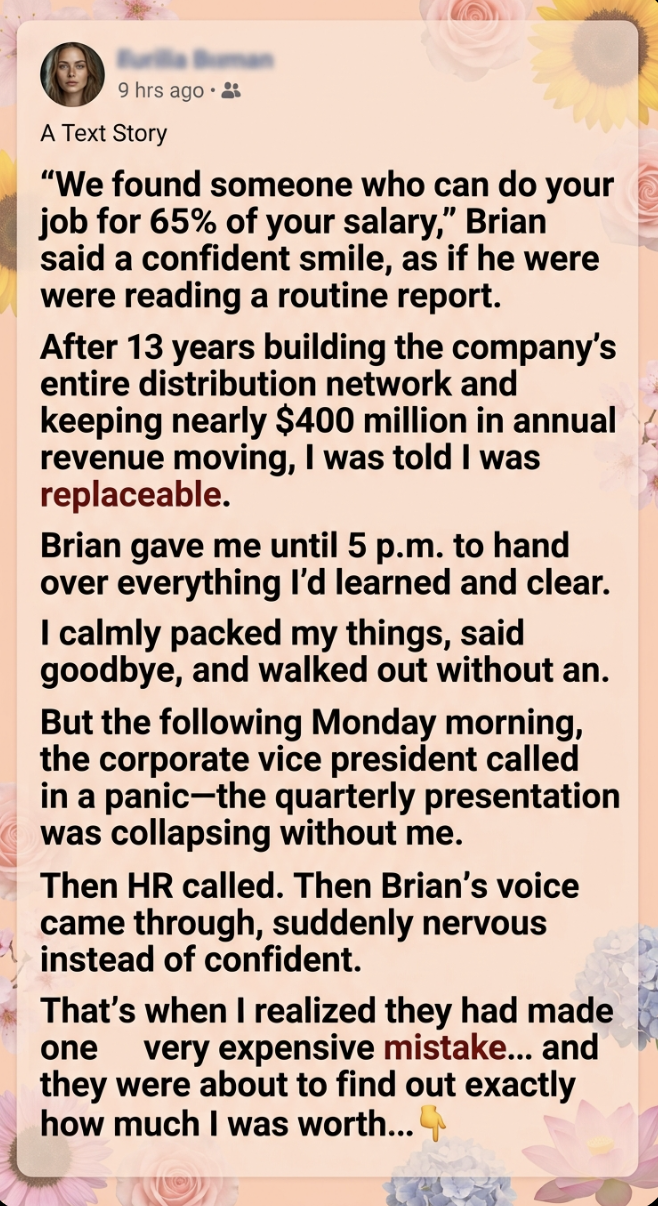
“We found someone who can do your job for 65% of your salary.”
Brian said it with a confident smile.
Almost cheerful.
As though he were announcing a promotion rather than ending thirteen years of my career.
I looked at him across the conference table.
“Who?”
He shrugged.
“Someone younger. More flexible. And frankly, less expensive.”
I nodded.
After thirteen years of building the company’s distribution network from the ground up, I suppose that was all I was worth to him.
Less expensive.
Brian slid a folder across the table.
“Your last day is today.”
I opened it.
Severance documents.
Confidentiality agreements.
A checklist for transferring my responsibilities.
Then came the sentence that made me almost laugh.
“You’ll need to document everything before five.”
Everything.
Thirteen years of relationships.
Thirteen years of supplier negotiations.
Thirteen years of emergency procedures.
Thirteen years of knowing which warehouse could handle an unexpected shipment and which one couldn’t.
Thirteen years of knowing which carrier would answer at midnight when everyone else ignored the phone.
They thought it could all be transferred in four hours.
I closed the folder.
“Understood.”
Brian leaned back.
“I appreciate your professionalism.”
I almost smiled.
He had no idea what professionalism was about to cost him.
I spent the afternoon doing exactly what they requested.
I created a transition document.
I listed routine procedures.
I transferred passwords according to company policy.
I explained the basic systems to the person replacing me.
But there were things that couldn’t be written down.
Not because I was hiding them.
Because they weren’t contained in software.
They existed in relationships.
A warehouse manager who would pick up my call at 2 a.m.
A carrier who would prioritize our emergency shipments because I had once helped him save his own business.
A supplier who trusted my judgment enough to hold inventory when the market became unstable.
A regional manager who could tell me in ten seconds whether a delay was real or whether someone was making excuses.
That knowledge had taken thirteen years to build.
Brian thought it came with my job title.
It didn’t.
It came with me.
At 4:47 p.m., I cleared the last drawer.
My desk looked strangely empty.
I picked up my old coffee mug.
Thirteen years ago, I had bought it during my first week.
I looked around the office.
No dramatic speech.
No angry confrontation.
I simply walked over to Brian’s office.
“Everything is transferred.”
He didn’t even look up.
“Good luck.”
I nodded.
“Good luck to you too.”
Then I walked out.
The following Monday morning, I woke up without an alarm.
For the first time in years, nobody needed me before sunrise.
I made coffee.
Sat by the window.
And enjoyed the silence.
At 8:16 a.m., my phone rang.
Corporate Vice President.
I almost didn’t answer.
“Hello?”
Her voice was frantic.
“Where are you?”
“At home.”
“Why?”
I laughed softly.
“Because I don’t work there anymore.”
Silence.
Then:
“We have a problem.”
“What kind?”
“The quarterly presentation.”
I waited.
“The distribution numbers don’t reconcile.”
I knew exactly what she meant.
“Did you contact Brian?”
“Yes.”
“Did you contact the new manager?”
“Yes.”
“And?”
Neither of them knew how to interpret the regional data.
I sighed.
“I’m sorry.”
“Can you come in?”
“No.”
Another silence.
Then she asked:
“Can you at least tell us where to look?”
I smiled.
“Everything you need is in the transition document.”
“It’s not.”
“I know.”
At 9:03, HR called.
At 9:17, another executive called.
At 9:41, a regional director called.
By 10:00, I had received seven missed calls.
I didn’t answer any of them.
Then my phone rang again.
Brian.
I stared at his name.
The man who had smiled while telling me I was replaceable.
The man who had given me four hours to transfer thirteen years of knowledge.
I answered.
“Hello?”
His voice sounded completely different.
“Can we talk?”
“Sure.”
“I think there may have been some misunderstandings.”
I smiled.
“No. I think everything was very clear.”
“We’re having some issues.”
“I heard.”
“We need your help.”
I looked out the window.
“You have someone who can do my job for 65% of my salary.”
He didn’t respond.
I continued.
“I’m sure they’ll figure it out.”
By Tuesday afternoon, the problem had grown.
Three major shipments were delayed.
A regional warehouse had misallocated inventory.
Two suppliers had stopped extending emergency terms.
A carrier had rejected a last-minute routing request.
And the quarterly presentation had been postponed.
The company wasn’t collapsing.
But it was bleeding money.
And everyone suddenly remembered my name.
Wednesday morning, the vice president called again.
This time, she didn’t sound angry.
She sounded honest.
“We underestimated your role.”
I said nothing.
“We thought your job was operational.”
“It was.”
“No.”
She corrected herself.
“We thought it was replaceable.”
I looked at my coffee.
“That’s different.”
She sighed.
“Would you consider consulting for us?”
I almost laughed.
“At what rate?”
There was a pause.
Then she gave me a number.
It was significantly higher than my old salary.
I declined.
She increased it.
I declined again.
Finally, she asked:
“What would you require?”
I thought about Brian’s words.
Someone can do your job for 65% of your salary.
“I don’t want my old job.”
“What do you want?”
“An independent consulting agreement.”
“Doing what?”
“Fixing the problems you created by eliminating the position.”
She was silent.
Then:
“How much?”
I gave her my number.
She accepted.
For the next six weeks, I worked with the company as an outside consultant.
Not as an employee.
Not as Brian’s subordinate.
As someone they had to listen to.
I rebuilt the distribution structure.
I renegotiated several supplier agreements.
I restored relationships they had damaged.
I helped the new manager understand the network.
And slowly, the company stabilized.
But something else happened.
During those six weeks, I realized I didn’t want to go back.
I had spent thirteen years helping one company grow.
Maybe it was time to build something of my own.
I started a small logistics consulting firm.
At first, it was just me.
Then two clients came.
Then five.
Then twelve.
Within a year, my former company’s competitors began hiring me.
Not because I was famous.
Because I knew something valuable.
How to keep a complicated distribution network moving when everything goes wrong.
The skill Brian had considered replaceable became the foundation of my new company.
And eventually, I hired people.
Good people.
People I trained properly.
People I respected.
And I promised myself I’d never make the same mistake Brian had made.
Two years later, I received an invitation to the company’s annual leadership conference.
I almost ignored it.
Then I noticed Brian’s name on the attendee list.
So I went.
After the presentation, Brian approached me.
He looked older.
Tired.
“You built quite a company.”
“Thank you.”
He hesitated.
“I owe you an apology.”
I waited.
“I thought you were expensive.”
I smiled.
“You were right.”
He looked surprised.
I continued.
“I was expensive.”
Then I shook his hand.
“Because I was valuable.”
Brian nodded slowly.
“I understand that now.”
I looked around the conference room.
Hundreds of executives were listening to presentations about efficiency, automation, and cost reduction.
Then I thought about that meeting years earlier.
They had tried to save money by replacing one person.
Instead, they had taught me the value of my own experience.
And that turned out to be worth far more than a salary.
I left the conference that evening without resentment.
I didn’t need revenge.
I didn’t need Brian fired.
I didn’t need the company to admit they had made a mistake.
They already had.
The biggest lesson wasn’t that I was indispensable.
It was that no employee should confuse being undervalued with being without value.
Sometimes an organization doesn’t recognize what you bring until you’re gone.
And sometimes, when they finally realize what they lost…
you’ve already built something far greater somewhere else.
Brian had thought he was saving 35% of my salary.
What he actually did was give me the freedom to discover what I was worth.