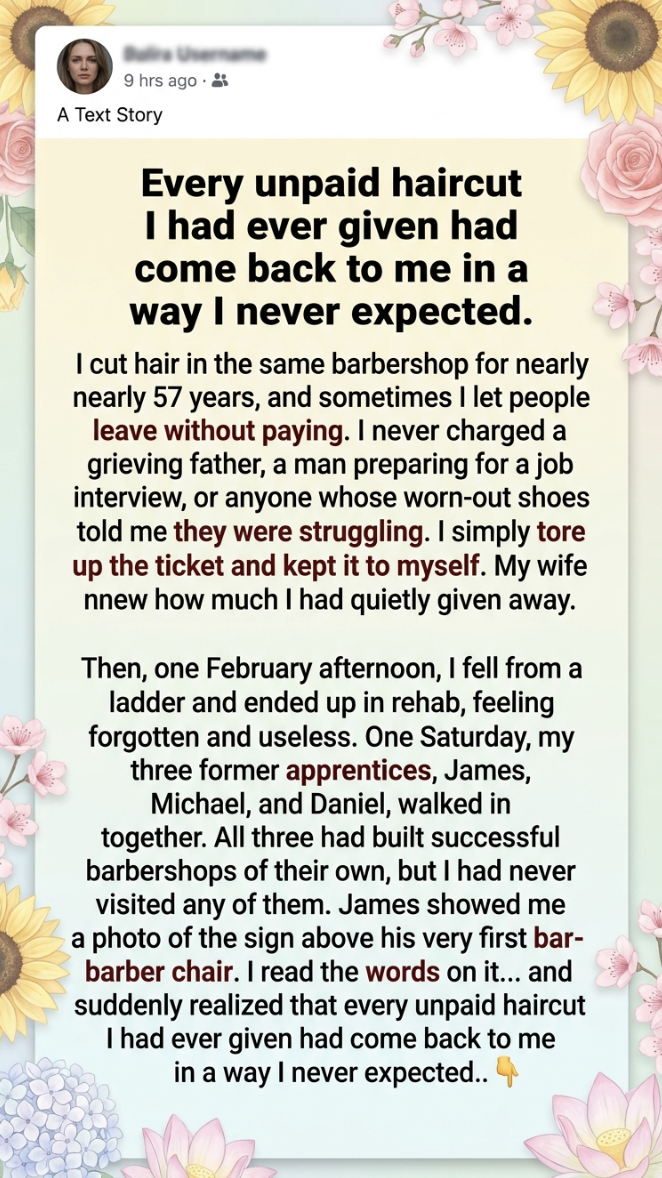
For nearly fifty-seven years, I stood behind the same barber chair.
I watched boys become fathers.
I watched fathers become grandfathers.
I watched men come through my door carrying grief, excitement, fear, and hope.
And sometimes, I cut their hair for free.
I never advertised it.
I never kept a list.
I never told anyone—not even my wife.
If a father came in after losing someone and sat silently in my chair, I didn’t ask for money.
If a nervous young man came in wearing his best shirt because he had a job interview that afternoon, I sometimes tore up his ticket before he could reach for his wallet.
And if a man’s worn-out shoes told me more about his situation than his words ever could, I’d simply say:
“Don’t worry about it.”
Most people thanked me.
Some tried to argue.
I’d wave them away.
“Pay me when life gets easier.”
Sometimes I knew they never would.
And that was okay.
I never considered those haircuts losses.
I considered them investments in people.
My wife, Margaret, knew I was generous.
But she never knew how generous.
Whenever she asked why the day’s cash was a little short, I’d shrug.
“Slow afternoon.”
She believed me.
I never told her that some afternoons had been slow because I’d deliberately made them that way.
There was something satisfying about helping someone without letting them feel like a charity case.
I didn’t want gratitude.
I wanted them to walk out standing a little taller.
That was enough.
Then, one February afternoon, everything changed.
I was climbing a ladder to replace a light above the shop.
I’d done it hundreds of times.
That day, my foot slipped.
The next thing I remember was waking up in a hospital bed.
After that came rehabilitation.
Weeks of exercises.
Long afternoons.
Longer nights.
The barber who had spent nearly six decades on his feet suddenly couldn’t stand without help.
At first, customers visited.
Then fewer came.
Eventually, the phone stopped ringing.
The shop was being handled by someone else.
My chair sat empty.
And I began to feel like furniture that nobody needed anymore.
One afternoon, I told Margaret:
“Maybe I’m finished.”
She squeezed my hand.
“You’re not finished.”
But I wasn’t convinced.
Then, one Saturday morning, the rehabilitation center receptionist walked into my room.
“You have visitors.”
“Who?”
She smiled.
“Three gentlemen.”
I expected family.
Instead, James walked through the door.
Behind him were Michael and Daniel.
I stared at them.
My three apprentices.
The boys who had once swept hair from my floor.
The boys who had asked me how to hold scissors.
The boys who had argued over who got to use my favorite chair.
Now they were grown men.
Successful barbers.
Owners of their own shops.
I hadn’t visited any of their businesses.
Life had simply carried us in different directions.
James sat beside my bed.
“You look terrible, old man.”
I laughed.
“Good to see you too.”
Michael hugged me.
Daniel brought coffee.
Then James pulled out his phone.
“I want to show you something.”
He turned the screen toward me.
It was a photograph.
A barber chair.
Beautiful wood.
Polished metal.
And above it was a sign.
I leaned closer.
The words read:
“NO ONE LEAVES THIS CHAIR WITHOUT A LITTLE MORE DIGNITY.”
I stared at it.
“That’s your shop?”
James nodded.
“I put that there because of you.”
I laughed nervously.
“I never said that.”
“You didn’t have to.”
Michael opened his phone next.
His sign was different.
It read:
“IF YOU CAN’T AFFORD THE CUT, YOU CAN STILL AFFORD TO WALK IN.”
I looked at him.
He smiled.
“That’s yours too.”
Daniel shook his head.
“Mine’s even worse.”
He showed me his.
Above the entrance was a simple sentence:
“KINDNESS IS ALWAYS FREE.”
I couldn’t speak.
For a moment, the room became very quiet.
Then James reached into a bag.
He pulled out an envelope.
“We’ve been talking.”
“About what?”
“About you.”
He handed me the envelope.
Inside was a photograph of my old barbershop.
Then another.
And another.
Customers.
Families.
Men sitting in chairs.
Some of them were people I recognized.
James explained.
“For years, every time one of us opened a shop, we copied something you taught us.”
Michael nodded.
“You taught us how to cut hair.”
Daniel added:
“But that’s not the most important thing you taught us.”
I looked at them.
“What was that?”
James smiled.
“How to see people.”
Then he told me something that left me speechless.
Every one of my former apprentices had kept a private record of people they helped for free.
Not because they wanted praise.
Because they wanted to continue the tradition.
James had given hundreds of free haircuts.
Michael had helped young men prepare for interviews.
Daniel had started a program giving free cuts to fathers and children who couldn’t afford them.
They had even begun training their own apprentices to do the same.
My unpaid haircuts hadn’t simply disappeared.
They had multiplied.
One act had become another.
Then another.
Then another.
I started crying.
I tried to hide it.
James noticed.
“Don’t.”
“I haven’t cried in front of customers in fifty-seven years.”
Michael laughed.
“Good thing we’re not customers.”
I wiped my face.
“Why are you telling me all this?”
Daniel reached into his pocket.
He pulled out a small envelope.
“We have one more thing.”
Inside was a photograph.
It showed a brand-new barber chair.
Above it was a plaque.
I read it slowly.
“THE FIRST CHAIR OF THE KINDNESS CHAIN.”
Underneath were four names.
James.
Michael.
Daniel.
And mine.
I stared at them.
“What is this?”
James smiled.
“We’re opening another shop.”
Michael continued:
“And we want you to be there for the first haircut.”
I shook my head.
“I can’t even stand properly.”
Daniel smiled.
“We’ll bring the chair to you.”
Two weeks later, they kept their promise.
They brought a portable barber chair into the rehabilitation center.
Staff members gathered.
Patients came into the hallway.
Margaret stood beside me, crying.
James placed the old barber scissors in my hand.
My hands trembled.
“I don’t know if I can do this.”
James smiled.
“You taught us.”
My first haircut after the accident was given to a young man from the rehabilitation center who couldn’t afford one.
When I finished, James handed me a mirror.
The young man looked at himself.
Then he smiled.
“Thank you.”
I reached for the ticket.
James stopped me.
“No charge.”
I looked at him.
He grinned.
“You taught us that part too.”
I returned to the shop months later.
The chair was still there.
The same chair.
The same mirror.
The same little bell above the door.
But something felt different.
I finally understood that I hadn’t spent fifty-seven years cutting hair.
I had spent fifty-seven years leaving small pieces of kindness behind.
I just hadn’t known where they would end up.
A free haircut had become a second chance for someone.
A second chance had become confidence.
Confidence had become a job.
A job had become a family.
And somewhere along the way, my three apprentices had taken everything I’d taught them and passed it forward.
That afternoon, I sat in my old chair.
James stood beside me.
Michael was sweeping the floor.
Daniel was talking to a customer.
And Margaret walked in carrying lunch.
She looked around.
Then she smiled.
“You know,” she said, “I finally figured out where all those missing haircut payments went.”
I laughed.
“So did I.”
She kissed my forehead.
Then she looked at the three men running around my shop.
“They were never missing, were they?”
I shook my head.
“No.”
I looked at James, Michael, and Daniel.
“They were just growing.”
And that was when I finally understood the greatest lesson of my life:
You may forget the kindness you give away, but kindness has a way of remembering you.
For fifty-seven years, I thought I had been giving people something they needed.
A haircut.
A little dignity.
A little hope.
A few dollars saved.
But when I needed help, all those small acts came back—not as money, not as applause, and not as a debt.
They came back as people.
Three apprentices.
Hundreds of customers.
And a legacy I never knew I was building.
I spent my life cutting hair.
They spent theirs making sure the kindness behind every haircut never ended.