Ethan never took my career seriously.
To him, I wasn’t a professional.
I was “helping people with spreadsheets.”
That’s how he described it whenever his friends asked what I did.
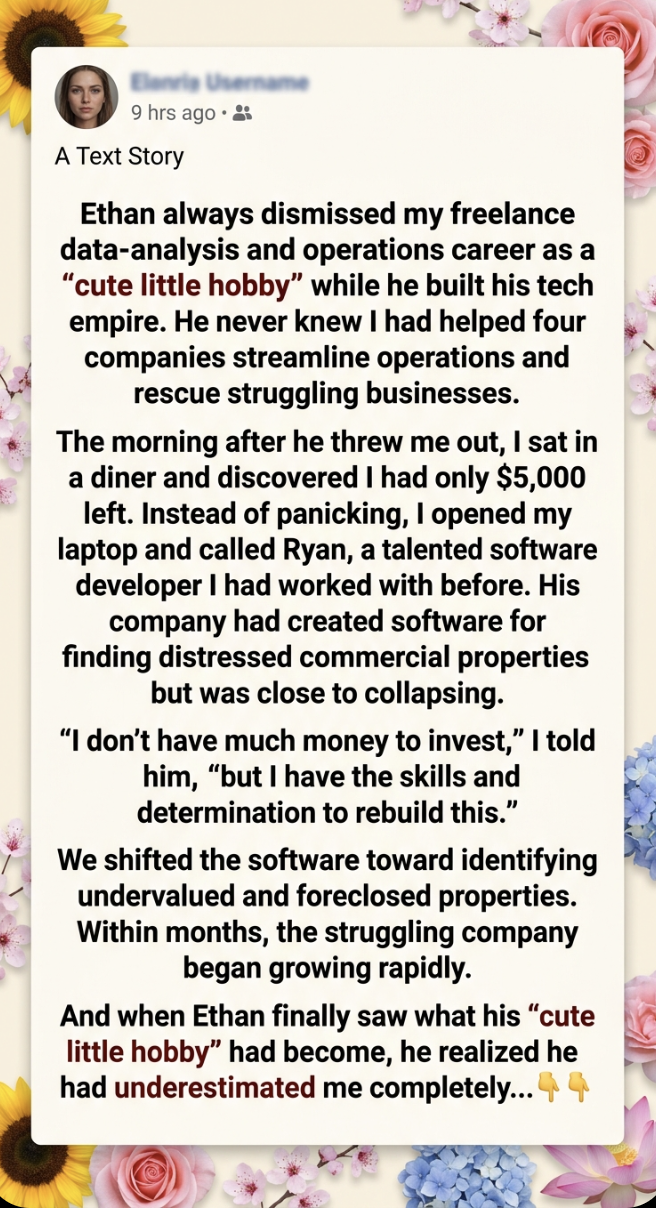
“She has a cute little freelance thing.”
A cute little thing.
That was what he called the career I had spent years building.
While Ethan was busy creating his technology empire, I worked quietly behind the scenes.
I analyzed data.
I redesigned inefficient operations.
I helped struggling businesses identify where they were losing money.
I built systems that saved companies thousands of dollars.
I never needed a fancy title.
I just needed results.
And results were something I had plenty of.
I had helped four companies stabilize their operations when they were close to collapsing.
But Ethan never asked.
He was too busy believing that his success made mine insignificant.
The morning he threw me out, I sat alone in a diner with $5,000 in my bank account.
Five thousand dollars.
That was all I could immediately access.
My marriage was over.
My home was gone.
And the person who had spent years telling me I couldn’t succeed without him had just made sure I had to prove him wrong.
I stared at my laptop.
Then I opened my contacts.
One name caught my attention.
Ryan.
Ryan was a software developer I’d worked with years earlier.
His company had developed a platform that identified distressed commercial properties.
The idea was brilliant.
The business wasn’t.
Ryan had been struggling for months.
The software had potential, but the company was nearly out of cash.
I called him.
He answered on the fourth ring.
“Hey.”
“Ryan, it’s me.”
He went quiet.
“Where have you been?”
“Starting over.”
I told him what happened.
Then I asked:
“How bad is the company?”
He laughed bitterly.
“Bad.”
“How bad?”
“Payroll is becoming a problem.”
I opened my notebook.
“What does the software actually do?”
He explained it.
I listened.
Then I asked:
“What if we’re targeting the wrong customer?”
Silence.
“What do you mean?”
“You’re selling information about distressed properties. But investors don’t just want distressed properties. They want undervalued opportunities.”
Ryan slowly understood.
“So…”
“We don’t rebuild the software.”
I paused.
“We reposition it.”
Over the next several weeks, we worked relentlessly.
The platform began analyzing foreclosure filings, property records, commercial vacancy rates, market trends, ownership changes, and other publicly available indicators.
Instead of simply showing properties in trouble, it helped users identify opportunities that might otherwise be overlooked.
Ryan rebuilt the technical side.
I rebuilt the business model.
We changed the pricing.
Redesigned the customer dashboard.
Created a simpler reporting system.
And most importantly, we stopped trying to sell a complicated product to everyone.
We focused on people who actually needed it.
Small investors.
Property managers.
Commercial brokers.
Investment groups.
Within three months, subscriptions began increasing.
Then they doubled.
Then tripled.
Ryan called me one night.
“Do you know how much revenue we did this month?”
I smiled.
“Tell me.”
He laughed.
“Enough to make me nervous.”
I laughed too.
“Good.”
Six months later, the company had completely changed.
The same business that had been struggling to meet payroll was hiring.
Investors started calling.
A major real-estate investment group requested a demonstration.
Then another.
Then another.
I still worked from a small office.
I still drank too much coffee.
I still wore the same inexpensive watch.
But something had changed.
For the first time, I wasn’t building someone else’s success.
I was building my own.
Then Ethan saw the company.
It happened at a technology conference.
He was there representing his own firm.
A presentation appeared on one of the large screens.
The company’s name appeared first.
Then the platform.
Then my name.
Chief Strategy & Operations Partner — [Name]
Ethan froze.
He watched the presentation.
He recognized the company.
The company he had once called “a dying little startup.”
Then he saw the valuation estimate.
His expression changed.
The company had grown dramatically.
And he finally realized something.
I hadn’t invested millions.
I hadn’t inherited anything.
I hadn’t been rescued by another wealthy person.
I had invested the only thing I had left.
My knowledge.
My discipline.
My ability to see problems differently.
That evening, Ethan found me outside the conference hall.
“Can we talk?”
I looked at him.
“It’s been a long time.”
“I know.”
He looked uncomfortable.
“I didn’t know.”
I almost smiled.
“You never asked.”
He looked down.
“You’re really doing this?”
I nodded.
“Yes.”
“How?”
I thought about it.
“By doing the work.”
He swallowed.
“I was wrong about you.”
“I know.”
“I thought your career was…”
He couldn’t finish the sentence.
“A hobby?”
He nodded.
I looked at him calmly.
“That’s the funny thing about hobbies, Ethan.”
He waited.
“Sometimes people call something a hobby because they don’t understand how valuable it is.”
He had no answer.
A few months later, the company received a major investment offer.
Ryan called me into the office.
The number on the proposal was far larger than anything I had imagined when I sat in that diner with $5,000.
I stared at it.
Ryan smiled.
“You realize what this means?”
I nodded.
“Yes.”
“You could walk away.”
“I could.”
“Are you going to?”
I looked around the office.
At the team.
At the screens.
At the people who had believed in the idea.
“No.”
I smiled.
“We’re just getting started.”
I eventually became financially secure.
But money wasn’t what mattered most.
The greatest victory happened much earlier.
It happened the morning after Ethan threw me out.
I had every reason to panic.
Instead, I opened my laptop.
I called Ryan.
And I reminded myself of something I had forgotten during my marriage:
My value had never depended on whether Ethan recognized it.
He had mistaken my quietness for weakness.
He had mistaken humility for lack of ambition.
He had mistaken my willingness to work behind the scenes for an inability to lead.
And by the time he finally understood who I was, I no longer needed him to understand.
Years later, when someone asked me how I built the company from almost nothing, I always gave the same answer:
“I didn’t start with money.”
I smiled.
“I started with five thousand dollars, a laptop, and years of experience someone else was arrogant enough to call a hobby.”
And that was enough.
Because sometimes the person who underestimates you isn’t your biggest obstacle.
They’re simply the person who gives you the freedom to finally discover what you’re capable of without them.