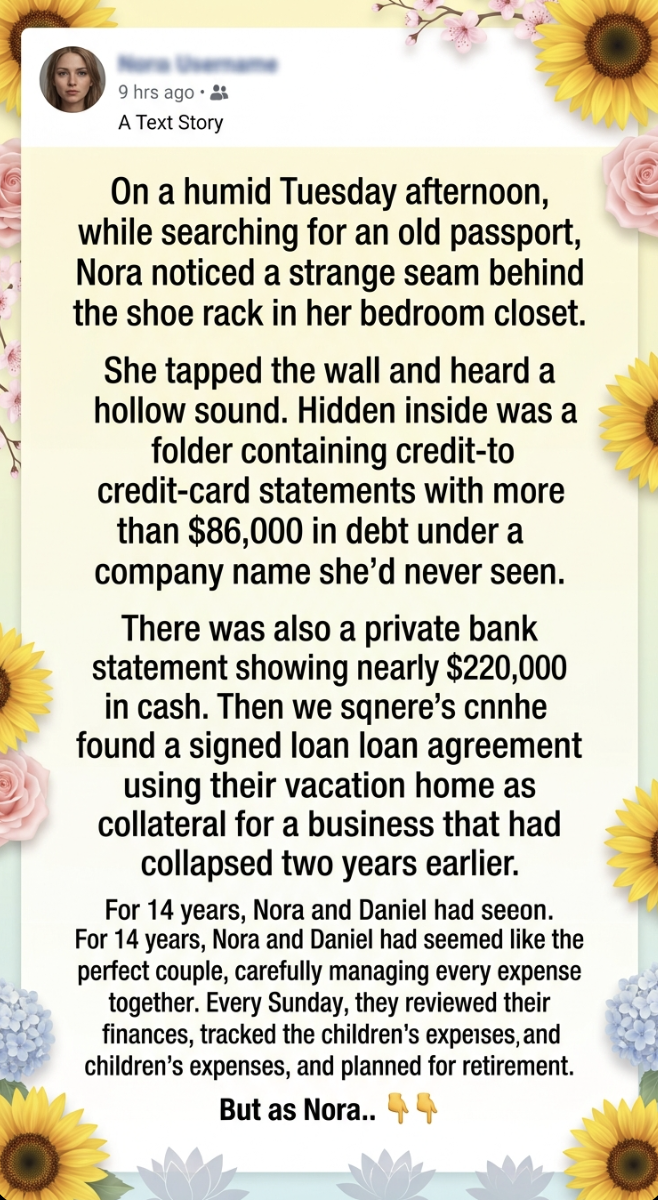
On a humid Tuesday afternoon, Nora was looking for an old passport.
It should have been an ordinary chore.
Instead, she found a wall that sounded hollow.
She moved the shoe rack aside and ran her fingers along the baseboard.
There.
A narrow seam.
She pressed it.
Nothing.
Then she tapped the wall again.
Thump.
Hollow.
Nora’s heart began to beat faster.
She found a small gap behind the molding and carefully pulled.
A section of the wall opened.
Inside was a dusty folder.
She pulled it out.
At first, she thought it might contain old receipts.
Instead, she found credit-card statements.
$86,417.23 in debt.
The account wasn’t in her name.
It wasn’t in Daniel’s personal name either.
It belonged to a company she had never heard of.
Nora stared at the documents.
Then she found another statement.
A private bank account.
Available cash: $219,846.11.
Her mouth went dry.
Daniel had never mentioned either account.
For fourteen years, they had reviewed their finances every Sunday.
Every bill.
Every investment.
Every children’s expense.
Every retirement contribution.
They had always told each other:
“No financial secrets.”
Yet here, hidden inside their bedroom wall, was evidence that their entire financial life had been a carefully constructed illusion.
Then Nora found the loan agreement.
She read it twice.
Their vacation home had been used as collateral.
For a business.
A business that had supposedly failed two years earlier.
She sat down on the bedroom floor.
Then she noticed something underneath the documents.
A black ledger.
Unlike the other papers, it had no company logo.
No bank stamp.
No account number.
Just one word written across the cover in Daniel’s handwriting:
PRIVATE.
Nora stared at it.
Then opened it.
And her entire understanding of her marriage changed.
The first page contained dates.
The second contained numbers.
The third contained names.
Some she recognized.
Most she didn’t.
But one name appeared repeatedly.
Martin Vale.
Nora knew Martin.
Or thought she did.
He had been Daniel’s former business partner.
Daniel had told her Martin disappeared after the company collapsed.
Apparently, that wasn’t true.
Martin had been receiving payments.
Monthly.
For two years.
Nora kept turning pages.
$8,000.
$12,500.
$15,000.
Sometimes more.
Beside each payment was a handwritten note.
“Settlement.”
“Protection.”
“Keep quiet.”
Nora stopped.
Keep quiet about what?
She turned another page.
And found a list of assets.
Properties.
Accounts.
Vehicles.
Companies.
One apartment was listed under a company name.
Another property was registered through a trust.
Then she saw something that made her hands tremble.
The vacation home wasn’t the only property Daniel had used as collateral.
There was another.
A small commercial building.
A property Nora had believed belonged to her father.
But according to the ledger, Daniel had quietly acquired an interest in it years earlier.
Why?
She had no idea.
Then she reached the final section.
There were copies of emails.
Legal correspondence.
And one envelope.
Inside was a handwritten note dated two years earlier.
Nora read it.
Then read it again.
The note said:
“If the company fails, Nora must never know where the money came from.”
Nora stopped breathing for a moment.
Her own name.
Written by her husband.
Daniel came home at 6:17.
He walked through the door carrying groceries.
“Hey, sweetheart.”
Nora was sitting at the kitchen table.
The black ledger was in front of her.
Daniel stopped.
The grocery bag slipped slightly from his hand.
He stared at the ledger.
Then at Nora.
Neither spoke.
Finally, Daniel whispered:
“Where did you find that?”
Nora looked at him.
“Behind the shoe rack.”
His face went completely pale.
“You weren’t supposed to find it.”
Nora almost laughed.
“Apparently.”
Daniel slowly placed the groceries down.
“Nora, please let me explain.”
“I want you to.”
He sat across from her.
For fourteen years, Nora had watched Daniel handle difficult situations calmly.
Job problems.
Family emergencies.
Investment losses.
He always had an explanation.
But now his hands were shaking.
“The company wasn’t my idea,” he said.
“Whose was it?”
“Martin’s.”
“Why did you invest?”
“Because I thought it would succeed.”
“It failed.”
“Yes.”
“You used our vacation home.”
“I thought I could recover the money.”
“You hid $220,000.”
Daniel looked down.
“That money isn’t what you think.”
“Then tell me what it is.”
He remained silent.
Nora pushed the bank statement toward him.
“Daniel.”
Finally, he spoke.
“That money came from selling my shares before the company collapsed.”
Nora stared at him.
“You knew the company was failing?”
“I suspected.”
“So you protected yourself.”
“I was trying to protect you.”
“No.”
Her voice was quiet.
“You were protecting yourself.”
Daniel didn’t argue.
Because he knew she was right.
But the biggest revelation was still hidden in the ledger.
Nora turned to the final pages.
“What’s this?”
Daniel looked at the page.
His expression changed.
“I don’t know.”
Nora stared at him.
“You don’t know?”
“No.”
The ledger contained a series of payments made to Martin.
But they weren’t labeled as business expenses.
They were labeled:
“Witness.”
“Records.”
“Silence.”
Nora looked up.
“What was Martin keeping?”
Daniel hesitated.
“I don’t know.”
“Then we’re going to find out.”
The next morning, Nora met with an attorney.
She brought every document.
The attorney spent hours reviewing everything.
Finally, she looked up.
“Your husband appears to have hidden substantial assets and liabilities from you.”
Nora nodded.
“But there’s something else.”
“What?”
“The payments to Martin.”
She pointed to the ledger.
“These don’t look like ordinary business settlements.”
“What do they look like?”
“Payments connected to information.”
Nora felt a chill.
“What information?”
The attorney turned to another document.
“This company didn’t collapse because it simply ran out of money.”
She paused.
“There was an investigation.”
Nora stared at her.
“Into what?”
“Fraudulent financial reporting.”
Nora’s heart sank.
That evening, Daniel finally told her everything.
The company had been falsifying certain financial reports.
Martin had discovered it.
Daniel hadn’t created the scheme.
But he had discovered it.
And instead of reporting it immediately, he had tried to distance himself.
He sold his shares.
Moved money.
Used property as collateral.
And paid Martin to remain silent while lawyers negotiated the fallout.
Then the company collapsed.
Martin threatened to expose everything.
Daniel kept paying him.
The $220,000 wasn’t stolen money.
But it was money Daniel had hidden from Nora while preparing for the possibility that everything would fall apart.
Nora listened quietly.
“So all these years…”
Daniel nodded.
“I was afraid.”
“Afraid of losing everything?”
“Afraid of losing you.”
Nora looked at him.
“You lost my trust long before I found that ledger.”
The legal process took months.
Some assets were recovered.
Some debts were settled.
The vacation home was saved.
The hidden company accounts were disclosed.
And Martin eventually cooperated with investigators.
Daniel wasn’t the mastermind.
But he wasn’t innocent either.
His biggest mistake wasn’t getting involved with the wrong business.
It was believing that secrecy could protect the people he loved.
It couldn’t.
Secrets didn’t protect their marriage.
They hollowed it out.
One Sunday, months later, Nora sat alone at the kitchen table.
For fourteen years, Sunday had been their financial-review day.
Daniel sat across from her.
There were no spreadsheets this time.
No hidden accounts.
No secret envelopes.
No locked drawers.
Just two people trying to decide whether a marriage could survive the truth.
Daniel looked at her.
“I’ll answer anything.”
Nora nodded.
“I know.”
“And if you want to leave, I’ll understand.”
She looked down at the black ledger.
Then closed it.
“I don’t know what happens next.”
Daniel nodded.
“Neither do I.”
Nora stood.
She placed the ledger in a box.
Not to hide it.
To preserve it.
Because she never wanted to forget what secrecy had cost them.
Then she said:
“We start with the truth.”
Daniel looked at her.
“Together?”
Nora paused.
“One day at a time.”
And that was how their marriage changed.
Not because everything was magically repaired.
Not because apologies erased fourteen years.
But because for the first time in a long time, there was nothing hidden between them.
Years later, Nora would still remember the afternoon she found that hollow wall.
She used to think the worst thing she discovered was the $86,000 debt.
It wasn’t.
The worst discovery was realizing that the person she trusted most had believed she couldn’t handle the truth.
But the black ledger taught her something else, too.
A marriage doesn’t survive because two people never make mistakes. It survives when both people are finally brave enough to stop hiding them.
And sometimes, the most valuable thing you can uncover isn’t money.
It’s the truth.