The first thing I noticed was the color.
Blue.
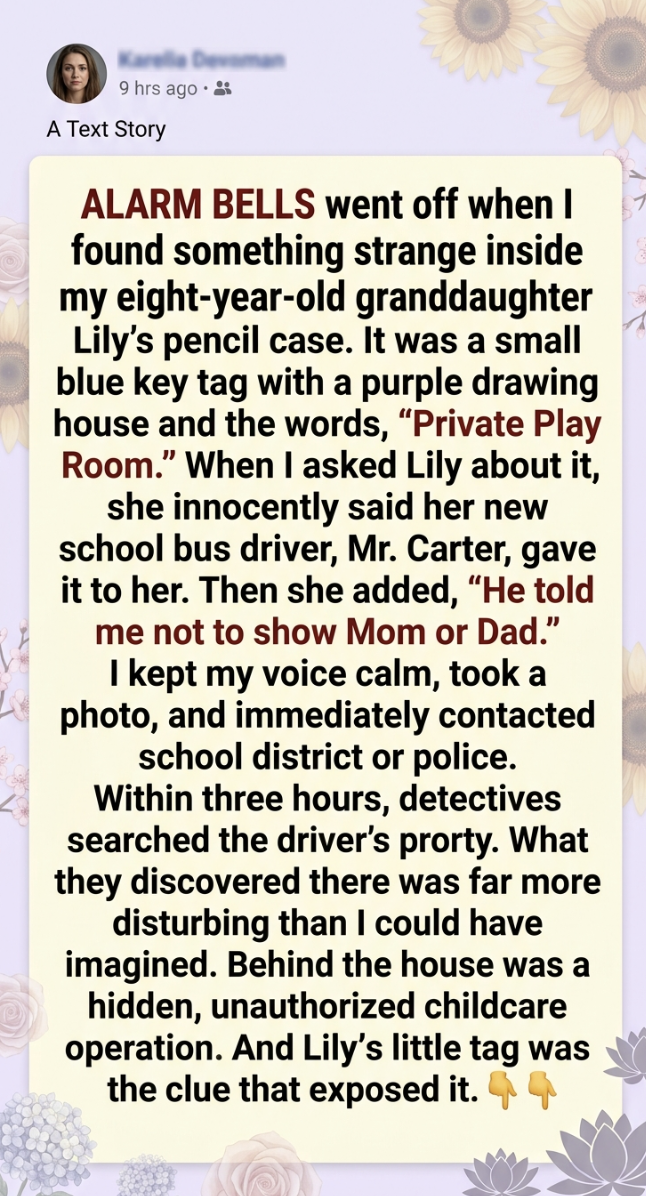
A tiny plastic key tag tucked inside my eight-year-old granddaughter Lily’s pencil case.
At first, I thought it was something she’d picked up at school.
Kids collect strange things.
Stickers.
Rocks.
Broken pencils.
Little pieces of paper.
So I almost put it back.
Then I saw the drawing.
A purple house.
Underneath it were three words:
PRIVATE PLAY ROOM
I froze.
Something about those words felt wrong.
Not because a playroom was unusual.
Because it said private.
And because Lily had never mentioned anything like it before.
I closed the pencil case.
“Lily?”
She looked up from her homework.
“Yes, Grandma?”
“Where did you get this?”
She looked at the key tag.
“Oh, that.”
“Yes. That.”
She smiled innocently.
“Mr. Carter gave it to me.”
My stomach tightened.
“Who is Mr. Carter?”
“My new bus driver.”
I tried to keep my voice calm.
“What did he say?”
She shrugged.
“He said it was for the special room.”
“What special room?”
She looked at me as though the answer were obvious.
“The private play room.”
Then she said something that made every alarm bell in my mind go off.
“He told me not to show Mom or Dad.”
I put the key tag down.
I didn’t panic.
I didn’t frighten Lily.
I didn’t start asking a hundred questions.
I simply smiled and said:
“Thank you for telling me.”
Then I took a photograph of the key tag.
And I made two phone calls.
One to the school district.
One to the police.
The first officer who arrived sat at the kitchen table with us.
He spoke gently to Lily.
He didn’t pressure her.
He asked simple questions.
Had she ever been inside the room?
No.
Had Mr. Carter ever asked her to go somewhere?
No.
Had he ever told her to keep anything else secret?
“No.”
The officer wrote everything down.
Then he asked me where Lily’s school bus stopped.
I told him.
He exchanged a look with his partner.
“We’re going to investigate.”
I nodded.
“Please do.”
By noon, the school district had confirmed something important.
Mr. Carter was indeed Lily’s new bus driver.
He had started several months earlier.
His background check had cleared.
There were no previous complaints on file.
But that didn’t explain the key tag.
And it certainly didn’t explain the secret room.
The police obtained a search warrant.
Three hours after I found the tag, detectives arrived at Mr. Carter’s property.
I stayed home with Lily.
I didn’t tell her what might happen.
I didn’t want her frightened.
Instead, I made her hot chocolate.
We watched cartoons.
Then my phone rang.
It was the detective.
His voice was serious.
“We found something.”
My heart sank.
“What?”
“There is a detached structure behind the house.”
“A shed?”
“No.”
He paused.
“It’s been converted into a childcare facility.”
I couldn’t speak.
“How many children?”
“We don’t know yet.”
The detectives discovered a fully furnished building behind the property.
There were small tables.
Plastic chairs.
Toys.
Sleeping mats.
A refrigerator filled with children’s food.
A whiteboard covered with schedules.
There were even cubbies labeled with children’s names.
But Mr. Carter wasn’t licensed to operate childcare.
The facility wasn’t registered.
And according to investigators, several parents had apparently been bringing their children there during the day.
Some believed it was a legitimate private childcare arrangement.
Others thought it was simply a neighborhood playgroup.
But investigators found something deeply troubling.
There were no proper enrollment records.
No safety inspection.
No licensing documents.
No authorized caregiver list.
And no explanation for why children had been transported there.
Then detectives found a notebook.
Inside were dates, names, pickup times, and notes about individual children.
Lily’s name wasn’t there.
But several other children’s names were.
That was when the investigation expanded.
The next morning, the school district contacted every family whose children had been transported by Mr. Carter.
Parents were asked whether they knew about the property.
Most didn’t.
One mother immediately said:
“My son told me he sometimes went to a blue house after school.”
Another parent said:
“My daughter mentioned a playroom.”
Another remembered receiving a strange message about an “after-school activity.”
Nobody had known the full story.
And nobody knew that Mr. Carter had been operating an unauthorized childcare business.
Then investigators discovered why the key tags existed.
Each child who attended the property had apparently been given a small plastic tag.
A different color.
A different drawing.
Different words.
The tags were meant to help children identify their assigned storage cubby.
But the investigators noticed something else.
The children had been instructed to refer to the place as a private play room.
That language wasn’t accidental.
It was designed to make the location sound harmless.
Normal.
Fun.
And private.
The detective told me:
“Your granddaughter’s comment about being told not to tell her parents was extremely important.”
I nodded.
“She did the right thing.”
“She did.”
A few days later, the school held a meeting for parents.
The superintendent stood in front of the room.
He looked exhausted.
“We failed to recognize warning signs.”
Nobody spoke.
A father stood.
“How did this happen?”
The superintendent didn’t try to avoid the question.
“We trusted a background check to tell us everything we needed to know.”
A mother shouted:
“That’s not enough!”
She was right.
A clean background check doesn’t guarantee someone’s future behavior.
A uniform doesn’t automatically make someone trustworthy.
And a child being told to keep a secret from their parents should never be dismissed as harmless.
Mr. Carter was arrested and charged with operating an unlicensed childcare facility and other offenses related to the investigation.
The authorities continued investigating whether additional laws had been broken.
Because the case involved children, many details were kept private.
I was grateful for that.
The children didn’t need their names in the news.
They needed adults to protect them.
Weeks passed.
Lily eventually stopped talking about the blue key tag.
One afternoon, I found it sitting on my desk.
She had placed it there.
“Grandma?”
“Yes?”
“Can I throw it away?”
I looked at her.
“Why?”
“Because I don’t like it anymore.”
I smiled.
“That’s okay.”
She picked it up.
Then she asked:
“Did I do something wrong?”
My heart broke a little.
“No.”
She looked confused.
“But Mr. Carter said not to tell.”
“You didn’t do anything wrong.”
I put my hand over hers.
“When an adult tells a child to keep a secret from their parents about where they are going, you should always tell a trusted grown-up.”
She nodded.
“Even if they’ll be mad?”
“Especially then.”
She thought about that.
Then she smiled.
“Okay.”
She threw the key tag into the trash.
And that was the end of it.
Or so I thought.
Six months later, the school district introduced a new safety policy.
Bus drivers were required to receive additional training.
Parents received clearer transportation information.
Students were taught the difference between a surprise and a secret.
A surprise is something happy that will eventually be revealed.
A secret that makes a child uncomfortable or asks them to hide something from a trusted adult is different.
Children were encouraged to speak up.
And the superintendent personally thanked me.
I told him I didn’t want thanks.
“I didn’t do anything extraordinary.”
He shook his head.
“You listened.”
I smiled.
“That’s what grandparents do.”
Lily eventually forgot most of the details.
She went back to school.
She made friends.
She complained about homework.
She asked for ice cream before dinner.
Life returned to normal.
But I kept the photograph of that little blue key tag.
Not because I wanted to remember Mr. Carter.
I wanted to remember Lily.
Because that tiny piece of plastic reminded me how important it is to listen when children speak.
Adults sometimes assume children misunderstand things.
Sometimes they do.
But sometimes a child notices one tiny detail that everyone else overlooks.
A drawing.
A key tag.
A strange phrase.
A secret.
And sometimes that tiny detail is the first clue that something isn’t right.
Lily didn’t know she was exposing anything.
She didn’t know what the police would find.
She didn’t understand why everyone suddenly became serious.
She simply knew one thing:
An adult had told her to keep something from her parents.
And instead of staying silent, she told someone she trusted.
That was all it took.
One little voice.
One strange blue tag.
One grandmother who listened.
And a hidden operation that might otherwise have remained invisible.
I still think about that afternoon sometimes.
I think about how easily I could have dismissed the key tag.
How easily I could have said, It’s probably nothing.
But I didn’t.
And whenever someone asks me what parents and grandparents should teach children about safety, I give them the simplest answer I know:
Teach them that they will never be in trouble for telling you the truth.
Because sometimes the smallest warning signs are the ones that matter most.
And sometimes, protecting a child begins with nothing more than sitting down, listening carefully, and taking them seriously.