For nine years, I paid the bills in that house.
Not occasionally.
Not when my husband was short.
Every month.
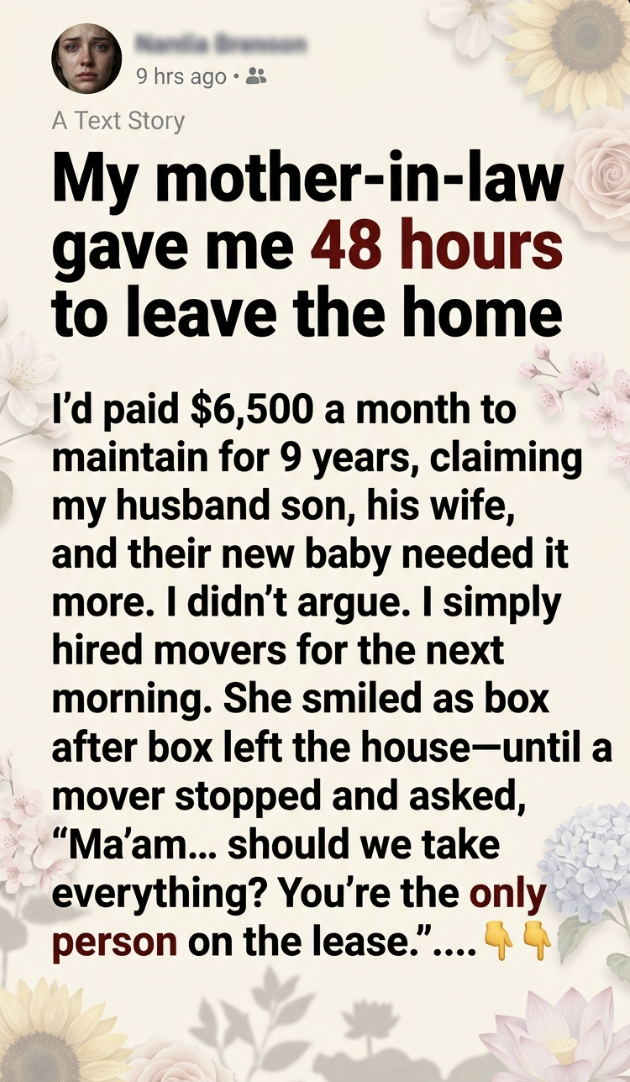
$6,500.
Mortgage contribution, utilities, insurance, repairs, maintenance, landscaping, and everything else that came with keeping a large house running.
My husband always called it our home.
His mother called it the family home.
But apparently, neither of them believed it was mine.
I discovered that on a Tuesday afternoon.
My mother-in-law arrived without warning.
She walked into the kitchen carrying a folder and wearing the expression of someone delivering a decision that had already been made.
“You’re going to need to move out.”
I thought I’d misheard her.
“What?”
She placed the folder on the counter.
“You have forty-eight hours.”
I laughed because surely she was joking.
She wasn’t.
“Why?”
She folded her arms.
“My son’s oldest boy needs the house now.”
I stared at her.
“My husband’s son?”
“Yes. Him, his wife, and their new baby.”
I looked around the kitchen.
The kitchen I had remodeled.
The cabinets I had paid to replace.
The roof I had helped repair.
The room where I’d spent nine years hosting birthdays, holidays, dinners, and family gatherings.
“You want me to leave my home so they can move in?”
“It’s not about you.”
That sentence hurt more than it should have.
She continued.
“They have a baby now. They need stability.”
I looked at her.
“And what do I need?”
She shrugged.
“You’ll figure something out.”
Then she smiled.
“We’re giving you forty-eight hours because we’re trying to be reasonable.”
I said nothing.
She apparently interpreted my silence as surrender.
“You can start packing tonight.”
Then she walked away.
My husband came home three hours later.
I was sitting at the dining table.
He saw the folder.
His face changed.
“Mom talked to you?”
“She did.”
He sighed.
“Please don’t make this difficult.”
I stared at him.
“You’re agreeing with her?”
He sat down.
“It’s complicated.”
“No.”
I shook my head.
“It’s actually very simple.”
He looked uncomfortable.
“My son needs the house.”
“Our house?”
He hesitated.
I asked again.
“Our house?”
He didn’t answer.
That was my answer.
For nine years, I had been paying $6,500 every month to maintain a home my husband apparently believed could be given away without asking me.
I stood.
“Okay.”
He looked surprised.
“Okay?”
“I’m leaving.”
His shoulders relaxed.
“I knew you’d understand.”
I smiled.
“Oh, I understand.”
I just don’t think you understand what you’ve done.
The next morning, I called a moving company.
“I need a full move.”
“When?”
“Today.”
The dispatcher asked for the address.
I gave it to her.
“Are you the homeowner?”
“No.”
“Tenant?”
“Yes.”
“Are you the person on the lease?”
“Yes.”
There was a pause.
“Then we’ll need your authorization.”
“Of course.”
I signed everything.
By 8:00 a.m., three movers arrived.
My mother-in-law was already there.
So was my husband’s son.
His wife.
And their baby.
They stood on the driveway watching.
My mother-in-law smiled.
She genuinely looked pleased.
“You’re leaving so quickly?”
I nodded.
“You gave me forty-eight hours.”
“Yes.”
“And I’m being cooperative.”
She smiled.
“I knew you would eventually understand.”
The movers entered.
They started with the living room.
Then the dining room.
Then the kitchen.
Box after box.
Chair after chair.
Painting after painting.
My mother-in-law’s smile slowly disappeared.
“Wait.”
I continued packing.
“What’s happening?”
“I’m moving.”
“Those aren’t all yours.”
I looked at her.
“Actually, they are.”
She pointed toward a cabinet.
“That was my son’s.”
“No.”
I opened a drawer.
“Receipt.”
Then the dining table.
“Receipt.”
The television.
“Receipt.”
The bedroom furniture.
“Receipt.”
The appliances.
“Receipt.”
Nine years of receipts.
Nine years of bank statements.
Nine years of maintenance records.
I had kept everything.
Not because I expected this day.
Because I had learned long ago that memory is unreliable.
Paper isn’t.
Around noon, the movers began loading the final rooms.
My mother-in-law became increasingly frantic.
“You can’t take the curtains!”
“I bought them.”
“The artwork?”
“I bought it.”
“The dining set?”
“Bought it.”
“That sofa?”
“Bought it.”
She looked at my husband.
“Stop her!”
He stared at me.
Then at the movers.
Then at his mother.
He finally said:
“Mom…”
She turned toward him.
“Do something!”
He looked helpless.
And for the first time, I saw something in his expression.
Fear.
Not fear of losing me.
Fear of losing the lifestyle I had funded.
The final room was the master bedroom.
I walked inside.
I looked around.
Nine years of memories.
Some beautiful.
Some painful.
I opened the closet.
My clothes were already packed.
I took one last photograph of the room.
Then I turned around.
One of the movers stood in the doorway.
He was holding a clipboard.
“Ma’am?”
“Yes?”
He looked confused.
“Should we take everything?”
I nodded.
“Everything that belongs to me.”
He glanced at the paperwork.
Then toward the hallway.
“But…”
He lowered his voice.
“You’re the only person listed on the lease.”
The room went silent.
My mother-in-law had followed him to the doorway.
She heard every word.
Her face changed.
“What did you say?”
The mover looked at her.
“She’s the only person on the lease.”
My mother-in-law stared at me.
I said nothing.
The mover continued.
“Technically, she’s the only authorized tenant listed here.”
My husband stepped forward.
“That’s not possible.”
I looked at him.
“You never asked to be added.”
His face went pale.
“You said it was temporary.”
“I said I was willing to put the lease in my name while we figured out the long-term arrangement.”
I smiled.
“Nine years ago.”
Nobody spoke.
My mother-in-law grabbed the folder she had brought.
“This says you’re supposed to leave.”
I looked at it.
“What exactly is this?”
“A family agreement.”
I opened it.
It wasn’t a legal eviction notice.
It wasn’t a lease termination.
It wasn’t anything enforceable.
It was simply a typed letter telling me that the family had decided I should leave.
I handed it back.
“This doesn’t remove me from the lease.”
She stared at me.
“But you’re married to my son.”
“Yes.”
“And he owns the house.”
I shook my head.
“He doesn’t.”
Silence.
Then I explained.
The property had originally belonged to his father.
After his father’s death, the estate had been placed into a family trust.
My husband had a beneficial interest.
But he wasn’t the legal tenant.
I had signed the lease.
I had paid the rent.
And I’d been the person responsible for maintaining the property.
My mother-in-law had apparently assumed that because her son lived there, he controlled it.
He didn’t.
Neither did she.
But there was another surprise.
The movers had found something in the garage.
An old file box.
Inside were maintenance records from nine years earlier.
One document caught my attention.
A handwritten agreement between my husband and his mother.
It stated that if the family wanted to use the property for another family member, they would need my written consent.
My husband had signed it.
So had his mother.
They had forgotten about it.
I hadn’t.
Because I had kept the original.
My mother-in-law stared at the document.
“You knew?”
“I remembered.”
She looked at my husband.
“You signed this?”
He didn’t answer.
“You signed this!”
He finally whispered:
“I forgot.”
I looked at him.
“That’s the problem.”
By 4 p.m., the house was almost empty.
My husband’s son stood in the doorway holding his baby.
He looked embarrassed.
“I didn’t know.”
I believed him.
He hadn’t been part of the conversation.
He had simply been told the house was available.
I looked at him.
“Take care of your family.”
He nodded.
“I’m sorry.”
“I know.”
His wife hugged the baby closer.
They left.
My mother-in-law remained.
She looked around the empty house.
For the first time, she seemed to understand.
She hadn’t removed me from my home.
She had removed herself from the person who had been holding the family together.
My husband stayed behind.
“Can we talk?”
I looked at him.
“About what?”
“Us.”
I waited.
“I made a mistake.”
“Several.”
He nodded.
“I thought you’d never leave.”
That sentence told me everything.
Not I thought you were happy.
Not I thought we were okay.
He thought I would stay because I’d always stayed.
I picked up my bag.
“That’s why I’m leaving.”
He looked at me.
“I love you.”
“I believe you.”
His eyes filled with tears.
“But love isn’t enough when respect is missing.”
Then I walked out.
Three months later, the divorce was finalized.
The financial records told the story more clearly than any argument could.
Nine years of payments.
Repairs.
Utilities.
Insurance.
Furniture.
Property improvements.
Everything documented.
I didn’t need revenge.
I needed independence.
I rented a smaller house overlooking a quiet lake.
It wasn’t nearly as large.
But it was mine.
Nobody could suddenly decide someone else “needed it more.”
Nobody could tell me to pack.
Nobody could rewrite nine years of my life with a folder.
On the first night, I sat on the porch with a cup of tea.
My phone buzzed.
A message from my husband.
“I finally understand.”
I stared at it.
Then another message arrived.
“You weren’t leaving because you wanted to punish us. You were leaving because we showed you exactly where you stood.”
I didn’t reply.
I didn’t need to.
Months later, I received a letter from my mother-in-law.
It was short.
She apologized.
She admitted she had treated my contributions as invisible because I never demanded recognition.
She wrote:
“I mistook your kindness for weakness.”
I read it twice.
Then I folded it and put it away.
Because that was the truth.
I had spent nine years paying for a home.
But somewhere along the way, I had also been paying for the illusion that I belonged in a family that only valued what I provided.
The day the mover asked, “You’re the only person on the lease?”
something inside me finally became clear.
I wasn’t losing my home.
I was leaving a situation where people had forgotten that I was the one keeping it standing.
And sometimes the most powerful thing you can do isn’t to fight for a seat at the table.
It’s to quietly take everything you built, walk out the door, and build a new table where nobody gets to decide whether you belong.