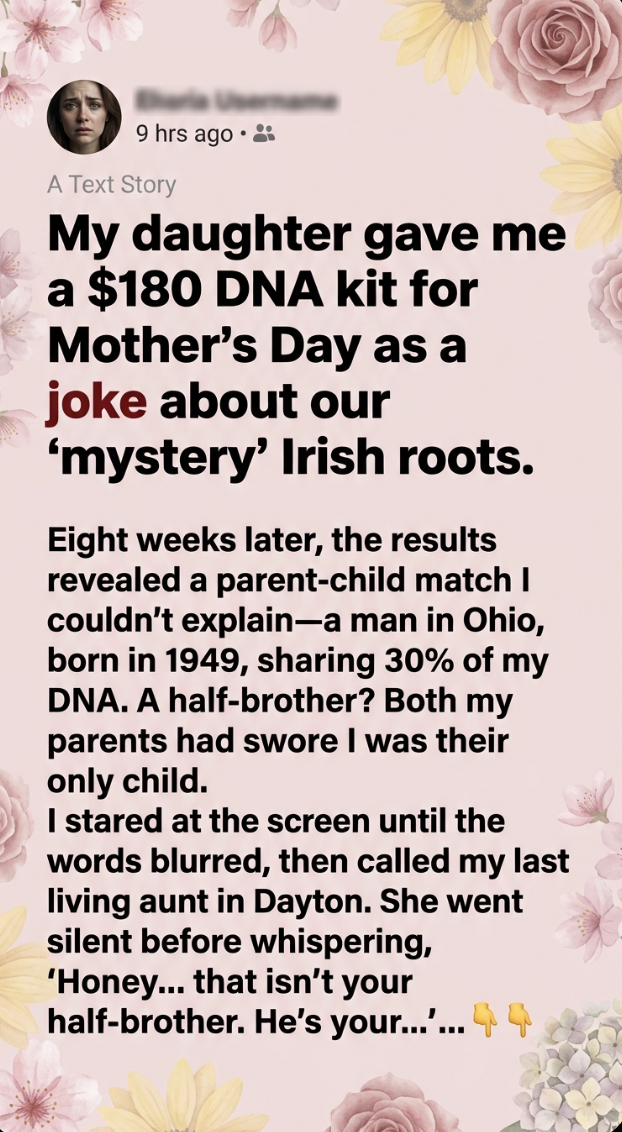
My daughter meant it as a joke.
That was the part I kept thinking about later.
The little white box had been wrapped in green paper for Mother’s Day, with a ridiculous card taped to the top.
“For Mom—because apparently we’re 37% Irish and 63% stubborn.”
I laughed so hard I nearly dropped it.
“One day,” I told her, “I’m going to discover we’re not Irish at all.”
She grinned.
“Then at least we’ll finally know what we’re hiding.”
I didn’t know how prophetic those words would become.
At the time, my parents were both gone.
My father had died twelve years earlier.
My mother followed three years after that.
They had always told me the same thing.
I was their only child.
No brothers.
No sisters.
No complicated family history.
Just me.
So when I mailed the DNA sample, I expected nothing more than some interesting percentages and maybe a map showing where my ancestors had lived.
Eight weeks later, I received an email.
YOUR DNA RESULTS ARE READY.
I opened it after breakfast.
I expected Ireland.
Instead, I found something else.
A section labeled:
Close Family Match
There was one name.
Thomas W.
Born: 1949
Location: Ohio.
Estimated relationship:
Parent/Child or Full Sibling-level connection.
I stared at the screen.
That couldn’t be right.
I checked again.
Then again.
The website estimated that Thomas shared approximately 30% of my DNA.
A half-sibling was possible.
But something about the numbers didn’t make sense.
I sat completely still.
My father was born in 1927.
My mother in 1930.
If Thomas was born in 1949, he could have been their child.
But they had sworn I was their only child.
My entire life.
I picked up the phone and called my aunt.
She was my mother’s younger sister.
The last person alive who had known my parents before I was born.
She lived in Dayton.
I waited while the phone rang.
Finally:
“Hello?”
“Aunt Rose?”
“Sweetheart?”
I swallowed.
“I took a DNA test.”
Silence.
Then I heard her breathing change.
“What did you find?”
I told her about Thomas.
The line went completely quiet.
Not confused silence.
Not surprised silence.
Fearful silence.
“Aunt Rose?”
She didn’t answer.
“Are you there?”
Finally, she whispered:
“Honey…”
Her voice cracked.
“That man isn’t your half-brother.”
My heart started pounding.
“Then who is he?”
Another long silence.
Then she said six words that changed everything I knew about my family.
“He’s your biological father.”
I couldn’t breathe.
“What?”
“I said he’s your father.”
I laughed.
It came out strangely.
Almost like a nervous cough.
“That’s impossible.”
“No.”
“My father was Daniel.”
“Daniel raised you.”
I stared at the wall.
“But Thomas is only—”
“He’s your biological father.”
I couldn’t process the words.
My father had been dead for twelve years.
And the man I had just discovered in Ohio was apparently my biological father.
A man I’d never met.
A man who had never known I existed.
Or so I thought.
I asked Aunt Rose everything.
At first, she refused.
Then she cried.
Finally, she told me what had happened.
My mother had been nineteen.
She had fallen in love with a young man named Thomas.
He was older.
He was working in Ohio temporarily.
They had a relationship that lasted less than a year.
Then my mother became pregnant.
Thomas wanted to marry her.
But my grandmother refused.
She believed he would ruin my mother’s life.
So the family intervened.
They separated them.
My mother was sent away.
Thomas was told that the baby had been lost.
My mother eventually married Daniel.
And Daniel believed the child was his.
Until years later, my mother confessed the truth to him.
But by then, I was already the center of their lives.
Daniel chose to raise me.
He never told me.
Not once.
I started crying.
“Why?”
Aunt Rose whispered:
“Because your father loved you.”
“Which father?”
She hesitated.
“Both.”
I spent the entire night going through old photographs.
There was my father, Daniel, holding me as a baby.
There was my mother beside him.
There were birthdays.
Christmas mornings.
School pictures.
Family vacations.
Everything I’d ever known.
But suddenly, I noticed something I’d never noticed before.
In one photograph, my mother was standing beside a man I’d never seen.
The picture was dated 1948.
I turned it over.
Written in faded ink were two words:
Thomas — Dayton.
My hands shook.
I called Aunt Rose again.
“Where did you get this?”
“I knew you’d eventually find it.”
“Why didn’t you tell me?”
“Because your mother made me promise.”
“She’s dead.”
“I know.”
“Then why are you still protecting her secret?”
Aunt Rose began crying.
“Because she wasn’t protecting herself.”
I waited.
“She was protecting you.”
The next morning, I searched for Thomas.
The DNA site allowed me to send a message.
I stared at the blank box for almost ten minutes.
Finally, I typed:
Hello. I believe we may be connected. My name is Catherine. I was born in 1950. My mother’s name was Margaret.
I hit send.
Then I waited.
Two hours.
Five hours.
Nothing.
The next morning, a response appeared.
Catherine?
I froze.
Another message arrived.
Is your mother Margaret Carter?
I typed:
Yes.
His reply came almost immediately.
I’ve been looking for you for seventy-five years.
I started crying.
Thomas was eighty-one.
He lived outside Dayton with his second wife.
He told me he had spent decades believing his daughter had died before birth.
His parents had told him my mother had lost the baby.
He never knew she had married.
He never knew I existed.
He had kept one photograph of my mother for more than seventy years.
When he sent it to me, I recognized her immediately.
She was young.
Happy.
And standing beside her was the man I’d just discovered was my biological father.
On the back, she had written:
“Someday, she’ll know.”
I couldn’t stop staring at those words.
Someday, she’ll know.
My mother had known this day might come.
A week later, I drove to Ohio.
I was terrified.
What do you say to the biological father you meet for the first time at seventy-six?
“Hello”?
“Nice to meet you”?
“Why weren’t you there?”
None of those words seemed large enough.
Thomas opened the door.
He was thinner than I expected.
His hair was completely white.
But his eyes…
I knew those eyes.
I had seen them in my own face every morning for decades.
He looked at me.
Neither of us spoke.
Then he whispered:
“You’re real.”
I smiled through my tears.
“So are you.”
He laughed.
Then he cried.
And eventually, so did I.
We spent six hours talking.
He showed me letters he’d written to my mother.
Dozens of them.
Letters she had never received.
Or perhaps had never been given.
He had written about the life he imagined for their daughter.
Her first birthday.
Her first day of school.
Her graduation.
Her wedding.
He had imagined everything.
And all those years, I had been living just a few states away from the man who had spent a lifetime believing he’d lost me.
Then he handed me a small wooden box.
Inside was a baby bracelet.
My name was engraved on it.
Catherine.
I stared at it.
“How did you get this?”
He smiled sadly.
“Your mother gave it to me before we separated.”
I couldn’t speak.
Before I left, Thomas asked me something.
“Are you angry?”
I thought about it.
“I was.”
“At me?”
“No.”
“At your mother?”
I shook my head.
“Not anymore.”
“Then who?”
I looked down at the bracelet.
“Time.”
He smiled.
“That’s a good answer.”
I hugged him.
And for the first time in my life, I understood something.
Families aren’t always defined by blood.
Sometimes they’re defined by who stayed.
Daniel wasn’t my biological father.
But he had been my father.
He had held me when I was sick.
He had taught me to ride a bicycle.
He had waited outside my school.
He had walked me down the aisle.
He had been there.
Thomas had given me my DNA.
Daniel had given me my childhood.
I didn’t have to choose between them.
Before I left Ohio, Thomas gave me one final letter.
It was addressed to me.
Written by my mother decades earlier.
I opened it in the car.
My dearest Catherine,
If you ever discover the truth, please don’t think your life was built on a lie.
You were never unwanted.
You were never abandoned.
Two people loved you enough to make very different sacrifices.
Thomas lost a daughter he didn’t know was alive.
Daniel gained a daughter and chose to become her father every day.
I know someday you may be angry with me. You have every right to be.
But please remember one thing: your life was never an accident.
You were loved before you ever knew what love was.
I folded the letter.
Then I cried.
Not because my childhood had been fake.
But because I suddenly realized how many people had loved me in ways I had never understood.
A year later, my daughter asked me:
“So… are you Irish?”
I laughed.
“I don’t know.”
She smiled.
“Then I guess the test wasn’t completely useless.”
“No.”
I looked at the photograph of Thomas and me sitting beside each other.
“It gave me something much more important.”
“What?”
I smiled.
“It gave me a missing piece of my life.”
The $180 DNA kit had started as a Mother’s Day joke.
It had uncovered a seventy-year-old secret.
It had introduced me to a father I never knew.
But most importantly, it taught me that family isn’t always as simple as a name on a birth certificate.
Sometimes the truth arrives decades late.
Sometimes it hurts.
Sometimes it changes everything.
But sometimes, behind a secret that everyone spent a lifetime trying to bury, there is something beautiful waiting to be found.
A person who spent eighty-one years believing he’d lost his daughter finally got to hold her hand.
And I finally learned that I hadn’t grown up without a father.
I had simply been loved by two fathers in two completely different ways—and one of them had been waiting seventy-six years to hear me call him Dad.