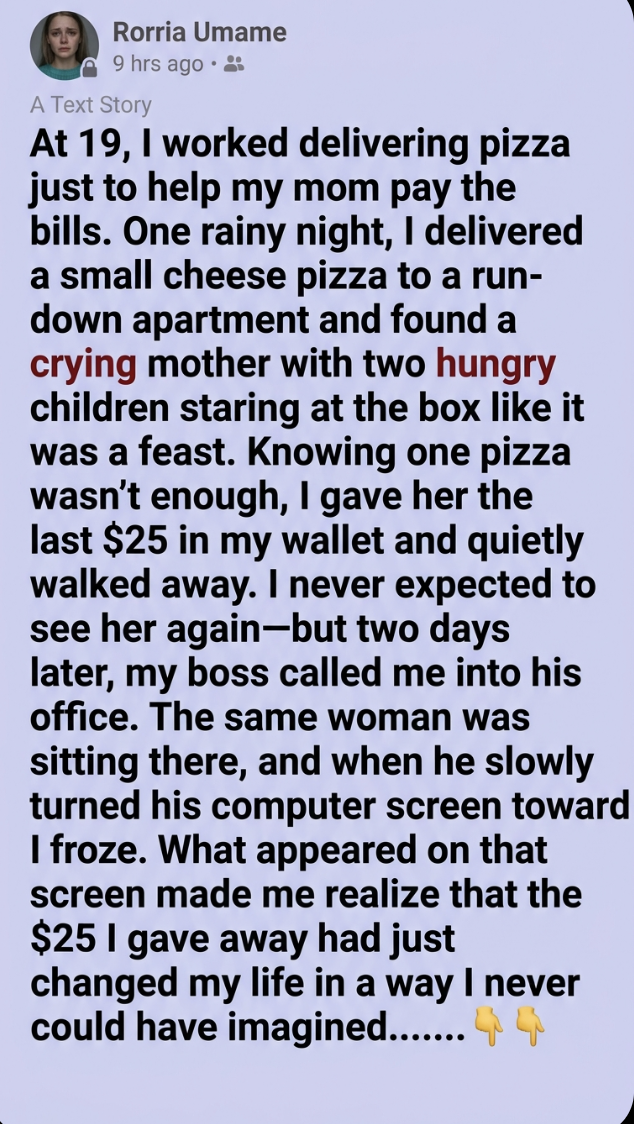
At nineteen, I wasn’t thinking about changing anyone’s life.
I was thinking about rent.
My mother and I lived in a small apartment above an old laundromat.
She worked mornings at a grocery store.
I worked evenings delivering pizza.
Between us, we barely had enough to cover everything.
But we managed.
Most nights, I’d come home smelling like garlic, cheese, and rain.
That particular Thursday had been awful.
It had rained for hours.
The streets were flooded.
Customers complained about late deliveries.
My manager complained about customers complaining.
By 10:30 p.m., I had one final delivery.
A small cheese pizza.
Apartment 3B.
I grabbed the box and drove through the rain.
The building looked like it hadn’t been repaired in twenty years.
The hallway smelled like damp carpet.
I knocked.
Nothing.
I knocked again.
Then I heard a little voice.
“Mommy, someone’s here.”
The door opened slightly.
A woman stood there.
She looked exhausted.
Behind her were two children.
A little boy and a girl.
Both were staring at the pizza box.
Not at me.
Not at my uniform.
At the box.
The boy swallowed.
The mother noticed.
Her face changed.
“I’m sorry,” she whispered.
I smiled.
“Pizza delivery.”
“I know.”
She looked down.
“I don’t have the full amount.”
I glanced at the receipt.
It was already paid.
“You’re fine.”
She looked confused.
“Paid?”
“Yes.”
I handed her the pizza.
She took it carefully.
The little girl whispered:
“Mommy, can we eat now?”
The mother nodded.
Then she looked at me.
“Thank you.”
I turned around.
But something stopped me.
I looked at the children again.
They weren’t eating.
They were waiting for their mother to open the box.
I knew immediately.
One small pizza wasn’t going to be enough.
I reached into my wallet.
I had $25.
It was everything I had.
Money I needed for groceries.
Money I had planned to use the next morning.
I looked at the mother.
Then at the children.
I handed her the money.
She stared at it.
“No.”
“It’s okay.”
“I can’t take this.”
“Please.”
Her eyes filled with tears.
“Why?”
I shrugged.
“Because kids shouldn’t go hungry.”
She covered her mouth.
I walked away before she could say anything else.
The next morning, I regretted it.
Not because I wished I hadn’t helped her.
But because I had $3.14 left.
My mother noticed.
“What happened?”
“Nothing.”
She stared at me.
“You’re a terrible liar.”
I smiled.
“I gave someone some money.”
She sighed.
“How much?”
I hesitated.
“Twenty-five.”
She shook her head.
“That’s all you had?”
“Yeah.”
She looked at me for a long moment.
Then she smiled.
“You did the right thing.”
“But now we’re short.”
“We’ll manage.”
She hugged me.
“You’ll always be able to earn another twenty-five dollars.”
Then she added:
“But kindness isn’t something you can always buy back.”
I never forgot that.
Two days later, my manager called me into his office.
I thought I was in trouble.
Maybe someone had complained about the delivery.
Maybe the customer had accused me of something.
I walked in.
The woman from apartment 3B was sitting in a chair.
I froze.
She stood.
“Hello.”
I couldn’t speak.
My manager closed the door.
“Sit down.”
I sat.
The woman looked nervous.
Then my manager turned his computer screen toward me.
There was a photograph on it.
It was me.
Standing outside her apartment.
Holding the pizza box.
But underneath the photograph was something else.
A news article.
LOCAL FAMILY RECEIVES UNEXPECTED HELP AFTER STRUGGLING TO FEED CHILDREN.
I looked at the woman.
She started crying.
“I didn’t know what else to do.”
I frowned.
“Do what?”
She reached into her purse.
She pulled out a folder.
Inside were documents.
Her name was Elena Carter.
She explained that she had been working two jobs while raising her children after her husband had left.
She had fallen behind on rent.
Her children had been missing meals.
That night, when I gave her the $25, she said something had happened.
Her landlord had come to the apartment the next morning.
He was about to evict her.
But he had seen the children eating.
He asked what had happened.
She told him about me.
He called someone.
That person called someone else.
And eventually, the story reached a local charitable foundation.
I still didn’t understand.
Then my boss clicked another file.
My heart stopped.
It was a bank statement.
A donation had been made.
$25,000.
I stared at the screen.
“What is this?”
Elena wiped her eyes.
“It’s for you.”
I laughed nervously.
“No.”
She shook her head.
“Please let me explain.”
The foundation belonged to an anonymous donor.
The donor had a program that rewarded ordinary acts of kindness.
Someone at the foundation had heard what I did.
They wanted to help.
But there was more.
The $25,000 wasn’t simply a gift.
It was the beginning of a scholarship.
I didn’t know that my boss had been secretly working with a community organization.
They had tracked down the delivery because Elena had given them my name.
The foundation had investigated my background.
They learned about my mother.
My job.
My financial situation.
And my dream.
I had once told my manager that I wanted to go to college.
I just couldn’t afford it.
The foundation offered to pay my tuition.
Not for one year.
For the entire degree.
Books.
Transportation.
Living expenses.
Everything.
I stared at the screen.
“I can’t accept this.”
Elena reached across the desk.
“Why not?”
“Because I didn’t do it for this.”
She smiled through her tears.
“I know.”
Then she said:
“That’s exactly why you should accept it.”
Three years later, I graduated.
My mother sat in the front row.
She cried harder than I did.
Elena was there too.
So were her children.
The little boy who had stared at the pizza box was now taller.
The little girl ran up and hugged me.
“You’re the pizza man!”
Everyone laughed.
I smiled.
“I’m not delivering pizza anymore.”
She looked disappointed.
“Why?”
“Because someone gave me a chance.”
I eventually started a nonprofit.
Its purpose was simple:
Help families before they reach the point of asking for help.
We provided groceries.
Emergency rent assistance.
School supplies.
And most importantly, we tried to help people without making them feel ashamed.
Because I remembered what Elena had looked like when she opened that apartment door.
She hadn’t wanted pity.
She had wanted dignity.
Years later, I returned to that same apartment building.
Apartment 3B was empty.
The building had been renovated.
I stood outside for a moment.
Then my phone rang.
It was Elena.
“Guess what?”
“What?”
“My daughter got accepted into college.”
I smiled.
“That’s wonderful.”
There was a pause.
“She wants to study social work.”
I laughed.
“That sounds familiar.”
Elena laughed.
Then she said:
“She wants to help people the way you helped us.”
I looked up at the building.
“I didn’t do much.”
“You gave us everything you had.”
“It was only $25.”
“No,” Elena said quietly.
“It was proof that somebody saw us.”
I didn’t know what to say.
So I simply said:
“Take care of yourself.”
She replied:
“You too.”
That night, I opened an old box in my closet.
Inside was my first pizza-delivery uniform.
My old name tag.
And a photograph.
Me.
Elena.
Her two children.
And a small cheese pizza.
On the back of the photograph, Elena had written:
“You thought you were giving us $25. You actually gave us hope.”
I stared at those words for a long time.
Because she was wrong about one thing.
I hadn’t given them hope.
They had given it back to me.
That $25 had disappeared from my wallet within minutes.
But what came from it lasted for the rest of my life.
And whenever someone asks me when my life changed, I don’t tell them it was the day I received a scholarship.
I don’t tell them it was the day I graduated.
I don’t even tell them it was the day I started my nonprofit.
I tell them about a rainy Thursday night.
A small cheese pizza.
Two hungry children.
A tired mother.
And a nineteen-year-old kid who had only $25 left in his wallet.
Because sometimes, the smallest thing you can afford to give becomes the biggest thing someone else remembers.
And sometimes, when you give away the last thing you have, life has a strange way of giving you something back that money could never buy.