Warren had been gone for seventeen days when I found the key.
Seventeen days.
That was how long I had been walking through our house like a guest.
His chair was still beside the window.
His reading glasses were still on the end table.
His coffee mug was still sitting in the cabinet where he had always kept it.
I couldn’t bring myself to move anything.
Then one Tuesday morning, I decided I had to start cleaning.
Not because I was ready.
Because I knew Warren would have told me to stop making excuses.
I opened the kitchen drawers.
Receipts.
Rubber bands.
Old batteries.
Takeout menus from restaurants that no longer existed.
Then I pulled out the bottom drawer.
Something underneath caught my finger.
I lifted it.
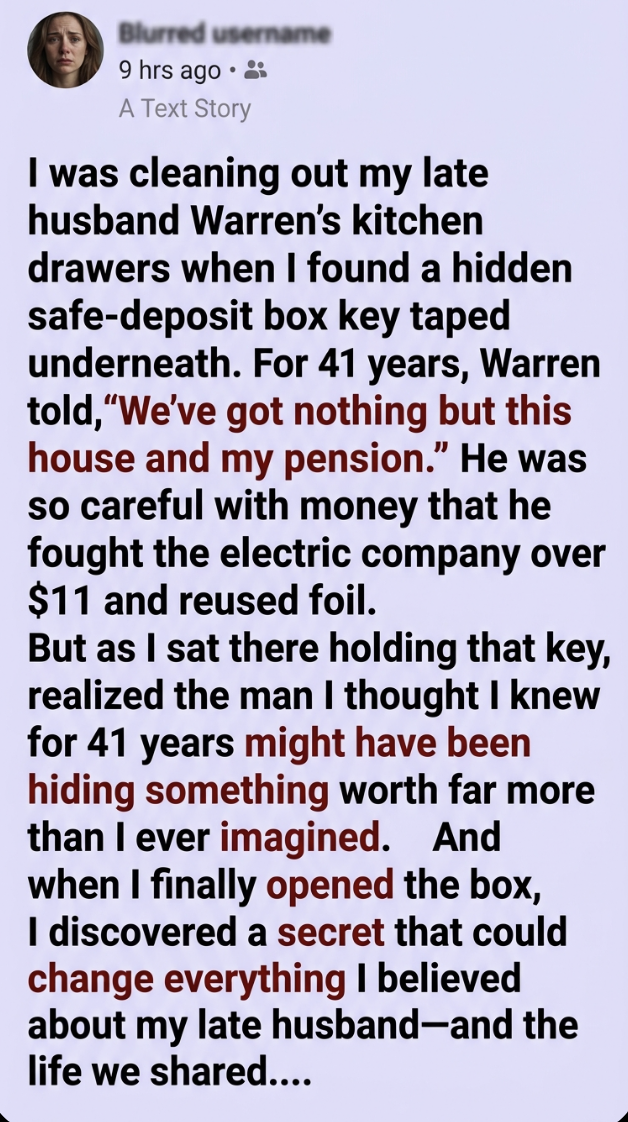
There was a small brass key taped to the underside.
My heart began beating faster.
Attached to it was a tiny white paper.
Three words.
BOX 417.
Nothing else.
I sat on the kitchen floor.
Warren had never mentioned a safe-deposit box.
Not once.
For forty-one years, Warren had told me the same thing whenever money came up.
“We’ve got nothing but this house and my pension.”
He wasn’t joking.
He was famous for being careful.
He once argued with the electric company for forty minutes over an $11 billing error.
He washed plastic bags.
He reused aluminum foil.
He turned lights off whenever he left a room.
When our daughter once bought him an expensive watch, he returned it the next morning.
“Too much money for something that tells time,” he said.
That was Warren.
Or at least, I thought it was.
I looked down at the key.
And for the first time in forty-one years, I wondered:
Who was my husband when I wasn’t looking?
The next morning, I went to the bank.
I gave the clerk the key.
She checked the number.
“Box 417?”
I nodded.
She asked for identification and the death certificate.
Then she disappeared into a back office.
A few minutes later, she returned.
“Your husband listed you as the beneficiary.”
My stomach tightened.
“Beneficiary of what?”
“The contents.”
She led me downstairs.
The metal door opened.
Inside was a small box.
Nothing dramatic.
No piles of gold.
No movie-style treasure.
Just a thick brown envelope.
A smaller black box.
And a letter with my name written on it.
My hands began shaking.
I opened the letter.
It started:
My dear Margaret,
I stopped breathing.
Warren’s handwriting.
I sat down.
Then I read.
If you’re reading this, I’m gone. And you’re probably angry with me. You have every right to be.
My eyes filled with tears.
But before you decide that everything I did was a lie, please read the entire letter.
I continued.
And what I learned next changed everything.
Thirty-nine years earlier, before we had children, Warren had made a promise.
Not to me.
To his younger brother, Daniel.
Daniel had been diagnosed with a serious illness and needed expensive treatment.
Their parents couldn’t afford it.
Warren had secretly taken a second job.
Night shifts.
Weekends.
He never told me because he didn’t want me to worry.
Daniel survived.
But years later, Daniel’s business failed.
He was facing bankruptcy.
Warren helped him again.
Then again.
And again.
The money came from the small savings account Warren had secretly maintained.
But there was more.
Much more.
Warren had started investing small amounts.
Nothing spectacular.
$50 here.
$100 there.
Whatever he could afford.
He reinvested everything.
Over decades, those tiny investments had grown.
The safe-deposit box contained records of accounts I had never known existed.
My hands trembled as I turned the pages.
Then I saw the total.
I read it twice.
Then a third time.
$1,842,700.
I couldn’t speak.
The man who had argued over an $11 electric bill had quietly accumulated nearly two million dollars.
But then I found the black box.
Inside were photographs.
Dozens of them.
Our children.
Our grandchildren.
Our wedding.
Our first apartment.
Our house being built.
Family birthdays.
Christmas mornings.
Ordinary moments.
Moments I hadn’t known he’d photographed.
At the bottom was another note.
These are the things I was really saving.
I began crying.
But then I found something that confused me.
A photograph of a small house.
On the back, Warren had written:
“For Margaret.”
I looked through the documents.
The house had been purchased eleven years earlier.
Not in Warren’s name.
In mine.
I stared at the deed.
He had been quietly paying the mortgage.
I didn’t understand.
Then I found another letter.
I knew you would outlive me. I also knew you would never spend money on yourself. So I bought you a place where you could live if you ever wanted to start over.
My hands covered my mouth.
It wasn’t just an investment.
It was a gift.
A second home near the lake.
A place where Warren and I had once taken a weekend trip during our thirty-fifth anniversary.
He had apparently loved it enough to buy it secretly.
I thought I had discovered everything.
I hadn’t.
At the bottom of the box was one final envelope.
It was addressed to our daughter, Emily.
I hesitated.
Then I read it.
Warren had written:
Your mother will probably believe I hid money from her because I didn’t trust her. That’s not true.
I hid it because she would have spent every extra dollar helping someone else.
I knew her. She would have given it away.
I laughed through my tears.
That was true.
I absolutely would have.
Then I read the next line.
And I wanted, for once, to leave something behind that nobody could take away from her.
When I came home, I sat at the kitchen table for hours.
The same table where Warren had counted coupons.
The same kitchen where he had complained about the price of coffee.
The same man who had told me we had “nothing but this house and my pension.”
Except now I understood.
He hadn’t been cheap.
He had been building something quietly.
Not for himself.
For us.
For our children.
For the future he knew he might not live to see.
Three days later, Emily came over.
I handed her the letter.
She read it.
Then she started crying.
“Mom…”
“What?”
“He told me.”
I stared at her.
“What?”
“Not everything.”
She wiped her face.
“But he told me once that Dad had a secret.”
I laughed.
“Apparently everyone knew except me.”
She smiled.
“That’s Dad.”
A month later, we sold nothing.
We didn’t move.
Instead, I kept the house exactly as it was.
But I changed one thing.
I stopped worrying about every dollar.
I took the lake house.
I planted flowers.
I bought the expensive coffee Warren would have complained about.
And every Sunday, I invited the family over for dinner.
One afternoon, I found myself standing in the kitchen holding a roll of aluminum foil.
I laughed.
“You’re not getting away with this, Warren.”
I threw it in the trash.
Then I heard my daughter’s voice behind me.
“What did you do?”
I smiled.
“I used the foil once.”
She stared at me.
“Mom…”
“I know.”
We both started laughing.
Six months after Warren died, I returned to the bank one final time.
I didn’t need the safe-deposit box anymore.
I removed the last photograph.
It was a picture of us on our wedding day.
We were young.
Terrified.
Happy.
Warren had written something on the back.
I had never seen it before.
“If I get to spend my whole life with her, I’ll already be the richest man alive.”
I held the photograph against my chest.
For forty-one years, I thought Warren had been hiding money from me.
But I finally understood.
He hadn’t been hiding wealth.
He had been quietly protecting our future.
And the greatest secret inside that box wasn’t the money.
It wasn’t the house.
It wasn’t the investment accounts.
It was the proof that every little sacrifice, every argument over an $11 bill, every reused piece of foil, every dollar he refused to waste had been part of a plan.
A plan built around one person.
Me.
I went home that evening and sat in Warren’s chair.
For the first time since his funeral, the house didn’t feel empty.
I looked around the kitchen and smiled.
“You could have just told me, you stubborn old man.”
The silence remained.
But somehow, it didn’t feel like silence anymore.
It felt like an answer.
And that’s when I realized the truth:
I had spent forty-one years thinking I knew exactly what Warren valued.
I was wrong.
He hadn’t valued money.
He had valued the people he loved.
And when he finally left this world, he didn’t leave me a fortune.
He left me something much more precious.
Proof that I had been loved—quietly, carefully, and completely—for forty-one years.