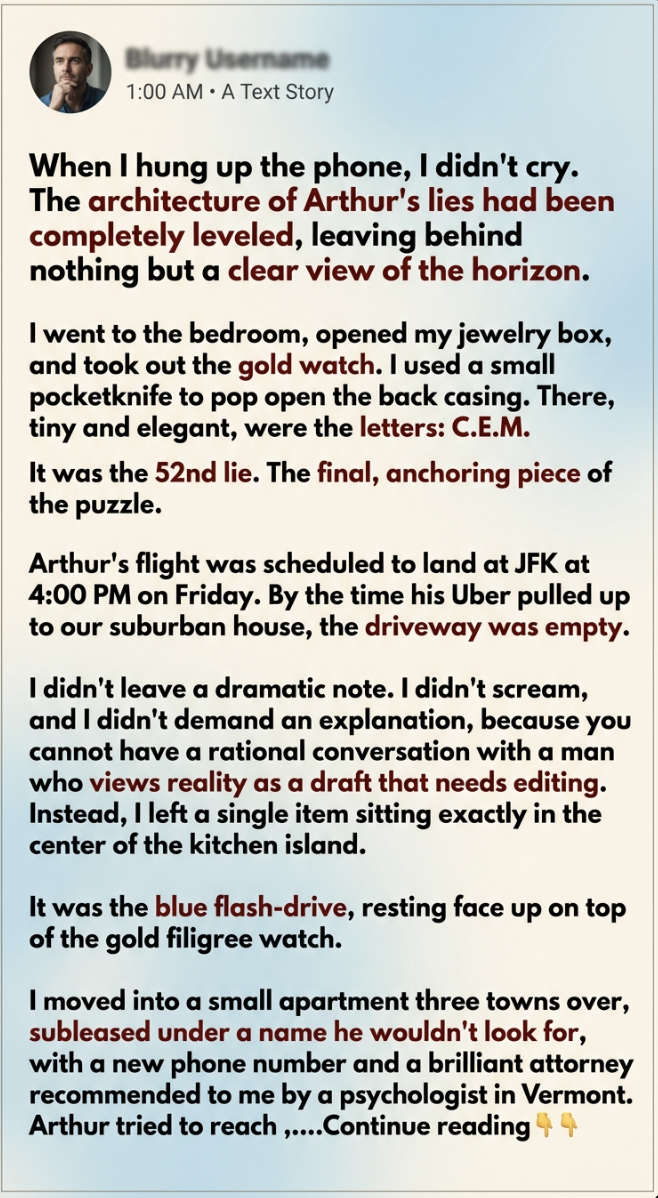
When I hung up the phone, I didn’t cry.
That surprised me.
For years, I had imagined that discovering the final truth about Arthur would destroy me.
Instead, I felt strangely calm.
It was as if someone had finally turned off a machine that had been running inside my head for years.
Every unexplained expense.
Every forgotten promise.
Every strange phone call.
Every business trip that didn’t quite make sense.
Every time Arthur had looked directly into my eyes and confidently explained something that later turned out to be completely false.
I had spent years thinking I was too suspicious.
Too sensitive.
Too emotional.
Too forgetful.
But now I knew.
I wasn’t imagining things.
Arthur had been constructing a second life behind mine.
And I had finally found the blueprint.
I walked into our bedroom and opened the jewelry box.
Inside was the gold watch Arthur had given me on our fifteenth anniversary.
He had called it an heirloom.
“Something you’ll keep forever,” he’d said.
I almost laughed.
I took the watch out.
Then I remembered something.
The initials.
I had never understood them.
C.E.M.
They were engraved inside the casing.
Arthur had always claimed they were the initials of his grandfather.
But Arthur’s grandfather’s name was Edward James Mercer.
No C.
No M.
Just another detail that hadn’t mattered until now.
I used a small pocketknife to carefully open the back.
Inside was something I had never noticed.
A tiny folded strip of paper.
My hands became cold.
I opened it.
There was a date.
A bank account number.
And three words:
“For Clara. Always.”
Clara.
The name I had seen once in an email.
The name Arthur had dismissed as a former employee.
The name that had appeared on an old hotel receipt.
The name that had disappeared from his phone after I asked about it.
C.E.M.
Clara Elizabeth Morgan.
I sat on the edge of the bed.
For a moment, I couldn’t breathe.
Then I laughed.
Not because it was funny.
Because suddenly the entire architecture of Arthur’s lies had collapsed.
The blue flash drive had been the beginning.
I found it hidden inside a box of old tax documents.
Arthur had labeled the folder “Home Renovation.”
There had been no renovation.
Inside the drive were spreadsheets.
Dates.
Names.
Payments.
Properties.
Transfers.
Private messages.
And notes written in Arthur’s own handwriting.
He had created an entire system for keeping his stories straight.
There were columns labeled:
WHAT SHE KNOWS
WHAT SHE THINKS SHE KNOWS
WHAT SHE MUST NEVER FIND
And one column that made my stomach turn:
EXPLANATION IF DISCOVERED
Arthur hadn’t simply lied.
He had documented his lies.
He had rehearsed them.
He had planned them.
Some entries went back more than eleven years.
Eleven years.
I stared at the screen.
Then I found something worse.
My name appeared beside a number.
Not my birthday.
Not our anniversary.
A dollar amount.
$480,000.
Underneath it:
“Expected after sale.”
I read it twice.
Then again.
My hands began shaking.
Our house wasn’t simply our house.
Arthur had been preparing to sell it.
Without telling me.
I called an attorney.
Not one Arthur knew.
Not one recommended by his friends.
A brilliant attorney recommended by a psychologist in Vermont whom I had spoken with during one of the darkest periods of my marriage.
I sent her copies of everything.
She called me the next morning.
“Don’t confront him.”
“I wasn’t planning to.”
“Don’t tell him what you found.”
“I won’t.”
“Don’t delete anything.”
“I won’t.”
“And whatever you do, don’t meet him alone.”
I paused.
“How bad is it?”
There was silence.
Then she said:
“Bad enough that you should assume everything you’ve been told is incomplete.”
That sentence stayed with me.
Arthur was scheduled to return Friday.
His flight would land at JFK at 4:00 PM.
I had three days.
I didn’t waste them.
I packed quietly.
Clothes.
Documents.
Photographs.
My passport.
The jewelry box.
The flash drive.
Copies of everything.
I left behind almost everything else.
The furniture didn’t matter.
The expensive paintings didn’t matter.
The kitchen we’d renovated didn’t matter.
Even the house itself didn’t matter.
What mattered was leaving before Arthur realized I knew.
I moved into a small apartment three towns away.
The lease was under a name he wouldn’t immediately recognize.
New phone.
New email.
New bank account.
New passwords.
My attorney handled everything else.
Then I waited.
At 4:00 PM on Friday, Arthur’s plane landed.
At 5:17, his Uber pulled into our driveway.
The house was empty.
No car.
No suitcase.
No wife waiting in the kitchen.
He walked inside.
I knew because my attorney had arranged for someone to monitor the property legally.
Arthur looked around.
Then he saw the kitchen island.
Exactly where I had left it.
The blue flash drive.
And beneath it, the gold watch.
Nothing else.
No letter.
No accusation.
No goodbye.
Just evidence.
For a man who had spent years controlling every conversation, silence was probably the most terrifying message I could have given him.
He called me twenty-three times.
I didn’t answer.
Then came the messages.
“We need to talk.”
“You don’t understand.”
“Please don’t do anything irrational.”
Then:
“I can explain.”
I almost smiled.
Of course he could.
Arthur could explain anything.
That was his greatest talent.
A lie never frightened him.
He simply edited reality until it sounded reasonable.
Then the intermediaries started.
A mutual friend.
His cousin.
His business partner.
Even a woman I hadn’t spoken to in six years.
Every person carried the same message.
Arthur was sorry.
Arthur was confused.
Arthur loved me.
Arthur had made mistakes.
Arthur wanted to fix everything.
And then came the most absurd explanation.
The spreadsheet was apparently “a creative writing exercise.”
I stared at that message for almost a minute.
Then I laughed.
It was his 53rd lie.
And somehow, it was the one that finally made me feel free.
The legal proceedings lasted months.
Arthur fought everything.
He challenged documents.
He questioned dates.
He claimed certain accounts weren’t his.
He said some of the spreadsheets had been fabricated.
But the problem with building your life around lies is that eventually you create too many records.
Bank transfers contradicted his statements.
Emails contradicted his explanations.
Travel records contradicted his stories.
And the initials inside the watch connected to a financial account Arthur had never disclosed.
The final piece came from Clara.
She agreed to speak.
Not because she wanted revenge.
Because she was tired of carrying Arthur’s secrets.
She provided messages.
Old contracts.
Photographs.
And one document that changed everything.
It was an agreement Arthur had signed years earlier.
My name appeared on it.
Except I had never signed it.
Someone had forged my signature.
My attorney looked at me.
“Do you want to know what this means?”
I nodded.
“It means this isn’t just a divorce anymore.”
Arthur finally asked to meet me.
I agreed only in the presence of attorneys.
He walked into the conference room looking older than I remembered.
For once, he didn’t look confident.
He sat across from me.
“I loved you.”
I looked at him.
“Maybe you did.”
His eyes filled with tears.
“I made mistakes.”
“You made systems.”
He looked down.
“I was afraid.”
“Of what?”
“Losing everything.”
I almost felt sorry for him.
Almost.
Then I remembered the spreadsheet.
The column.
WHAT SHE MUST NEVER FIND.
I leaned back.
“You didn’t lose everything, Arthur.”
He looked at me.
“You lost the person who believed your lies.”
He didn’t respond.
The case eventually ended.
I walked away with enough to rebuild my life.
But the money wasn’t the victory.
The victory was waking up one morning and realizing I no longer checked my husband’s phone.
I no longer wondered whether his business trip was real.
I no longer questioned my own memory.
I no longer apologized for asking reasonable questions.
I could breathe.
Months later, I moved into a small house near the coast.
It wasn’t luxurious.
It didn’t need to be.
There was a little garden behind it.
A kitchen with old cabinets.
A porch where I could drink coffee in the morning.
And nobody inside the house was keeping secrets from me.
One evening, I opened the jewelry box.
The gold watch was still there.
I turned it over.
C.E.M.
I finally understood what those initials meant.
They weren’t the initials of Arthur’s grandfather.
They were the initials of a woman who had unknowingly helped me discover the truth.
I smiled.
Then I placed the watch back in the box.
I didn’t need it anymore.
The blue flash drive was different.
I kept that.
Not as a reminder of Arthur.
As a reminder of myself.
Because there was a time when I thought discovering the truth would destroy my life.
Instead, it gave me my life back.
And the final lesson was painfully simple:
The most dangerous lies aren’t the ones someone tells you.
They’re the ones that make you stop trusting yourself.
Arthur spent years convincing me that I was imagining things.
But in the end, his own lies became the evidence that saved me.
And when he tried to tell the 53rd lie, I finally understood something.
I didn’t need another explanation.
I didn’t need an apology.
I didn’t need him to admit everything.
I already knew the truth.
I closed the jewelry box, walked onto my porch, and watched the sun disappear beyond the horizon.
For the first time in eleven years, the silence didn’t feel lonely.
It felt like freedom.