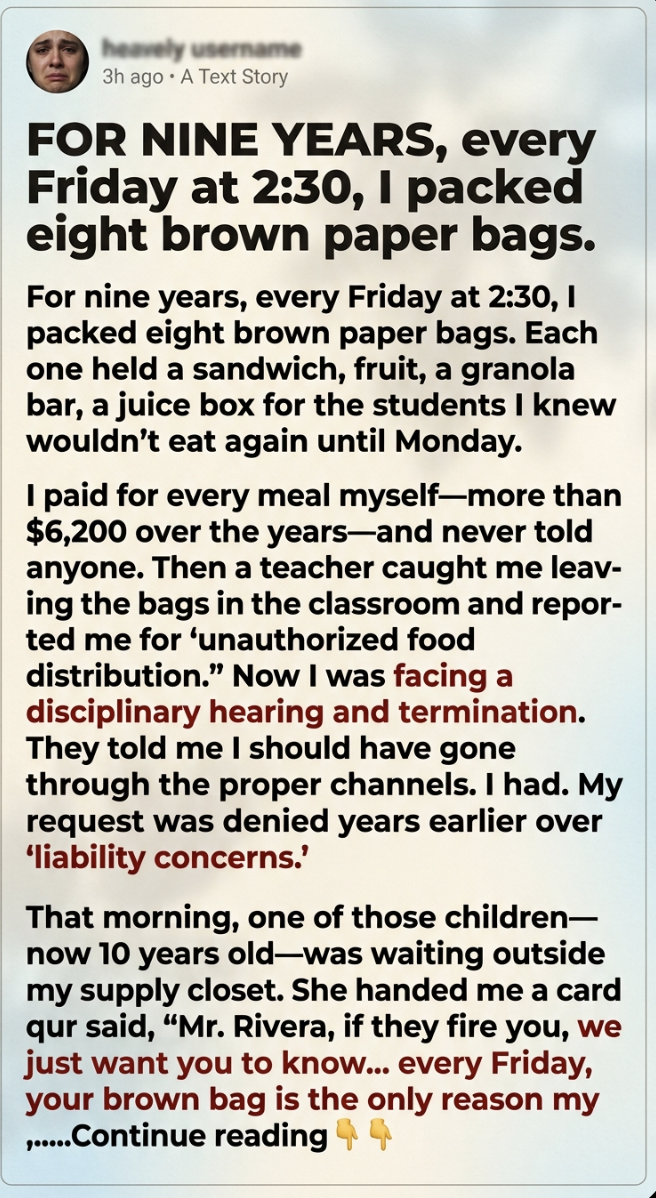
For nine years, every Friday at exactly 2:30, I did the same thing.
Eight brown paper bags.
Eight sandwiches.
Eight pieces of fruit.
Eight granola bars.
Eight juice boxes.
Nothing fancy.
Nothing anyone would post about on social media.
Just enough food to make sure eight children had something to eat when they went home for the weekend.
I was a school custodian, but the kids knew me as Mr. Rivera.
I wasn’t a teacher.
I wasn’t a counselor.
I wasn’t wealthy.
I didn’t have a foundation or a nonprofit.
I simply noticed things other people didn’t.
I noticed the children who lingered in the cafeteria long after everyone else had left.
I noticed the ones who quietly asked classmates if they were going to finish their lunch.
I noticed the little girl who always drank her milk slowly because she knew it was the last thing she would have until Monday.
And once you notice something like that, it’s difficult to pretend you didn’t.
So I started bringing food.
At first, it was only one bag.
Then two.
Eventually, it became eight.
Every Friday.
For nine years.
I never told anyone.
Not my coworkers.
Not the principal.
Not even my wife.
I didn’t want praise.
I didn’t want photographs.
I didn’t want anyone calling me a hero.
I just wanted eight children to have something to eat.
Then one Thursday afternoon, everything changed.
I was carrying the bags toward the supply room when a teacher saw me.
She stopped.
“What are those?”
“Food.”
“For the students?”
I nodded.
“You’re not allowed to distribute food without authorization.”
I sighed.
“I requested authorization years ago.”
She frowned.
“And?”
“They said no.”
“Then you need to stop.”
I looked at the bags.
“I can’t.”
The next morning, I received an email.
DISCIPLINARY HEARING — UNAUTHORIZED FOOD DISTRIBUTION.
I read it twice.
Possible suspension.
Possible termination.
My stomach sank.
After nine years of quietly helping children, I was suddenly being treated like I’d committed some terrible offense.
They said it was about liability.
What if a child had an allergy?
What if a parent complained?
What if someone got sick?
I understood the concerns.
But I also understood something they didn’t.
Hunger didn’t wait for paperwork.
That Friday, I almost didn’t make the bags.
I stood in my kitchen at 5:30 in the morning, staring at eight brown paper bags.
My wife walked in.
She looked at me.
“What’s wrong?”
I finally told her everything.
She listened without interrupting.
Then she asked,
“How long?”
“Nine years.”
Her eyes widened.
“Nine years?”
I nodded.
“How much have you spent?”
“I don’t know.”
She opened a calculator.
We added the receipts I had saved.
More than $6,200.
My wife stared at the number.
“You never told me.”
“I didn’t want anyone to think I was doing it for attention.”
She smiled sadly.
“You’re an idiot.”
I laughed.
“Probably.”
She picked up one of the bags.
“Then make eight.”
That afternoon, I walked toward the supply closet.
But someone was waiting for me.
A little girl stood there.
She was ten years old.
Her name was Sofia.
She had been one of the children receiving a bag.
She was holding a folded piece of paper.
“Mr. Rivera?”
“Yes?”
“Can I talk to you?”
“Of course.”
She handed me the paper.
I opened it.
Inside was a card.
Eight names were written across the front.
All eight children.
Sofia looked at me.
“We heard you’re in trouble.”
I swallowed.
“Who told you?”
“Kids hear everything.”
I smiled.
She looked down.
“If they fire you, we just want you to know something.”
“What?”
She took a breath.
“Every Friday, your brown bag is the reason my little brother and I make it through the weekend.”
I couldn’t speak.
She continued.
“My mom works nights.”
Another child stepped out from behind the corner.
Then another.
Then another.
All eight.
They had somehow gathered there.
One boy held a drawing.
Another carried a small envelope.
A girl held a handwritten letter.
The children stood in front of me.
No adults.
No cameras.
No speeches.
Just eight kids.
The boy with the drawing handed it to me.
It showed a brown paper bag with a giant red heart on it.
Underneath were the words:
THANK YOU FOR FRIDAYS.
I looked away because my eyes were filling with tears.
Then Sofia said,
“You always told us not to be embarrassed.”
I nodded.
“So don’t be embarrassed either.”
That sentence destroyed me.
I hugged her.
Then the other children joined us.
For a few seconds, that supply hallway became the most important place in the entire school.
The disciplinary hearing was scheduled for Monday.
I expected to sit alone.
I didn’t.
When I entered the conference room, there were teachers.
Administrators.
Parents.
The principal.
And at the back of the room were eight families.
My wife sat beside them.
I looked at her.
She smiled.
The principal began.
“Mr. Rivera, this hearing concerns repeated violations of school policy regarding unauthorized food distribution.”
I nodded.
“I understand.”
“You knowingly continued after being informed that your actions were not authorized.”
“Yes.”
“Why?”
I looked around the room.
Then I answered simply.
“Because children were hungry.”
Silence.
The principal shifted in his chair.
“We have procedures.”
“I followed them.”
“We cannot simply allow employees to distribute food.”
“I understand.”
“Then why did you continue?”
I took a breath.
“Because the answer I received wasn’t ‘we’ll help you do it safely.'”
I looked at the administrators.
“It was ‘liability concerns.'”
Nobody spoke.
Then Sofia’s mother stood up.
She was crying.
“My daughter used to hide food in her backpack because she was afraid there wouldn’t be enough at home.”
The room became quiet.
Another parent spoke.
“My son never told me he was hungry because he knew I was struggling.”
Then another.
“And Mr. Rivera never judged us.”
The principal looked uncomfortable.
One teacher raised her hand.
“I need to say something.”
Everyone turned.
It was the teacher who had reported me.
She looked at me.
“I’m sorry.”
I didn’t respond.
She continued.
“I thought I was protecting the school.”
She wiped her eyes.
“But I didn’t understand what those bags meant.”
Then she looked toward the administrators.
“Maybe instead of asking why Mr. Rivera broke the rules, we should ask why the rules didn’t give him a safe way to help.”
Nobody answered.
Two weeks later, the school board held a meeting.
They didn’t fire me.
They didn’t suspend me.
Instead, they created something called the Friday Family Food Program.
The school partnered with local businesses and community organizations.
The eight bags became forty.
Then eighty.
Then hundreds.
Parents could participate without shame.
Teachers could refer families privately.
Students could receive food without anyone knowing who needed it.
And the program was named after the person who had started it.
I argued against it.
“Don’t put my name on anything.”
The superintendent smiled.
“Too late.”
A small plaque appeared in the hallway.
THE RIVERA FRIDAY FOOD PROGRAM
I stared at it for a long time.
Then Sofia walked up beside me.
“Looks good.”
I smiled.
“You did this.”
She shook her head.
“No.”
She pointed at the plaque.
“You started it.”
Years later, Sofia graduated high school.
She became the first person in her family to attend college.
At graduation, she found me in the crowd.
She ran toward me.
She was taller than me now.
She hugged me.
“Remember the brown bags?”
I laughed.
“How could I forget?”
She smiled.
“I want you to know something.”
“What?”
“I never thought those bags were just food.”
I looked at her.
“They made me feel like somebody knew I mattered.”
I couldn’t answer.
She hugged me again.
Then she whispered,
“You taught me that kindness doesn’t have to be loud to change someone’s life.”
That night, I went home and found one of the original brown paper bags in an old box.
It was empty.
Faded.
Wrinkled.
Worth almost nothing.
But I kept it.
Because sometimes the smallest things carry the biggest memories.
Nine years.
More than $6,200.
Eight children.
Eight brown paper bags every Friday.
I never thought I was changing anyone’s life.
I thought I was just making sure a few children had lunch.
But years later, I finally understood.
You don’t always know how far one small act of kindness will travel.
Sometimes a sandwich becomes hope.
Sometimes a juice box becomes dignity.
Sometimes a brown paper bag becomes the reason a child believes someone cares.
And sometimes the person everyone calls a rule-breaker is simply the person who refused to look away.
I started packing eight brown bags because eight children were hungry.
I kept packing them because I learned something even more important:
A child should never have to wonder whether they matter.
And every Friday at 2:30, long after the disciplinary hearing was forgotten, the school still filled with the sound of brown paper bags being folded.
Not eight anymore.
Hundreds.
And on every bag, someone had written the same simple message:
“See you Monday. You are not forgotten.”