Three days after we buried our father, the house felt strangely small.
Every room seemed to hold an echo of him.
His boots were still beside the back door.
His coffee mug sat on the counter.
His old work jacket hung from the chair where he’d left it.
Dad had spent forty-three years building a plumbing business from nothing.
He started with an old van, a toolbox, and a phone number written on a piece of cardboard.
By the time he retired, the company had three trucks, several employees, and more customers than he could remember.
He wasn’t rich.
But he was comfortable.
The house was paid off.
The trucks were paid off.
And there was nearly $250,000 sitting in the business reserve account.
My sister, Claire, had always handled Dad’s paperwork.
Bills.
Insurance.
Taxes.
Appointments.
I never questioned it.
She was organized.
I wasn’t.
So when she walked into Dad’s kitchen that morning carrying a thick folder, I assumed she knew what she was doing.
She placed the folder on the table.
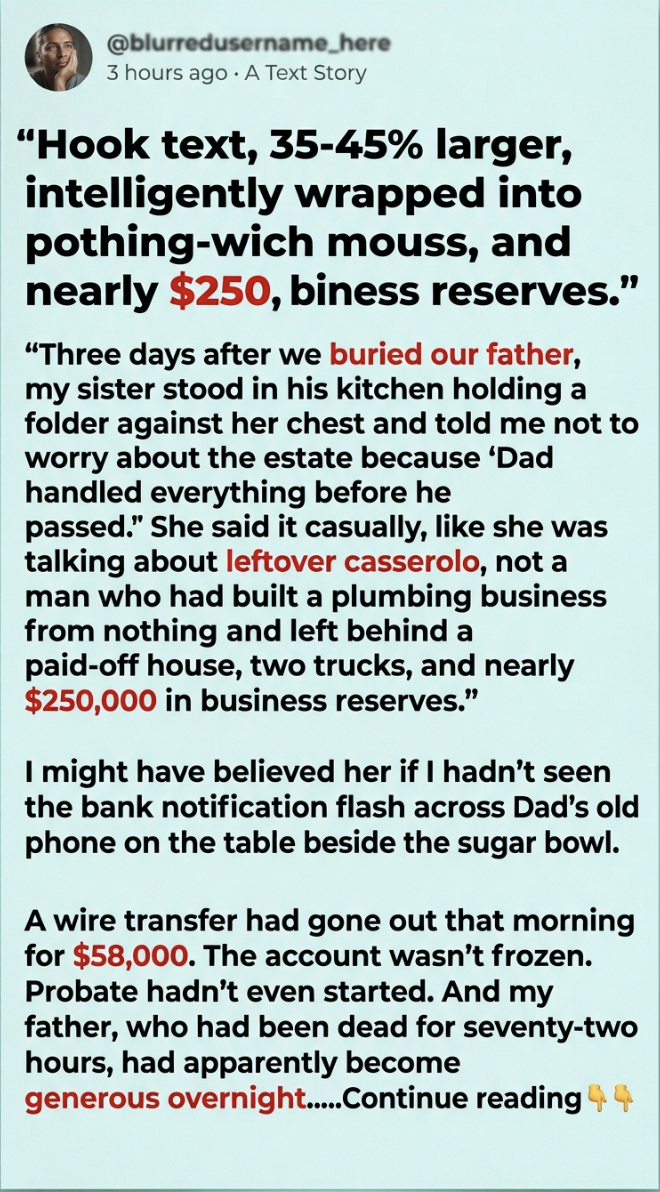
“Don’t worry about the estate,” she said.
I looked at her.
“What do you mean?”
“Dad handled everything before he died.”
She said it so casually.
Like she was telling me there was leftover casserole in the refrigerator.
“Handled everything?”
She nodded.
“There’s nothing for us to fight about.”
That sentence bothered me.
“Who said anything about fighting?”
She smiled.
“I’m just saying, everything is already arranged.”
I looked toward Dad’s old phone.
It was sitting beside the sugar bowl.
His phone had been dead for days, but I’d charged it because I wanted to save some of his photographs.
The screen suddenly lit up.
A notification appeared.
WIRE TRANSFER COMPLETED — $58,000.
I froze.
I read it again.
Then again.
“Claire.”
She stopped.
“What?”
I pointed at the phone.
“What is that?”
Her face changed.
Only for a second.
But I saw it.
“Probably nothing.”
“Fifty-eight thousand dollars is nothing?”
She reached for the phone.
I grabbed it first.
“Don’t.”
She stared at me.
“Give me the phone.”
“Why?”
“Because it’s Dad’s.”
“Exactly.”
I opened the notification.
The transfer had been made that morning.
Three days after Dad’s funeral.
The money had gone from the business account.
To an account I didn’t recognize.
I looked at Claire.
“Who received this?”
She crossed her arms.
“Dad probably arranged it before he died.”
“But the transfer happened today.”
“Maybe the bank processed it today.”
I shook my head.
“Probate hasn’t even started.”
She didn’t answer.
That was when I realized something.
Claire wasn’t surprised by the transfer.
She was worried that I’d seen it.
I picked up my coat.
“Where are you going?”
“To the bank.”
Her voice suddenly became sharp.
“You don’t need to.”
“I think I do.”
She stepped in front of the door.
“You need to trust me.”
I stared at her.
“I trusted you.”
Her expression softened.
“Then keep trusting me.”
I didn’t answer.
I walked around her and left.
The bank manager knew Dad.
He had handled the company’s finances for years.
When I showed him the notification, he became serious.
“You’re certain your father didn’t authorize this?”
“He died three days ago.”
The manager frowned.
“Then this needs to be investigated.”
He pulled up the account history.
The $58,000 transfer wasn’t the only unusual transaction.
There were three others.
$12,000.
$24,500.
$8,700.
All made during the previous two weeks.
All sent to different accounts.
I felt sick.
“Who authorized these?”
The manager looked at the records.
“Your sister.”
I stared at him.
“Claire?”
He nodded.
“She had signing authority on the business account.”
“Since when?”
“Your father added her several years ago.”
I sat back.
That explained the access.
But it didn’t explain the transfers.
“Can you stop the money?”
“We can freeze what remains and notify the estate attorney.”
I nodded.
“Please do.”
That evening, I returned to Dad’s house.
Claire was sitting at the kitchen table.
The folder was still there.
She didn’t look up.
“You went to the bank.”
It wasn’t a question.
“Yes.”
She sighed.
“I was trying to protect you.”
“From what?”
She opened the folder.
Inside were copies of documents.
A handwritten letter.
Several bank statements.
And a will.
My heart started pounding.
“What’s that?”
“Dad’s will.”
I read it.
The house was supposed to be divided equally between us.
The business was to be sold, with the proceeds divided equally.
The reserve account was also to be split.
Everything was equal.
Then I saw the date.
The will had been signed eight months earlier.
I looked at Claire.
“So why did you tell me Dad handled everything?”
“Because he did.”
“No.”
I held up the bank statements.
“He didn’t authorize those transfers.”
She looked away.
“I did.”
My stomach dropped.
“Why?”
She started crying.
“I was going to put the money back.”
“Where did you send it?”
She wiped her eyes.
“To Mom.”
I froze.
“Mom died six years ago.”
“I know.”
“Then why?”
Claire reached into the folder and pulled out another document.
It was a medical bill.
Then another.
And another.
All belonging to our mother.
Not recent.
Old.
From the final year of her life.
I looked at the dates.
Claire had apparently discovered that Dad had never paid several outstanding medical expenses.
Interest had accumulated for years.
“But why use Dad’s business money?”
She shook her head.
“Because I thought he would have wanted me to.”
“Did he?”
She didn’t answer.
I looked at the $58,000 transfer.
“Where did that money actually go?”
Claire finally looked at me.
“Not to Mom.”
My heart sank.
“Then where?”
She whispered,
“To a lawyer.”
“What lawyer?”
“The lawyer handling a lawsuit against Dad’s company.”
I stared at her.
“What lawsuit?”
She pushed another document toward me.
It was a settlement demand.
Years earlier, one of Dad’s former employees had been injured while working.
The case had never been resolved.
Dad had spent years fighting it.
Claire had discovered that the company could lose a substantial amount if the case continued.
She had transferred money into a legal escrow account to protect the business.
“But you said Dad handled everything.”
“I panicked.”
She looked at me.
“Dad had been sick. He didn’t tell us how serious things were. I was afraid the company would collapse after he died.”
I sat down.
“So you weren’t stealing the money.”
“No.”
She shook her head.
“But I knew how it looked.”
“Then why lie?”
She lowered her eyes.
“Because I knew you’d stop me.”
She was right.
I would have.
But there was something else.
“Claire.”
“What?”
“What about the other transfers?”
She went silent.
I waited.
Finally, she whispered,
“Those were for employees.”
I stared at her.
“What?”
“Dad owed them money.”
She opened another folder.
Inside were handwritten notes.
Names.
Amounts.
Dates.
Dad had apparently kept a private list of employees who needed help.
One needed surgery.
Another had a child in college.
Another had lost his home.
Dad had promised to help them if the business survived.
Claire had been quietly paying them.
I looked at her.
“Why didn’t you tell me?”
“Because Dad made me promise.”
I stared at the papers.
Suddenly, the picture changed.
The $58,000 wasn’t disappearing.
It was going somewhere Dad had already intended it to go.
But Claire had still made a terrible mistake.
She had moved money after his death without proper authorization.
She had hidden it.
And she had lied to me.
We sat in silence.
Then I noticed something at the bottom of the folder.
A small envelope.
My name was written on it.
I opened it.
Inside was a letter from Dad.
My hands trembled.
It said:
“If you’re reading this, I’m probably gone.”
I stopped.
Then continued.
“I know you two may disagree about what happens next. Your sister knows more about the business than you do, but don’t let that make you think she loves you less.”
I swallowed hard.
“And don’t let money turn you against each other. I didn’t spend forty-three years building this company so my children could spend the next forty years fighting over it.”
Tears filled my eyes.
Then came the final paragraph.
“If there is one thing I want you both to remember, it’s this: the business was never my greatest achievement. You two were.”
I couldn’t read anymore.
I folded the letter.
Claire was crying.
“I’m sorry,” she whispered.
I looked at her.
“You should have told me.”
“I know.”
“You should have trusted me.”
“I know.”
“And you should never have moved money without legal authority.”
She nodded.
“I know.”
I stood.
“Then let’s fix it.”
She looked up.
“What?”
“We’ll go back to the bank.”
“And the lawyer.”
“And the employees.”
“And we’ll do everything properly.”
She wiped her tears.
“You still want to work with me?”
I smiled sadly.
“You’re my sister.”
She nodded.
“And you’re my brother.”
The following weeks were difficult.
We hired an estate attorney.
We froze the remaining accounts.
We documented every transfer.
We contacted the employees.
We resolved the legal dispute.
And eventually, the business was sold.
The house was divided according to Dad’s will.
The money was divided fairly.
But before we finalized everything, Claire and I returned to the kitchen.
The same kitchen where she had first told me not to worry.
Dad’s coffee mug was still sitting there.
She picked it up.
“Do you think he knew we’d fight?”
I smiled.
“Probably.”
She laughed.
“He knew us too well.”
We stood there together.
Then Claire looked at me.
“Can I tell you something?”
“What?”
“I wasn’t afraid of losing the money.”
“What were you afraid of?”
She looked down at Dad’s mug.
“Losing you.”
I didn’t answer immediately.
Then I hugged her.
Because our father had been right.
Money could be divided.
A business could be sold.
A house could change owners.
But family was something you couldn’t replace once it was gone.
Months later, we held a small gathering at Dad’s old shop.
His employees came.
His customers came.
We put a photograph of him above the old counter.
Underneath it, we placed a simple plaque:
HE BUILT MORE THAN A BUSINESS.
HE BUILT PEOPLE.
And beside it was another sentence from his letter:
“Don’t let what I leave behind destroy what I gave you.”
That became the sentence Claire and I carried with us.
Because three days after Dad’s funeral, we thought we were about to lose each other over money.
Instead, we discovered the truth.
The $58,000 had never been the real inheritance.
The house wasn’t.
The business wasn’t.
The money wasn’t.
The real inheritance was the lesson our father left behind:
When someone you love is gone, don’t waste the rest of your life fighting over what they left behind.
Honor them by taking care of what they loved most.
And for our father, that had never been the money.
It had always been us.