The first thing I noticed was the sound of paper.
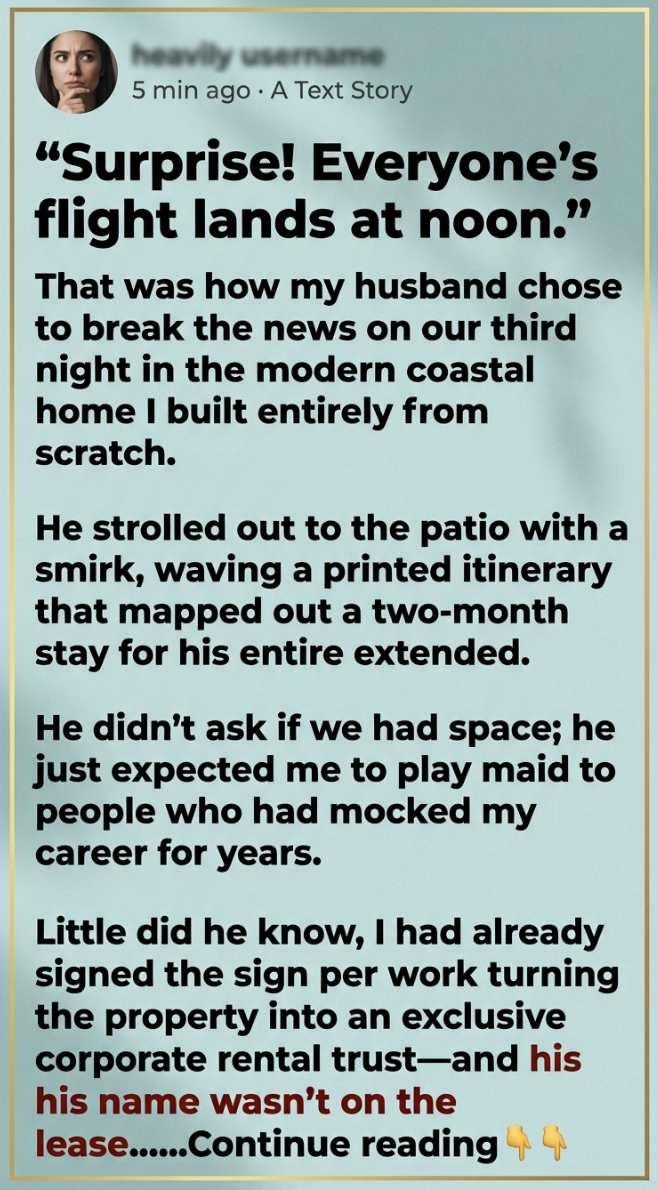
My husband, Mark, was standing on the patio, waving a printed itinerary like he’d just won a prize.
“Surprise!”
I looked up from my coffee.
“What?”
He grinned.
“Everyone’s flight lands at noon.”
I stared at him.
“Everyone?”
He nodded.
“My parents, my sister, her husband, the kids, my aunt, Uncle Richard…”
He continued listing names.
I stopped counting after twelve.
“How long are they staying?”
He smiled.
“About two months.”
I thought he was joking.
He wasn’t.
We were standing in the coastal house I had spent years designing, saving for, and building.
Every wall had been chosen by me.
Every window.
Every piece of wood.
Every light fixture.
I had worked late nights to afford it.
My husband had helped occasionally, but most of the financial burden had been mine.
And now he was telling me that more than a dozen relatives were moving in.
Without asking.
“Mark, where are they going to sleep?”
He shrugged.
“We’ll figure it out.”
“Where are they going to park?”
“There’s plenty of space.”
“Who is going to cook?”
He laughed.
“Come on. It’s family.”
That sentence had always been his answer.
Family.
It meant I was supposed to sacrifice.
Family meant I was expected to forgive.
Family meant his relatives could insult my career at dinner and still expect me to serve dessert.
His mother had once told me my career was “a hobby with a paycheck.”
His sister had laughed when I told her I was building the house.
“Why would a woman need a place that big?”
Now they wanted to stay there.
For two months.
I looked at the itinerary.
“Did you already book everything?”
“Of course.”
“You didn’t ask me.”
He frowned.
“Why would I need permission? It’s our house.”
I said nothing.
That was when his smile returned.
He thought he’d won.
He didn’t know what I had done six weeks earlier.
After years of watching Mark treat my work as something secondary, I had finally made a decision.
I had placed the property into a corporate rental trust.
The house was legally reserved for executive and corporate rentals when we weren’t using it.
The paperwork had already been completed.
And Mark wasn’t listed as a leaseholder or authorized property manager.
I hadn’t done it to punish him.
I’d done it because I was tired of being treated as though everything I built automatically belonged to everyone else.
So I smiled.
“Okay.”
Mark blinked.
“Okay?”
“Yes.”
He looked suspicious.
“You’re not angry?”
“I’m tired.”
He laughed.
“I knew you’d understand.”
I took another sip of coffee.
“I understand more than you think.”
The next morning, the first message arrived.
LANDED!
Then another.
WE’RE ON THE WAY!
Then:
CAN’T WAIT TO SEE THE HOUSE!
Mark was delighted.
He spent the morning arranging furniture.
He moved my office equipment.
He cleared shelves.
He even removed some of my framed photographs.
I watched quietly.
“Where should I put your mother’s things?”
“In my office.”
“No.”
He looked at me.
“What?”
“My office stays mine.”
He laughed.
“You’ll survive.”
I didn’t respond.
At 11:47, the first cars arrived.
Then another.
Then another.
Suitcases rolled across the driveway.
Children ran toward the house.
Mark’s mother hugged him.
“Finally!”
Then she looked at me.
“Well, sweetheart, I hope you’ve prepared enough food.”
I smiled.
“I haven’t.”
She laughed.
“Very funny.”
“I’m serious.”
Her smile disappeared.
Before anyone could respond, I walked toward the front door.
“Everyone, I have something to tell you.”
They gathered around.
Mark looked annoyed.
“What are you doing?”
I held up an envelope.
“Before anyone unpacks, you need to understand the arrangement.”
His sister laughed.
“Arrangement?”
I nodded.
“This property is now managed through a corporate rental trust.”
Mark’s face changed.
“What?”
“The house isn’t available for private long-term guests.”
His mother looked at Mark.
“But you said—”
“I know what he said.”
I looked at my husband.
“He didn’t ask me.”
Mark stepped closer.
“You can’t do this.”
I handed him the envelope.
“Read it.”
He opened it.
The first page explained the trust arrangement.
The second page explained the rental terms.
The third page showed the authorized occupants.
His name wasn’t there.
His mother’s name wasn’t there.
His sister’s name wasn’t there.
Nobody’s name was there.
Except mine.
Mark looked at me.
“What did you do?”
“What I should have done years ago.”
“You put our house into a trust without telling me?”
“It’s legally mine.”
He stared at the paperwork.
His sister stepped forward.
“This is ridiculous.”
I looked at her.
“You mocked my career for years.”
She went silent.
“You told me I was wasting my time.”
Her husband looked uncomfortable.
“You said I didn’t need a house this large.”
I pointed toward the driveway.
“And now you’re standing in front of it with three suitcases.”
Nobody spoke.
Mark’s mother finally said,
“But we’re family.”
I smiled.
“Family asks.”
Silence.
“Family doesn’t announce that twelve people are moving into someone else’s home.”
Mark’s face was red.
“Where are they supposed to go?”
I shrugged.
“That’s something you should have thought about before buying their plane tickets.”
His sister began arguing.
His mother started crying.
The children looked confused.
I didn’t yell.
I didn’t insult anyone.
I simply stood there.
Mark lowered his voice.
“You’ve humiliated me.”
I looked at him.
“No.”
“You have.”
“You did that yourself.”
He stared at me.
I continued.
“You made a decision that affected my home, my privacy, and my life without asking me.”
He had no answer.
Then his father spoke.
“Mark, let’s go.”
Mark looked at him.
“But—”
“Go.”
One by one, the suitcases disappeared from the driveway.
The cars left.
The house became quiet again.
When the last car turned the corner, Mark remained.
He looked exhausted.
“Are you really doing this to me?”
I shook my head.
“I’m doing this for myself.”
He sat down.
For the first time in years, he looked less like my husband and more like a man who had finally realized he had taken something for granted.
“Why didn’t you tell me?”
I answered honestly.
“Because every time I tried to have a conversation about boundaries, you called me selfish.”
He looked away.
I continued.
“I kept thinking you’d eventually understand.”
“Maybe I can.”
“Maybe.”
He looked at me.
“Can I stay?”
I took a breath.
“Not tonight.”
He nodded slowly.
Then he picked up his bag.
At the door, he stopped.
“Do you still love me?”
I looked at him.
“That’s not the question.”
“What is?”
“Do you respect me?”
He couldn’t answer.
That told me everything.
Months later, Mark and I began counseling.
Not because I wanted to save the marriage at any cost.
But because I wanted to know whether the marriage was worth saving at all.
He learned to ask.
He learned that my work wasn’t a hobby.
He learned that my home wasn’t a family hotel.
Most importantly, he learned that being married to someone didn’t give him ownership over her decisions.
Eventually, we rebuilt our relationship slowly.
And the coastal house remained exactly what I had intended it to be.
A home.
Not a resort.
Not a family shelter.
Not a place where people could arrive with suitcases simply because someone else had given them permission.
One evening, Mark and I sat on the patio watching the sunset.
He smiled.
“Your house is beautiful.”
I looked at him.
“Our home.”
He smiled.
“You’re right.”
I took his hand.
But this time, I didn’t hear the word family as an excuse.
I heard it as a promise.
A promise that family should mean respect.
Communication.
And knowing that love doesn’t give you permission to cross someone’s boundaries.
That day, when twelve relatives arrived expecting a two-month vacation, they thought they were walking into a house where everything had already been decided for them.
They were wrong.
Because sometimes the strongest thing you can say isn’t a long argument.
Sometimes it’s simply:
“You should have asked.”
And sometimes, protecting your peace means being willing to disappoint everyone who benefited from you having none.