The new branch manager had been there for only three weeks.
His name was Trevor.
He was young, confident, and always seemed to be in a hurry.
He had replaced a manager named Patricia, who had retired after nearly twenty years.
Patricia had known me well.
She knew my history.
She knew I had worked at the branch for thirty-one years.
She knew my accounts.
Most importantly, she knew that I had always handled my own finances.
Trevor didn’t know any of that.
To him, I was simply an older woman standing at the counter.
That Tuesday morning, I walked into the bank because I needed to withdraw $1,900.
My roof had developed a serious leak.
The contractor was scheduled to begin repairs that afternoon.
I had the money.
It was my money.
I had saved it carefully over many years.
I walked to the counter and handed the teller my identification.
“Good morning. I’d like to withdraw $1,900.”
The teller entered something into the computer.
Then she frowned.
“I’m sorry, ma’am. Your account has been restricted.”
I thought I had misheard her.
“Restricted?”
She looked uncomfortable.
“Yes. The manager placed a temporary hold.”
“Why?”
She glanced toward Trevor’s office.
“He’d like to speak with you.”
A few minutes later, Trevor appeared.
He smiled.
“Mrs. Harrison, why don’t we step into my office?”
I followed him.
He sat behind his desk.
I sat across from him.
He folded his hands.
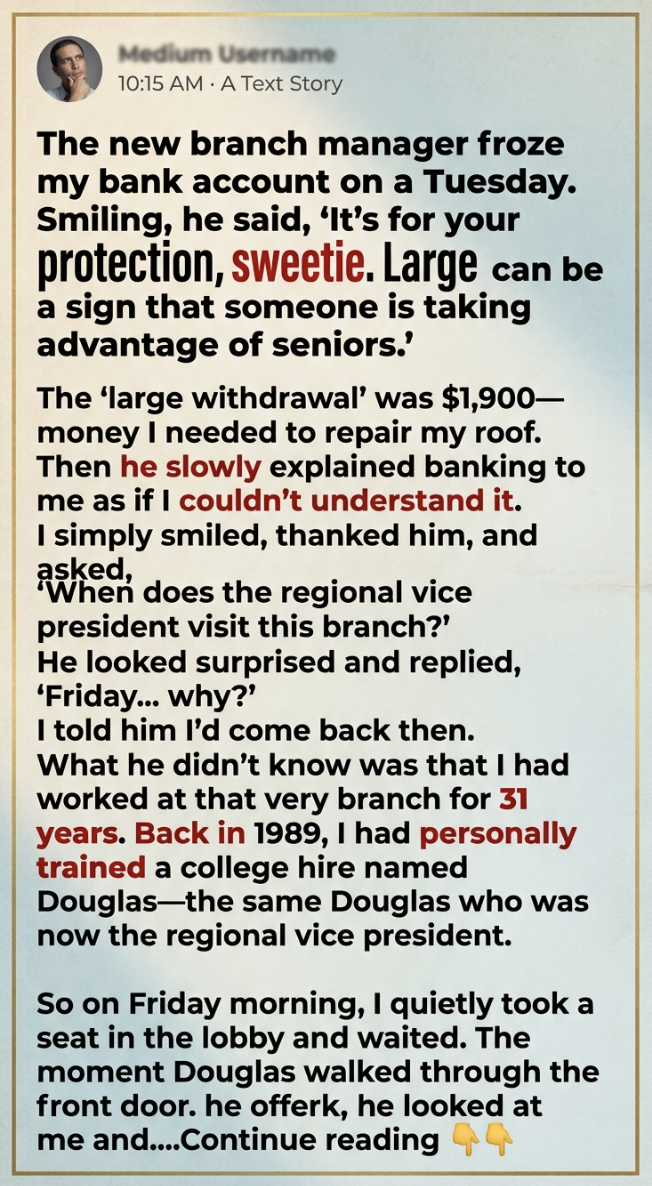
“It’s for your protection, sweetie.”
I immediately disliked the word.
Sweetie.
“I’m sorry?”
“We noticed a large withdrawal request.”
I looked at him.
“$1,900?”
He nodded seriously.
“For someone your age, large withdrawals can sometimes indicate financial exploitation.”
I stared at him.
I had worked in banking for thirty-one years.
I knew exactly what $1,900 meant.
It wasn’t a large withdrawal.
It was a routine transaction.
But I didn’t argue.
Instead, I asked calmly,
“Why do you believe I’m being exploited?”
He leaned back.
“Sometimes older customers don’t realize what’s happening with their money.”
I smiled politely.
“Are you suggesting I don’t understand my own account?”
“I’m suggesting we have procedures.”
“Of course.”
He continued explaining basic banking concepts.
He explained checking accounts.
He explained withdrawals.
He explained fraud.
He explained how “people my age” could be manipulated.
I listened quietly.
Then I asked,
“When does the regional vice president visit this branch?”
He looked surprised.
“Friday.”
“Morning?”
“Yes.”
“Thank you.”
He frowned.
“Why?”
“I’ll come back Friday.”
I stood.
He smiled again.
“That’s fine. We’ll discuss it then.”
I left the office.
But I didn’t leave the bank angry.
I left amused.
Because Trevor didn’t know something.
Something he should have learned before speaking to me that way.
I had worked in that building from 1989 until my retirement.
I had helped open accounts.
Processed loans.
Trained employees.
Handled audits.
Solved customer disputes.
And trained a young college graduate named Douglas.
Douglas had arrived in 1989 with a cheap suit, a nervous smile, and absolutely no idea how banking worked.
I remembered his first day.
He had accidentally entered the wrong account number.
I stayed late to teach him how to correct it.
Years later, Douglas became a branch manager.
Then a district manager.
Then a regional vice president.
He had never forgotten where he started.
And he certainly hadn’t forgotten who trained him.
Friday morning came.
I arrived at 8:45.
I sat quietly in the lobby.
Trevor walked past me.
He recognized me.
“Mrs. Harrison.”
I smiled.
“Good morning.”
He looked nervous.
“You came early.”
“I wanted to see Douglas.”
He nodded.
“Yes. He’ll be here.”
I simply smiled.
At 9:12, the glass doors opened.
Douglas walked inside.
He was older now.
His hair was gray.
But I recognized him immediately.
He stopped.
His eyes widened.
“Margaret?”
I stood.
“Hello, Douglas.”
He stared at me for a second.
Then he smiled.
“You trained me.”
I laughed.
“Thirty-seven years ago.”
He walked straight toward me and hugged me.
Trevor stood behind his desk watching.
Douglas turned toward him.
“Why didn’t you tell me she was here?”
Trevor looked confused.
“She was a customer who had a withdrawal issue.”
Douglas’s expression changed.
“Customer?”
He looked at me.
“Margaret worked here.”
Trevor froze.
Douglas continued.
“She trained half the staff in this region.”
The lobby became silent.
I could see the color leaving Trevor’s face.
Douglas looked at him.
“What’s going on?”
Trevor began explaining.
“Mrs. Harrison requested a $1,900 withdrawal. Given her age, I thought—”
Douglas interrupted.
“Her age?”
Trevor stopped.
Douglas’s voice became firm.
“Did you freeze her account?”
“Temporarily.”
“Did you have evidence of fraud?”
“No.”
“Did you contact her family?”
“No.”
“Did you have a documented exploitation concern?”
Trevor hesitated.
“No.”
Douglas looked at me.
“Why was the account frozen?”
I answered calmly.
“He said it was for my protection.”
Douglas turned back to Trevor.
“Protection from what?”
Trevor had no answer.
Douglas asked for the account records.
He reviewed them.
Then he looked at Trevor.
“This customer has maintained accounts here for decades.”
“Yes.”
“Her withdrawal was consistent with her normal financial activity.”
“Yes.”
“She identified the purpose of the withdrawal.”
“Yes.”
“She provided identification.”
“Yes.”
“Then why did you restrict her account?”
Trevor swallowed.
“I was following senior-protection procedures.”
Douglas shook his head.
“No. You were making assumptions.”
He turned toward me.
“Margaret, I’m sorry.”
I smiled.
“Thank you.”
Douglas immediately instructed the staff to remove the restriction.
Then he did something I didn’t expect.
He asked me to join him in the manager’s office.
I followed.
Trevor stood there silently.
Douglas looked at both of us.
“Margaret taught me something when I was twenty-two.”
I smiled.
“What was that?”
He laughed.
“You told me never to confuse caution with judgment.”
I remembered.
“I probably said that.”
“You did.”
He turned toward Trevor.
“And today, you’re going to learn it too.”
Trevor looked embarrassed.
Douglas continued.
“We absolutely protect elderly customers from financial exploitation.”
“That’s good.”
“But protecting customers doesn’t mean treating them like children.”
I nodded.
“Exactly.”
Douglas looked at me.
“Would you like to withdraw your $1,900?”
I smiled.
“Yes, please.”
He walked with me to the counter.
The teller processed the transaction.
I received the cash.
Then Douglas said something that surprised everyone.
“Actually, Margaret, would you mind staying for five minutes?”
“Why?”
“I’d like you to tell our staff what customer service looked like when you worked here.”
I laughed.
“Are you asking me to train your employees again?”
He smiled.
“Just five minutes.”
Five minutes became forty-five.
I talked about listening to customers.
About never making assumptions.
About recognizing genuine fraud without humiliating innocent people.
About treating older customers with dignity.
When I finished, the employees applauded.
Even Trevor clapped.
Afterward, he approached me.
His face was completely different from Tuesday.
“Mrs. Harrison.”
“Yes?”
“I’m sorry.”
I waited.
“I made an assumption about you.”
“Yes, you did.”
“I shouldn’t have spoken to you that way.”
“No.”
He nodded.
“Can you forgive me?”
I smiled.
“I can.”
Then I added,
“But I hope you remember this.”
He looked at me.
“Every person who walks through that door has a story you don’t know.”
He nodded.
“I’ll remember.”
I left the bank with my $1,900.
That afternoon, the roof repair was completed.
The next week, I received a handwritten letter from Douglas.
He thanked me for reminding the branch what customer service really meant.
At the bottom he wrote:
“You trained me in 1989. Apparently, I still have lessons to learn from you.”
I framed the letter.
Years later, people still ask me about that Friday.
I always tell them the same thing.
I didn’t go back to the bank to embarrass the manager.
I didn’t go back to prove I was smarter.
I went back because I wanted someone to understand the difference between protecting someone and disrespecting them.
Age doesn’t erase experience.
And needing help doesn’t mean someone has lost the ability to make decisions.
That young manager thought he was looking at an elderly customer who needed to be taught how banking worked.
What he didn’t realize was that he was standing across the desk from someone who had spent three decades teaching bankers how to treat people.
And the person who finally reminded him of that…
was the very young man I had trained thirty-seven years earlier.
Sometimes you don’t need to raise your voice to make your point.
You just need to sit quietly, wait for the right person to walk through the door—and let the truth introduce you.