The night of my graduation was supposed to be one of the happiest nights of my life.
My grandparents would have been proud.
They had passed away several years earlier, but their presence was everywhere.
Their photograph sat beside my graduation certificate.
My grandmother’s handwriting appeared in the recipe book on the kitchen shelf.
My grandfather’s old watch rested safely in my bedroom.
They had always told me the same thing:
“Education is something nobody can take away from you.”
They had also left me something else.
An inheritance.
A very large one.
Several investments, properties, and financial accounts had eventually been placed under a structure that would become mine when I reached adulthood.
My parents knew about it.
So did my younger sister, Claire.
But my grandparents had always warned me to be careful.
My grandfather once told me,
“Money doesn’t change people.”
“It reveals them.”
I didn’t fully understand what he meant until the months before graduation.
My parents began asking questions.
Not ordinary questions.
Specific questions.
“When exactly do you get control of the inheritance?”
“How much is available?”
“Have you spoken to the bank?”
“Are you planning to keep everything invested?”
My mother asked whether I would consider helping the family purchase a larger home.
My father joked that I could finally “take care of everyone.”
Claire started talking about college expenses.
At first, I didn’t think much of it.
They were my family.
I trusted them.
But one conversation changed everything.
My father asked me to sign several documents.
“Just routine paperwork.”
I read them carefully.
They weren’t routine.
They would have given another person significant authority over several financial decisions.
I refused.
My father became angry.
“It’s your family.”
“I know.”
“Why don’t you trust us?”
I didn’t know how to answer.
Because I wasn’t sure I did anymore.
So during the week of my graduation, I contacted an independent financial adviser and an attorney.
I didn’t tell my family.
Together, we reviewed the inheritance structure.
The safest option was to move the assets into a properly established trust with independent administration and clear protections.
I didn’t do it to punish anyone.
I did it because my grandparents had taught me to protect what they had worked for.
The transfer was completed quietly during the afternoon of my graduation party.
That evening, everyone celebrated.
My mother hugged me.
My father gave a speech.
Claire took photographs.
Everyone looked happy.
My father raised his glass.
“To our daughter.”
“She’s going to take care of this family.”
Everyone laughed.
I smiled.
But I remembered my grandfather’s words.
Money doesn’t change people.
It reveals them.
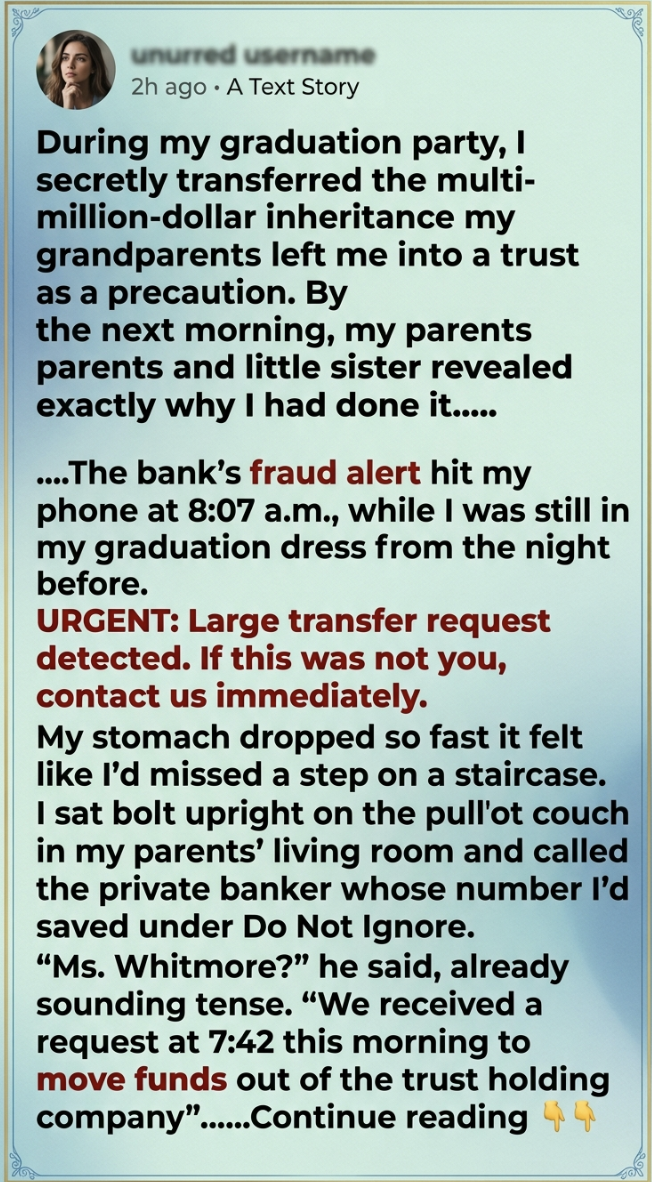
The next morning, I woke up on the couch in my graduation dress.
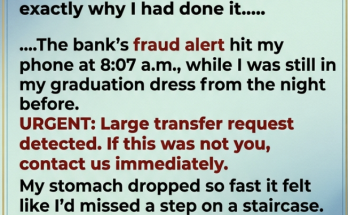
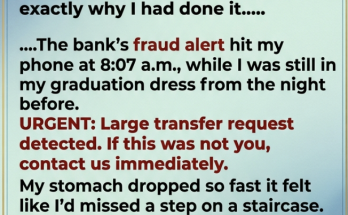
My phone buzzed.
8:07 a.m.
URGENT: LARGE TRANSFER REQUEST DETECTED.
My stomach dropped.
I immediately called my private banker.
“Ms. Whitmore?”
His voice sounded tense.
“We received a request at 7:42 this morning to move funds out of the trust holding company.”
“I didn’t authorize anything.”
“I know.”
“That’s why we’re calling.”
I sat upright.
“How much?”
He told me.
I felt sick.
It was an enormous amount.
“Where was the request sent from?”
“Your family’s home network.”
I looked toward the kitchen.
My parents were asleep upstairs.
Claire was in the guest room.
Someone inside the house had tried to access the account.
The banker asked,
“Who else has access to your financial documents?”
I thought about the documents my father had asked me to sign.
Then I remembered something else.
During the graduation party, my mother had taken my laptop upstairs.
She said she wanted to upload photographs.
I had trusted her.
Now I wasn’t so sure.
I contacted my attorney.
He immediately instructed the bank to freeze the affected accounts while the attempted transfer was investigated.
Then he asked me one question.
“Did anyone know you moved the inheritance into the new trust?”
“No.”
“Think carefully.”
I did.
Only three people knew.
My attorney.
My financial adviser.
And me.
But someone had apparently discovered it.
We reviewed the login records.
There had been several unsuccessful attempts during the night.
Then, at 7:42 a.m., someone submitted a transfer request.
The request contained information that wasn’t publicly available.
My attorney contacted the bank’s fraud department.
They traced the digital activity to a device connected to my father’s office.
My hands went cold.
I didn’t want to believe it.
My father came downstairs.
He looked at me.
Then noticed the attorney sitting at the dining table.
“What happened?”
I looked at him.
“Someone tried to transfer the inheritance.”
His expression changed.
“What?”
“The bank traced the request to your computer.”
Silence.
My mother walked into the room.
She looked confused.
Then frightened.
Claire appeared behind her.
Nobody spoke.
Finally, my father said,
“I didn’t do that.”
The bank’s investigation continued.
It turned out my father had not personally submitted the request.
Claire had.
She had used information stored on the family computer to attempt to access the account.
But there was another layer.
My mother had been helping her.
Claire had found copies of my financial documents and believed she could move the money before the new trust protections fully took effect.
They had assumed the inheritance was still held in the original structure.
They didn’t realize the transfer had already been completed.
My father admitted that he had encouraged them to “find out what was available.”
He insisted he never intended to steal anything.
But the evidence showed otherwise.
They had prepared documents.
Opened accounts.
And discussed transferring money into accounts they controlled.
My attorney looked at me.
“You were right to protect the assets.”
I looked at my family.
My mother was crying.
Claire wouldn’t look at me.
My father finally whispered,
“We’re still your family.”
I nodded.
“I know.”
“That’s why this hurts.”
The legal process took months.
The attempted transfer was stopped.
The bank secured the accounts.
The trust remained intact.
My parents eventually agreed to cooperate with the investigation.
Claire apologized.
Not immediately.
But eventually.
She admitted that she had convinced herself the money was “family money.”
I told her something my grandfather had once told me.
“An inheritance can be shared.”
“But it cannot be taken.”
Our relationship changed after that.
For a long time, I kept my distance.
I didn’t want to punish anyone.
I simply needed boundaries.
Eventually, my mother and I began speaking again.
My father sent me a letter.
He didn’t ask for money.
He didn’t ask me to forgive him.
He wrote:
“Your grandfather warned me about this years ago.”
“He told me that if I ever became more interested in your inheritance than your happiness, I’d lose my daughter.”
“I didn’t listen.”
“I’m sorry.”
I kept the letter.
Not because everything was suddenly fixed.
But because it was the first honest thing he had said about the situation.
Years later, I still remember that graduation morning.
The fraud alert.
The phone call.
The fear.
The realization that the people closest to me had been planning around money they didn’t own.
But I also remember something else.
My grandparents didn’t leave me millions simply to make me wealthy.
They left me a responsibility.
To protect what they built.
To make wise decisions.
And to understand that love and financial trust are not always the same thing.
Today, the inheritance remains protected.
I use part of it to support education programs in my grandparents’ names.
Every year, scholarships are given to students who remind me of the person I was before I knew how complicated money could become.
At the scholarship ceremony, I often tell them:
“Never let money decide who you are.”
“And never let fear prevent you from protecting what matters.”
My grandparents taught me that wealth is temporary.
Family can be complicated.
Trust must be earned.
And sometimes…
The hardest lesson comes from discovering that the people you expected to protect you were the very people you needed protection from.
That graduation weekend was supposed to mark the beginning of my adult life.
Instead, it taught me the first lesson of adulthood:
You can love your family deeply while still protecting yourself from their worst decisions.
And sometimes the most important inheritance isn’t the money someone leaves you.
It’s the wisdom they leave behind.