I had never thought much about my adoption.
My parents had always been honest with me.
They told me I had been adopted when I was very young.
They never made it sound like something shameful.
They simply said,
“Your story started before we met you.”
I loved them.
They were my parents in every way that mattered.
Still, there had always been one unanswered question in the back of my mind.
Who was my biological mother?
I knew almost nothing.
I had been adopted through a private agency in 1987.
My adoptive parents had paid approximately $12,000 in fees and expenses.
The agency closed several years later.
The records available to my family were limited.
I had a birth certificate.
A few medical documents.
And almost no information about my biological family.
So I eventually stopped searching.
Then, on an ordinary Saturday afternoon, everything changed.
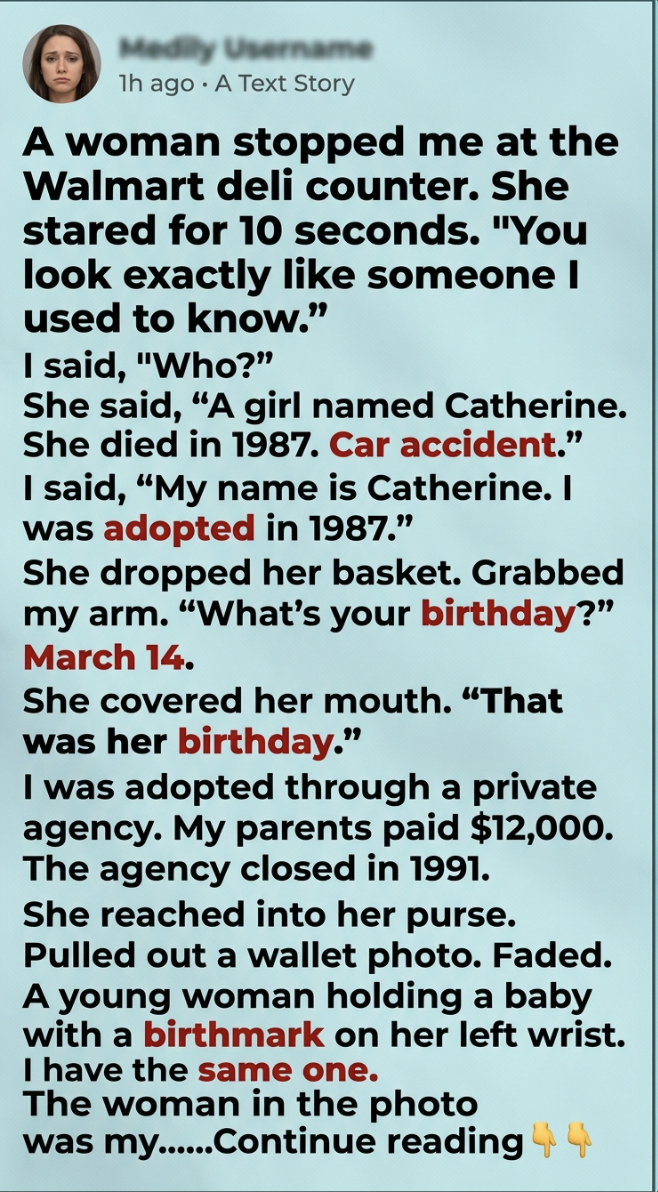
I was standing at the Walmart deli counter waiting for my order when an older woman walked past me.
She stopped.
Turned around.
And stared.
Not a quick glance.
Ten full seconds.
Finally, she said,
“I’m sorry.”
“You look exactly like someone I used to know.”
I smiled awkwardly.
“Who?”
She hesitated.
“A girl named Catherine.”
My heart skipped.
“My name is Catherine.”
The woman’s face changed.
“She died in 1987.”
I swallowed.
“How?”
“Car accident.”
There was a long silence.
Then I said something I had never expected to tell a stranger in a grocery store.
“I was adopted in 1987.”
She dropped her basket.
The sound echoed across the deli area.
She grabbed my arm gently.
“What is your birthday?”
“March 14.”
She covered her mouth.
“That was her birthday.”
I felt dizzy.
She looked at me as if she were seeing a ghost.
Then she reached into her purse.
Her hands were shaking.
She pulled out an old leather wallet.
From inside, she removed a faded photograph.
She handed it to me.
I stared at the picture.
A young woman stood beside a hospital bed.
She was holding a newborn baby.
The photograph was old and faded, but the woman’s face was unmistakable.
I looked at the baby.
Then at my own wrist.
There was a small birthmark on the baby’s left wrist.
The same birthmark I had.
My voice disappeared.
“Who is she?”
The woman looked at me through tears.
“Catherine.”
I looked again.
The young woman in the photograph was my biological mother.
The woman standing in front of me was someone I had never met.
She whispered,
“I’m Margaret.”
“I was her best friend.”
I couldn’t speak.
She told me that Catherine had given birth to a baby girl in early 1987.
She had named her Catherine after herself.
Margaret had visited her in the hospital.
She remembered the birthmark.
She remembered Catherine holding the baby and saying,
“She’s the most beautiful thing I’ve ever seen.”
Then, weeks later, Catherine died in the car accident.
According to the records Margaret had seen at the time, the baby had been placed for adoption.
But there was something Margaret had never understood.
Catherine had been planning to raise her daughter herself.
She had even rented a small apartment.
She had bought a crib.
She had written letters to her daughter.
Then everything changed after the accident.
I asked the question that frightened me most.
“Did my mother know she was going to die?”
Margaret shook her head.
“No.”
“She thought she had her whole life ahead of her.”
That night, I couldn’t sleep.
The next morning, Margaret called me.
She had spent the night searching through old boxes.
She had found letters.
Photographs.
Hospital records.
And one small notebook.
Inside the notebook were several pages written by my biological mother.
The final entry was dated only two weeks before the accident.
“I don’t know what the future will look like.”
“But I know one thing.”
“My daughter will always know she was loved.”
I cried reading those words.
Because for years, I had wondered whether I had been given away because I wasn’t wanted.
Now I knew the truth.
I hadn’t been abandoned.
I had been loved by a young mother whose life ended before she could raise me.
But there was another mystery.
Why had my mother been placed for adoption so quickly?
Margaret helped me contact the attorney who had handled Catherine’s estate.
Most of his files were gone.
But one old storage box remained.
Inside was a copy of the original adoption paperwork.
And there was something unusual.
A handwritten note attached to the file.
It said:
“Family friend requests confidentiality regarding biological father’s identity.”
I stared at it.
“Biological father?”
Margaret looked surprised.
“I never knew who he was.”
We searched.
Eventually, we found a name.
David.
He had been Catherine’s boyfriend.
He had apparently been overseas when she died.
The adoption agency had listed him as unreachable.
But he hadn’t disappeared.
He had simply never been told about the baby.
That discovery led to another search.
David had passed away years earlier.
But his daughter was still alive.
I contacted her.
She agreed to meet.
When she arrived, she carried an old photograph.
She looked at me.
Then smiled.
“My father kept this picture for thirty years.”
She showed it to me.
It was Catherine.
Pregnant.
Smiling.
I had never seen the picture before.
On the back, my biological father had written:
“The day I realized I wanted to become a father.”
I cried again.
For the first time, I had pieces of both sides of my biological family.
My mother’s photographs.
My father’s memories.
Letters.
Stories.
A history that had existed before I ever knew it.
But there was one thing I wanted to do more than anything.
I wanted to visit my mother’s grave.
Margaret took me there.
She had maintained the grave for nearly forty years.
There were flowers.
A small stone bench.
And a faded photograph tucked behind the marker.
I knelt down.
I didn’t know what to say.
So I simply whispered,
“Hi, Mom.”
For a long time, I sat there.
Then I placed my hand over the stone.
“I wish you could have met me.”
Margaret stood quietly behind me.
Finally, she said,
“She would have been proud.”
I smiled through tears.
“I think I would have liked her.”
“You would have.”
We laughed.
That strange meeting at Walmart eventually changed my entire understanding of myself.
I didn’t lose the parents who raised me.
I gained another part of my story.
My adoptive parents were still my parents.
They were the ones who stayed up when I was sick.
The ones who taught me to ride a bicycle.
The ones who celebrated every birthday.
The ones who loved me when I was difficult.
And now I also understood the woman who gave me life.
She wasn’t a mystery anymore.
She was Catherine.
She was young.
She was hopeful.
She had dreams.
And she loved her daughter.
Years have passed since that afternoon at Walmart.
Margaret and I still speak regularly.
Every March 14, we celebrate my birthday together.
She brings the same kind of cake Catherine supposedly loved.
And every year, she tells me the same thing:
“Your mother would have been so happy to know you were found.”
I used to think adoption meant I had lost a part of my identity.
Now I see it differently.
My story isn’t about being abandoned.
It’s about being loved by people who knew me at different points in my life.
One family raised me.
Another family gave me my beginning.
And one unexpected woman at a Walmart deli counter gave me the missing chapter.
Sometimes we spend years searching for the people who gave us life…
only to discover that the most important thing they left behind wasn’t a name.
It was proof that we were loved.
And on my mother’s grave, beneath her name and the dates of a life that ended far too soon, I finally understood the sentence she had written before I was old enough to read it:
“My daughter will always know she was loved.”
Now I do.