I almost threw the key tag away.
It looked completely ordinary.
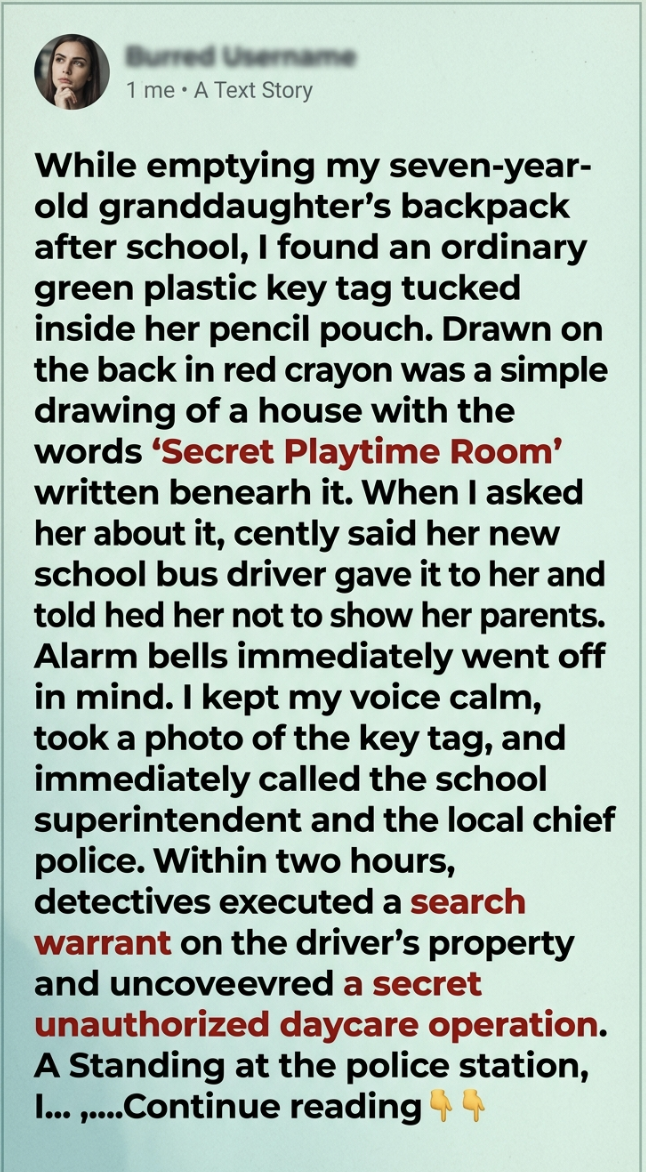
A small green piece of plastic, the kind people use for spare keys.
I found it while emptying my seven-year-old granddaughter Lily’s backpack after school.
She usually came home with drawings, worksheets, and the occasional crushed snack.
That afternoon, however, I noticed something tucked inside her pencil pouch.
I pulled it out.
There was a little house drawn on the back in red crayon.
Underneath it were four words:
SECRET PLAYTIME ROOM
I immediately felt uneasy.
“Lily, where did you get this?”
She looked up from her coloring book.
“My new bus driver gave it to me.”
“Why?”
She shrugged.
“He said it was our special place.”
I kept my voice calm.
“What did he tell you?”
She answered innocently.
“He said I shouldn’t show Mom or Dad because it was a secret.”
That was enough.
I didn’t frighten her.
I didn’t ask leading questions.
I simply told her she had done nothing wrong and that adults should never ask children to keep secrets from their parents or guardians.
Then I took a photograph of the key tag.
I called my daughter.
Then I contacted the school superintendent and the police.
Within hours, investigators began looking into the driver’s background and employment history.
The police eventually obtained a search warrant for his property.
What they found there was deeply concerning.
There was an unauthorized room set up with children’s furniture, toys, school supplies, and several backpacks belonging to students.
There were also lists containing children’s names and information that the driver had no legitimate reason to possess.
The authorities immediately began identifying which families might have been affected.
Standing at the police station later that evening, I watched detectives carry boxes of evidence through the hallway.
My hands were still shaking.
A detective approached me.
“Mrs. Harris?”
“Yes?”
“We need to ask Lily a few questions.”
My heart sank.
“Is she in trouble?”
“No.”
He shook his head firmly.
“She did exactly the right thing.”
That sentence brought tears to my eyes.
Lily was interviewed carefully, with her parent present.
The investigators did not pressure her.
They simply allowed her to explain what she remembered.
She told them that the driver had repeatedly talked about a “special room” where selected children could play.
She also remembered being told not to mention it at home.
That detail became critical.
The investigation eventually revealed that the driver had been using his position to build relationships with children outside the normal boundaries of his job.
He had no authorization to operate any kind of childcare program.
The school immediately suspended his access to students while the investigation continued, and authorities contacted the families whose children may have been approached.
What happened afterward was painful for our community.
Parents were frightened.
Some were angry.
Others blamed themselves.
But the school reminded everyone of something important:
The children were not responsible for what an adult chose to do.
Lily kept asking me one question.
“Grandma, did I do the right thing?”
I hugged her.
“You did exactly the right thing.”
“But I didn’t know it was bad.”
“That’s okay.”
“You told us what happened.”
“That’s what matters.”
A few weeks later, the school introduced new safety procedures.
Bus drivers received additional training.
Parents were reminded that children should never be encouraged to keep secrets from their trusted adults.
And teachers began using a simple distinction with students:
Good surprises have an ending. Unsafe secrets are never a child’s responsibility to carry.
For example, keeping a birthday present secret for a short time can be fun.
But if an adult says, “Don’t tell your parents,” especially about a private place, meeting, gift, message, or activity, a child should know they can tell a trusted adult immediately.
Lily eventually stopped thinking about the green key tag.
But I never did.
I kept a photograph of it.
Not because I wanted to remember the fear…
But because I wanted to remember what happened after it.
One small object.
One innocent question.
One child who spoke up.
And several adults who listened.
Months later, the superintendent invited our family to a community safety event.
He asked Lily if she wanted to attend.
She did.
Near the end, he thanked her publicly.
Lily looked embarrassed.
Afterward, she whispered to me,
“Grandma, I wasn’t brave.”
I smiled.
“You don’t have to be fearless to do the right thing.”
She thought about that.
Then asked,
“So what was I?”
I squeezed her hand.
“You were honest.”
And sometimes honesty is the bravest thing a child can give an adult.
The investigation continued through the proper legal process, and the authorities handled the case from there.
Our family never learned every detail—and honestly, we didn’t need to.
What mattered was that Lily was safe, listened to, and believed.
That little green key tag taught our entire family a lesson we will never forget:
Children should never have to carry an adult’s secret.
And when a child says something feels strange, the safest response isn’t to dismiss it.
It’s to listen calmly, take it seriously, and make sure the right adults know.
Because sometimes…
A child’s simple sentence—
“He told me not to tell you”
—is the moment when an entire truth finally comes to light.