For thirty-four years, I worked as the head custodian at Lincoln Elementary School.
Most people barely noticed me.
I unlocked the doors before sunrise.
Fixed broken desks.
Cleaned muddy hallways after rainy days.
Changed light bulbs.
Shoveled snow in winter.
To most people, I was simply “Mr. Rivera.”
The man with the janitor’s keys.
But children notice things adults often miss.
They notice who smiles at them every morning.
Who remembers their names.
Who quietly asks if they’re okay after a difficult day.
After enough years, I learned something heartbreaking.
Every Friday afternoon, several students rushed to drink extra milk in the cafeteria.
Some wrapped leftover crackers inside napkins.
Others quietly asked classmates if they were going to finish their apples.
At first, I thought they were simply hungry.
Later, I learned the truth.
Many of them depended on free school meals.
Once school ended Friday afternoon…
They often had very little to eat until Monday morning.
I couldn’t stop thinking about it.
I met with administrators.
I proposed a simple weekend food program.
The answer was polite but firm.
“Liability concerns.”
“Budget limitations.”
“Storage regulations.”
I understood the policies.
But policies didn’t quiet an empty stomach.
So I made a decision.
Every Thursday evening after work, I visited the grocery store.
Bread.
Peanut butter.
Turkey.
Cheese.
Fruit.
Granola bars.
Juice boxes.
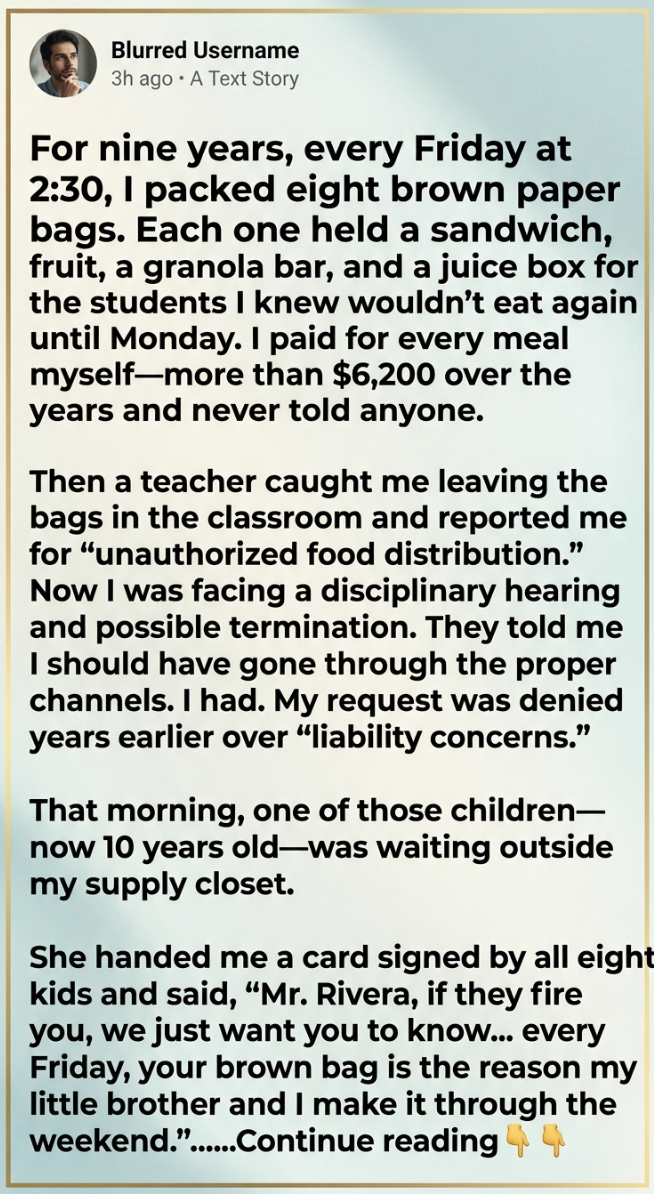
Every Friday afternoon at exactly 2:30, after most teachers had gone home, I quietly placed eight brown paper bags inside a storage cabinet near the classrooms.
Nothing fancy.
Just enough food to help a child make it through the weekend.
I never asked anyone to thank me.
I never kept a list.
I never wanted recognition.
Over nine years, I spent more than $6,200 from my own paycheck.
It wasn’t charity.
It simply felt like the right thing to do.
Children shouldn’t spend weekends wondering where their next meal would come from.
Everything remained quiet until one Friday.
A new teacher saw me carrying the bags.
She asked what I was doing.
I smiled and explained.
The following Monday, I was called into the principal’s office.
Someone had reported me for violating district policy.
“Unauthorized food distribution.”
A formal disciplinary hearing was scheduled.
Possible suspension.
Possible termination.
I wasn’t angry with the teacher.
She believed she was following the rules.
Still…
The thought of losing the only job I’d ever loved hurt deeply.
The morning of the hearing, I arrived early.
As I unlocked my supply closet, I heard a small voice behind me.
“Mr. Rivera?”
I turned around.
It was Lily.
Ten years old.
One of the children who had quietly picked up a brown bag every Friday for years.
She held a handmade card decorated with colorful markers and tiny handprints.
“What’s this?”
She smiled nervously.
“We heard you might get fired.”
Inside the card were dozens of signatures.
Not only from the eight children receiving food…
But from classmates who had quietly learned what those bags meant.
At the bottom, written in careful handwriting, were words I will never forget.
“Mr. Rivera…”
“If they fire you…”
“Please remember…”
“Every Friday, your brown bag is the only reason my little brother and I have enough to eat until school starts again.”
“Thank you for never letting us feel forgotten.”
By the time I reached the hearing room, my hands were shaking.
The school board members sat in a long row.
Policies.
Reports.
District regulations.
Everything looked painfully official.
The superintendent began.
“Mr. Rivera…”
“Do you acknowledge distributing food without authorization?”
“Yes.”
“Did you understand this violated district policy?”
“Yes.”
“Then why continue?”
I reached into my jacket.
Placed the handmade card on the table.
“I’d like you to read this first.”
Silence filled the room.
One by one, board members quietly read every page.
Some wiped away tears.
Then something unexpected happened.
The principal stood.
“I need to say something.”
He looked toward the board.
“Nine years ago, Mr. Rivera asked permission to start a weekend meal program.”
“I denied it.”
“I believed I was protecting the district.”
He paused.
“I now believe I failed those children.”
Another voice spoke.
It was the cafeteria manager.
“I’ve watched him buy groceries every Thursday for years.”
“I knew exactly what he was doing.”
“I simply never had the courage to help.”
One teacher stood next.
Then another.
Within minutes, nearly every employee in the room was sharing stories.
How Mr. Rivera quietly paid for winter coats.
Repaired bicycles after school.
Bought notebooks for families who couldn’t afford supplies.
Never asking for credit.
Never telling anyone.
When the meeting ended, the superintendent looked at me.
“Mr. Rivera…”
“You broke policy.”
He paused.
“But you reminded us why schools exist in the first place.”
Instead of terminating my employment…
The district unanimously approved something entirely new.
A permanent Weekend Backpack Program.
Funded by community donations.
Local grocery stores partnered with the schools.
Churches volunteered.
Retired teachers organized food packing.
Within six months, eight children became eighty-three.
By the second year, more than three hundred students received weekend meals every Friday.
None of the bags carried my name.
That’s exactly how I wanted it.
Five years later, after I retired, I received an invitation to speak at the program’s anniversary celebration.
I almost declined.
Then I noticed one name listed among the speakers.
Lily.
Now a college student studying pediatric nursing.
She stood before the audience holding one familiar brown paper bag.
“I still remember opening this every Friday.”
“My little brother thought Mr. Rivera was magic.”
“He never knew groceries cost money.”
“He only knew someone cared.”
She smiled through tears.
“Because one man refused to let eight children go hungry…”
“I grew up believing kindness still existed.”
After the applause ended, she handed me something wrapped in brown paper.
Inside was a small wooden plaque.
It simply read:
“The contents of your bag lasted two days.
The kindness inside it lasted a lifetime.”
Today, that plaque hangs above my kitchen table.
People often ask whether I regret risking my job.
I always answer the same way.
Rules matter.
Policies matter.
But compassion matters too.
Sometimes the greatest changes begin with one person quietly refusing to look away from someone else’s pain.
I never intended to start a movement.
I only wanted eight children to have enough food for the weekend.
The meals were simple.
A sandwich.
A piece of fruit.
A granola bar.
A juice box.
But what those children really carried home each Friday wasn’t just food.
It was hope.
And sometimes…
Hope is the most nourishing thing we can ever place inside a brown paper bag.