For twenty-seven years, I believed my husband and I were partners.
We built everything together.
Our first apartment had peeling wallpaper and a leaking ceiling.
Our first home came after years of overtime, skipped vacations, and careful budgeting.
Every dollar we earned carried a memory.
Every improvement to our house represented another sacrifice we had made together.
I trusted him completely.
So when he walked into the kitchen one Tuesday evening carrying a folder, I barely looked up from preparing dinner.
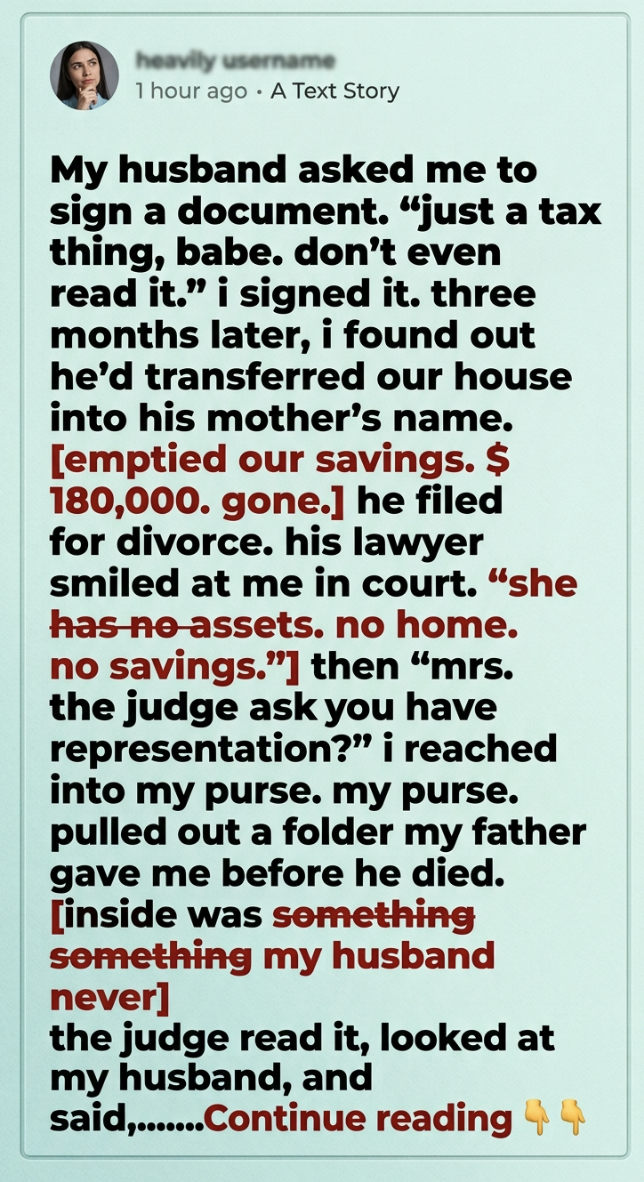
“Just a tax document, babe.”
He smiled casually.
“Nothing exciting.”
“Sign here.”
I laughed.
“You know I hate paperwork.”
“Exactly.”
“That’s why I’m handling it.”
He pointed where I should sign.
I didn’t read a single page.
I signed.
Then life continued as usual.
Or so I thought.
Three months later, everything changed.
I came home from work and found several unopened bank notices on the kitchen counter.
One letter mentioned an account I didn’t recognize.
Another stated that our joint savings account had been closed.
Confused, I logged into our online banking.
Balance:
$0.00
I refreshed the page.
Again.
Still zero.
Nearly $180,000 had disappeared.
My hands began shaking.
I called my husband.
No answer.
An hour later, he walked through the front door carrying a suitcase.
“I’m leaving.”
I stared at him.
“What?”
He looked strangely calm.
“I’ve already filed for divorce.”
“I think it’s better this way.”
I couldn’t even process his words.
“Our savings?”
“I transferred them.”
“The house?”
He looked away.
“My mother owns it now.”
I felt as though the room had disappeared beneath my feet.
“The paperwork you signed…”
“It authorized the transfer.”
I could barely breathe.
“You tricked me.”
“I asked you to read it.”
“You chose not to.”
Those words haunted me.
Within weeks, I found myself sitting in a courtroom I never imagined entering.
His attorney stood confidently before the judge.
“My client legally owns no marital residence.”
“The remaining funds were transferred before separation.”
“The petitioner has no substantial assets.”
He smiled politely toward me.
“Mrs. Reynolds possesses no house, no savings, and no legal claim.”
I sat alone.
No attorney beside me.
The judge adjusted his glasses.
“Mrs. Reynolds…”
“Do you have legal representation?”
I slowly stood.
“No, Your Honor.”
The courtroom grew quiet.
“But…”
I opened my purse.
Removed a worn leather folder.
The same folder my father had handed me six months before he passed away.
I remembered his exact words.
“I hope you never need this.”
“But if someone you trust ever turns your honesty against you…”
“Open it.”
Until that morning…
I never had.
I handed the folder to the bailiff.
The judge carefully opened it.
Inside were several notarized documents.
A property agreement.
Financial records.
And one sealed handwritten letter from my father.
The judge silently read every page.
Then looked directly at my husband.
His expression changed completely.
“Mr. Reynolds…”
“Were you aware your father-in-law retained an ownership interest in the original property purchase?”
My husband’s face turned pale.
“What?”
The judge continued.
“The down payment for this residence was provided entirely by Mrs. Reynolds’ father.”
“The funds were documented as a protected family investment rather than a personal gift.”
My husband stared at his attorney.
The attorney looked equally surprised.
The judge continued reading.
“The agreement further states that any transfer of ownership requires written notification to all recorded financial stakeholders.”
He looked up.
“Which did not occur.”
My husband’s confidence disappeared.
The judge wasn’t finished.
“There is also evidence that the transfer documents signed by Mrs. Reynolds failed to clearly disclose their legal purpose.”
He closed the folder.
“This court has significant concerns regarding informed consent.”
Over the following weeks, forensic accountants examined years of financial records.
What they discovered shocked everyone.
The $180,000 hadn’t disappeared.
Most of it had been moved through several accounts controlled by my husband’s mother.
Additional transfers had occurred months before he filed for divorce.
Several signatures were inconsistent.
The judge ordered every transaction reviewed.
Eventually, the court ruled that multiple transfers had violated financial disclosure requirements during the dissolution of the marriage.
The property transfer was set aside pending proper legal proceedings.
The savings were frozen until an equitable division could be completed.
Instead of walking away with everything…
My husband found himself explaining years of hidden financial activity.
Months later, the divorce finally concluded.
I kept my share of the assets.
More importantly…
I kept my dignity.
After everything was over, I returned to my childhood home.
My father’s workshop remained exactly as he had left it.
On the workbench sat the old toolbox he carried for forty years.
Inside, beneath a layer of neatly arranged tools, I found another envelope addressed to me.
Inside was one short note.
“Trust is beautiful.”
“Blind trust is dangerous.”
“Love should never require you to surrender your understanding.”
I cried harder reading those words than I had during the entire divorce.
Because I finally understood what he had been trying to teach me.
Months later, I received an unexpected phone call.
It was my former mother-in-law.
She sounded exhausted.
“I didn’t know.”
“I believed my son.”
“When I realized what had happened…”
“I signed everything back.”
“I’m sorry.”
For the first time since everything began…
I believed someone.
Not because of paperwork.
Not because of promises.
Because her actions matched her words.
Today, I live in a smaller home.
I own fewer things.
But I sleep peacefully.
People often ask if I regret trusting my husband.
I tell them no.
Trust wasn’t my mistake.
Deception was his.
The lesson wasn’t to stop trusting people.
The lesson was to understand what you’re signing, ask questions without guilt, and remember that healthy love never pressures someone into blind agreement.
My father gave me far more than a folder full of legal documents.
He gave me wisdom that protected me when he no longer could.
And every time I see that worn leather folder resting safely in my desk drawer, I’m reminded of one simple truth:
The greatest inheritance a parent can leave behind isn’t money or property.
It’s the wisdom that helps their children stand back up when life tries to knock them down.