For as long as I could remember, Sunday belonged to my mother.
Even after she moved into an assisted living community, I never broke that tradition.
Every Sunday morning, I bought her favorite blueberry muffins, filled a small thermos with coffee exactly the way she liked it, and drove forty minutes across town.
She always waited near the front window.
The moment she saw my car, she’d smile like I was still ten years old coming home from school.
Those Sundays became our little tradition.
We talked about family.
Old memories.
Her garden.
The grandchildren.
Sometimes we didn’t say much at all.
We simply sat together.
After she developed early dementia, those visits mattered even more.
Even on days she forgot what month it was, she never forgot that Sundays were “our day.”
Then life became complicated.
A major project at work required months of travel.
I still called every week, but the nurses often told me,
“She’s resting.”
“She’s in therapy.”
“Today isn’t a good day.”
I trusted them.
I trusted my sister Janet, who had offered to help coordinate our mother’s care while I was away.
She assured me everything was fine.
“Mom asks about you.”
“I tell her you’re busy.”
“I’ll let you know if anything changes.”
I believed her.
Fourteen months later, my schedule finally settled.
The first thing I did was buy blueberry muffins and drive to see Mom.
The receptionist looked at her computer.
Then frowned.
“I’m sorry.”
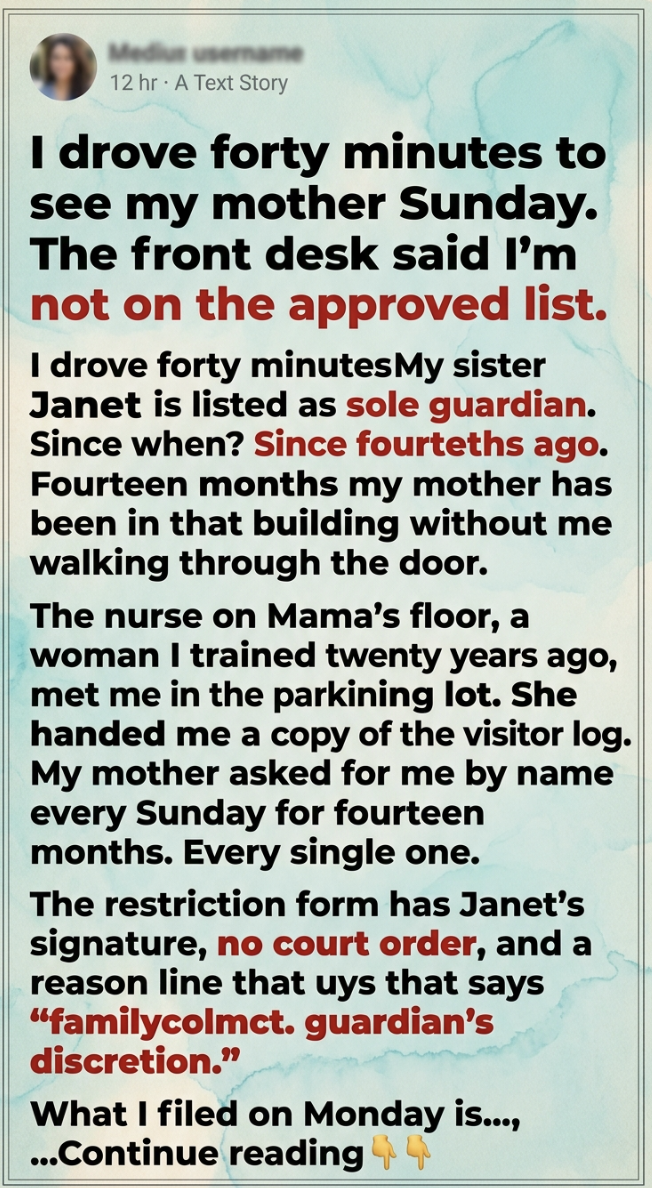
“You’re not on the approved visitor list.”
I smiled politely.
“There must be a mistake.”
She shook her head.
“The only authorized family guardian is Janet.”
I stared at her.
“Since when?”
She checked the records.
“Fourteen months ago.”
The words hit me like a punch.
“Fourteen months?”
She nodded apologetically.
“I can’t override the restrictions.”
I walked back toward my car completely numb.
Just as I reached the parking lot, someone quietly called my name.
“Emily?”
I turned around.
Standing beside the employee entrance was Karen.
Twenty years earlier, I had trained her during her first year as a nursing assistant.
Now she supervised the memory care unit.
She glanced around carefully.
“Walk with me.”
Once we were out of sight, she handed me several photocopied pages.
“I probably shouldn’t do this.”
“But your mother deserves better.”
They were visitor logs.
Every Sunday…
My mother’s name appeared.
Beside it, the same handwritten request.
“Has Emily come yet?”
“Is my daughter here?”
“Maybe she’s running late.”
Every single Sunday.
For fourteen months.
Tears blurred the pages.
Karen spoke softly.
“She never stopped asking.”
I could barely breathe.
“Why wasn’t I called?”
Karen hesitated.
“Because someone instructed us not to.”
She handed me one more document.
It was the restriction form.
Signed only by Janet.
Reason for restriction:
Family conflict. Guardian’s discretion.
No judge’s signature.
No court order.
No physician recommendation.
Nothing.
Just Janet’s signature.
That night, I didn’t sleep.
Monday morning at 8:00 a.m., I met with an elder law attorney.
After reviewing everything, he looked up.
“Your sister may have exceeded her legal authority.”
“What do we do?”
He smiled.
“We start by asking the court some questions.”
Within days, we filed an emergency petition requesting an independent review of my mother’s guardianship arrangements and immediate restoration of family visitation.
The judge scheduled a hearing.
Janet looked shocked when she saw me in the courtroom.
“You hired a lawyer?”
“I hired the truth.”
During the hearing, the judge asked one simple question.
“What evidence justified prohibiting your sister from visiting?”
Janet hesitated.
“Family disagreements.”
“Specifics?”
Silence.
The judge turned toward the facility administrator.
“Did Mrs. Collins ever express that she wished to stop seeing her daughter?”
The administrator looked uncomfortable.
“No.”
“In fact…”
He glanced at the visitor logs.
“She requested her every Sunday.”
The courtroom became silent.
Then Karen testified.
She described watching my mother wait near the window week after week.
She described the disappointment each time visiting hours ended.
By the end of the hearing, even Janet couldn’t hold back tears.
“I thought I was protecting Mom.”
The judge looked at her kindly.
“Protecting someone never means isolating them from the people they love.”
The court immediately restored my visitation rights.
It also ordered an independent review of all future decisions regarding my mother’s care.
That following Sunday, I carried blueberry muffins through the front entrance once again.
This time, no one stopped me.
Mom sat near the same window.
When she saw me, her eyes filled with tears.
“There you are.”
“I knew you’d come.”
I knelt beside her chair.
“I’m sorry it took me so long.”
She gently touched my face.
“I saved your favorite seat.”
As if no time had passed at all.
Months later, Janet finally asked if we could have coffee.
She looked exhausted.
“I was overwhelmed.”
“I thought if only one person made decisions, everything would be easier.”
I listened quietly.
She looked down.
“But somewhere along the way…”
“I stopped asking what Mom wanted.”
Instead…
“I started deciding for her.”
That was the first truly honest conversation we’d had in years.
Healing wasn’t immediate.
Trust rarely returns overnight.
But slowly, our family began rebuilding what pride had nearly destroyed.
Today, Janet and I visit Mom together every other Sunday.
Sometimes Mom remembers both of us.
Sometimes she remembers neither.
But every visit ends exactly the same way.
She squeezes our hands and smiles.
“My girls came.”
And somehow…
That’s enough.
Looking back, I often think about how easily one signature almost erased fourteen months of love.
Not because the law allowed it.
But because no one questioned it.
Families don’t always fall apart through loud arguments.
Sometimes they drift apart through quiet decisions made without conversation.
Through assumptions.
Through pride disguised as protection.
If there’s one lesson I carry from that painful season, it’s this:
Never let paperwork replace compassion.
Never let authority silence love.
And never assume someone who cannot always speak for themselves has stopped needing the people who love them.
Because my mother never stopped waiting.
Every single Sunday.
And I’ll spend the rest of my life making sure she never has to wait for me again.