For thirty-one years, I believed my husband and I had built a life that could survive anything.
We weren’t rich when we married.
We started with an old pickup truck, a tiny apartment, and more dreams than money.
We worked hard.
Raised two children.
Paid off the mortgage.
Built a business together.
Every success we celebrated belonged to both of us.
Or so I believed.
Three weeks before his sixty-third birthday, everything changed.
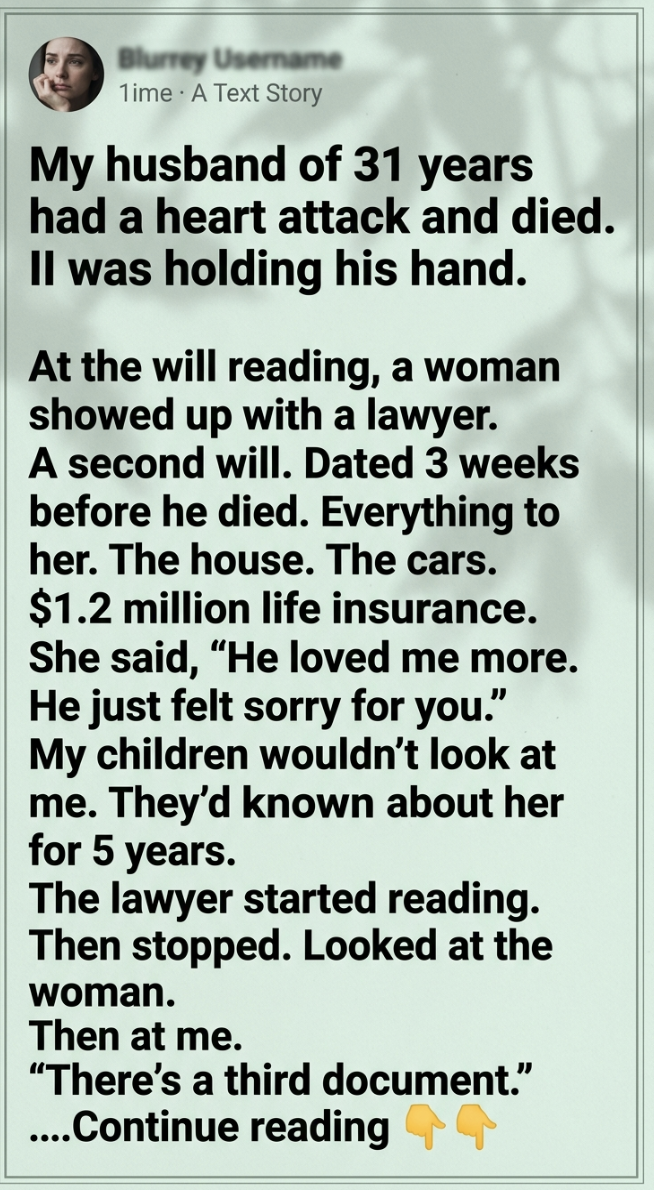
My husband, Daniel, suffered a massive heart attack while we were eating breakfast.
I called for an ambulance.
Held his hand.
Whispered that I loved him.
He squeezed my fingers once…
Then he was gone.
The weeks that followed felt like walking through heavy fog.
I barely slept.
I couldn’t bear to throw away his slippers still sitting beside our bed.
Even hearing his favorite song on the radio made me cry.
Then came the day our family gathered at the attorney’s office.
I expected paperwork.
Nothing more.
Instead, the receptionist quietly opened the door and announced another appointment.
A woman walked in.
Elegant.
Confident.
About twenty years younger than me.
She wasn’t alone.
A lawyer followed closely behind her.
She sat without asking permission.
“My client has a more recent will.”
The room fell silent.
Daniel’s attorney frowned.
“A more recent will?”
The younger lawyer slid a sealed folder across the table.
Signed.
Witnessed.
Dated only three weeks before Daniel’s death.
According to that document…
Everything belonged to her.
The house.
The vacation cabin.
The cars.
Investment accounts.
Even the $1.2 million life insurance policy.
My hands shook so badly I could barely breathe.
The woman folded her arms calmly.
“He loved me.”
“He stayed with you because he felt guilty.”
“You should let go gracefully.”
Then I looked at my children.
Neither of them looked at me.
Finally, my son whispered,
“We found out about her years ago.”
My heart broke all over again.
“You knew?”
My daughter quietly nodded through tears.
“For five years.”
“We begged Dad to tell you.”
“He said he would.”
“He never did.”
I couldn’t speak.
Thirty-one years.
Reduced to silence.
Daniel’s attorney adjusted his glasses.
He looked troubled.
He slowly opened Daniel’s original estate file.
Then paused.
His expression changed.
He looked toward the younger woman.
Then back at me.
“I’m sorry.”
“I almost forgot.”
“There is one final document.”
The room became perfectly still.
It wasn’t another will.
It wasn’t even addressed to the court.
Across the envelope, in Daniel’s handwriting, were the words:
“To be opened only if there is disagreement about my estate.”
The attorney carefully unfolded several pages.
“This document was signed on the same day as the second will.”
Everyone leaned forward.
The attorney began reading.
“If this letter is being read…”
“Then my greatest fear has come true.”
“Someone is trying to use my illness to take advantage of my family.”
The younger woman suddenly shifted nervously in her chair.
The attorney continued.
“Three weeks ago, I was diagnosed with severe memory impairment following repeated strokes.”
“Because of my condition, I instructed my attorney to investigate any legal documents signed during that period.”
The younger lawyer interrupted.
“My client has a valid document.”
Daniel’s attorney calmly raised another folder.
“I wasn’t finished.”
Inside were medical reports.
Neurological evaluations.
And security camera photographs.
The attorney continued reading.
“If a newer will appears, it was almost certainly signed during a period when my doctors documented that I was legally incapable of understanding financial decisions.”
The room went completely silent.
Then came the final sentence.
“The only estate plan reflecting my true wishes is the one created six months earlier.”
Daniel’s attorney opened another folder.
The valid will.
This one left everything exactly as we had planned together years before.
Half to me.
The rest equally divided between our children.
One additional page remained.
It was addressed personally to me.
“Margaret…”
“I failed you.”
“Not because I stopped loving you.”
“Because I became too ashamed to admit how badly I had damaged our marriage.”
“I should have confessed everything years ago.”
“Instead, I convinced myself I had more time.”
“I was wrong.”
“If you can forgive me, I hope you’ll remember the man I spent thirty years trying to be—not the mistakes I made near the end.”
No one spoke.
The younger woman’s attorney quietly closed his briefcase.
Within weeks, investigators uncovered the full story.
The second will had been prepared after Daniel’s illness had already affected his judgment.
Several financial transfers had also been made without proper authorization.
The court declared the document invalid.
The younger woman eventually settled the remaining legal disputes and disappeared from our lives.
Months passed.
Healing came slowly.
One Sunday afternoon, my son came to visit.
He sat across from me at the kitchen table.
“I’m sorry.”
“I should’ve told you.”
I looked into his eyes.
“I know.”
“I was afraid.”
“So was your sister.”
“We thought telling you would destroy the family.”
I reached across the table and took his hand.
“The truth doesn’t destroy families.”
“Secrets do.”
That sentence changed all of us.
Over the following year, we attended family counseling together.
Not because we wanted to erase the past.
But because we refused to let it define our future.
On what would have been Daniel’s sixty-fourth birthday, the four of us gathered at his favorite lake.
We scattered wildflower seeds instead of ashes.
The grandchildren laughed nearby.
For the first time in a long while, the day felt lighter.
Before leaving, I quietly read Daniel’s final letter one last time.
Then folded it carefully and placed it back inside its envelope.
Not because I wanted to remember the betrayal.
But because I wanted to remember the lesson.
Love cannot survive where honesty disappears.
Silence protects no one.
And forgiveness does not mean pretending someone never hurt you.
It means refusing to let their mistakes become the final chapter of your own story.
Today, people sometimes ask how I managed to move forward after everything that happened.
I tell them this:
Thirty-one years of marriage cannot be summarized by one terrible decision.
People are complicated.
They can love deeply and still fail the people they love.
That doesn’t excuse betrayal.
But it reminds us that one person’s worst mistake does not have to become another person’s permanent prison.
The greatest inheritance Daniel ultimately left me wasn’t the house, the insurance, or the savings.
It was the courage to choose truth over bitterness, peace over revenge, and hope over the heartbreak that almost convinced me my life was over.
Because sometimes, the most important document isn’t the last will.
It’s the last honest letter someone leaves behind.