For twelve years, I believed my husband and I were building a future together.
We started with almost nothing.
A tiny apartment with peeling wallpaper.
One old car that broke down every other month.
Countless nights eating inexpensive dinners while dreaming about the life we hoped to create.
I supported him while he earned promotions.
I worked two jobs when money was tight.
I celebrated every success as though it belonged to both of us.
When he finally became a senior executive, I thought we had reached the finish line together.
Instead, that was the day everything fell apart.
One evening, he came home unusually quiet.
He placed divorce papers on the dining table.
“I’ve met someone.”
The words hurt enough.
But what came next stayed with me for years.
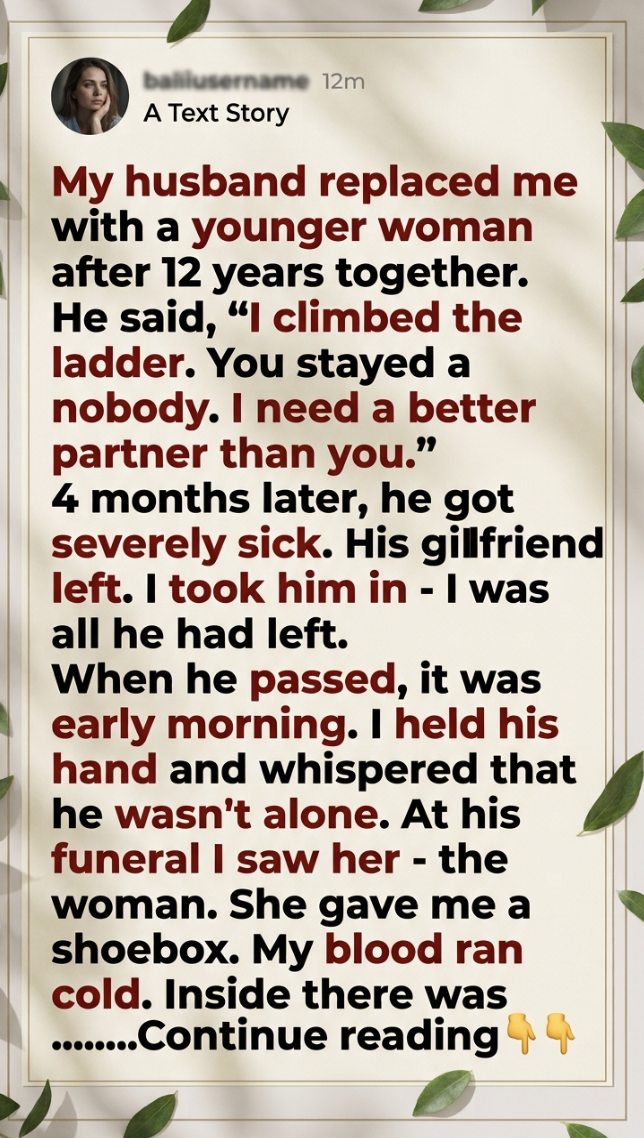
“I’ve climbed the ladder.”
“You never did.”
“I need a partner who fits the life I have now.”
His new girlfriend was nearly twenty years younger.
Elegant.
Confident.
Successful.
Within weeks, he moved into a luxury apartment with her.
Friends stopped calling.
Some quietly chose sides.
I packed away twelve years of photographs and tried to rebuild a life I never expected to lose.
Four months later, my phone rang.
It was a number I didn’t recognize.
A doctor introduced himself.
“There isn’t anyone else to contact.”
My ex-husband had collapsed at work.
Tests revealed an aggressive illness.
He needed long-term treatment.
I assumed his girlfriend would be beside him.
She wasn’t.
She had already packed her belongings and left.
When I visited the hospital, he looked smaller than I remembered.
Not physically.
Emotionally.
“I don’t expect forgiveness,” he whispered.
“I just didn’t want to die alone.”
Despite everything, I couldn’t walk away.
Not because he deserved it.
But because compassion isn’t measured by another person’s mistakes.
I brought him home.
Prepared his meals.
Drove him to appointments.
Sat beside him through sleepless nights.
Sometimes we spoke.
Sometimes we simply watched the rain through the living room window.
One evening, he quietly asked,
“Why are you doing this?”
I smiled sadly.
“Because caring about someone doesn’t disappear the day a marriage ends.”
As the months passed, his health slowly declined.
He apologized often.
Not dramatically.
Just honestly.
“I thought success meant leaving behind everyone who reminded me of where I’d started.”
“I was wrong.”
Near the end, he asked if I would forgive him.
I answered truthfully.
“I forgave you long ago.”
“Forgiveness doesn’t erase pain.”
“It simply refuses to let pain decide the rest of your life.”
Early one autumn morning, I held his hand as the sun rose.
His breathing became slower.
He looked toward the window.
Then back at me.
“Thank you…”
Those were his final words.
He passed away peacefully.
The funeral was small.
Many of his business acquaintances sent flowers.
Very few attended.
As people quietly left the cemetery, I noticed a familiar face standing alone beneath an old maple tree.
His former girlfriend.
She looked nothing like the confident woman I remembered.
She walked toward me carrying a worn shoebox.
“I think this belongs to you.”
Before I could ask what she meant, she placed it into my hands.
Then quietly walked away.
Inside were dozens of sealed envelopes.
Each carried my name.
None had ever been mailed.
Confused, I opened the first one.
It was dated three years before our divorce.
“Today you brought me soup when I worked too late.”
“I forgot to thank you.”
Another.
“You stayed awake until midnight helping me prepare for tomorrow’s presentation.”
“I couldn’t have done it without you.”
Another.
“I’m scared that success is changing me.”
“Sometimes I barely recognize myself.”
The letters continued year after year.
Each one contained words he had never spoken aloud.
Gratitude.
Regret.
Fear.
Love.
At the very bottom of the box rested one final envelope marked:
“Only if I’m gone.”
With trembling hands, I opened it.
“If you’re reading this…”
“Then I ran out of time to become the man you deserved.”
“I spent years believing ambition required leaving behind the people who loved me before I became successful.”
“The greatest mistake of my life wasn’t falling in love with someone else.”
“It was forgetting who believed in me before anyone else did.”
“The woman you think replaced you never truly replaced you.”
“She found these letters after I became sick.”
“She realized every page was about you.”
“She left because she understood my heart had never stopped belonging to the person who stood beside me when I had nothing.”
Tears fell onto the paper.
A week later, I received one final surprise.
His attorney invited me to the office.
My ex-husband had changed his will shortly before he died.
Most of his financial estate had been donated to a scholarship fund for students pursuing nursing and caregiving professions.
But there was one personal request.
He had left me our first apartment key.
Mounted inside a simple wooden frame.
Below it was a small engraved plaque.
“Home was never a place.”
“It was the person who stayed.”
Years have passed since then.
People sometimes ask why I chose to care for the man who broke my heart.
My answer is always the same.
I didn’t care for him because he deserved another chance.
I cared for him because I didn’t want bitterness to become the final chapter of my own life.
Loving someone doesn’t always mean staying married.
And forgiveness doesn’t mean pretending the past never happened.
It means choosing peace over revenge.
Compassion over resentment.
Grace over pride.
The shoebox still sits on a shelf in my study.
Not as a reminder of betrayal.
But as proof that people sometimes recognize the value of love only after they lose it.
His greatest success was never the career he spent years chasing.
It was finally understanding, before the end, that the richest person in the room is rarely the one with the highest title.
It’s the one who still has someone willing to hold their hand when everyone else has walked away.
And in that quiet hospital room, as the morning sun rose through the window, I realized something that changed me forever:
The strongest hearts are not the ones that never break.
They are the ones that choose kindness… even after they have been broken.