The day my daughter graduated from nursing school should have been the happiest day of my life.
She had worked harder than anyone I knew.
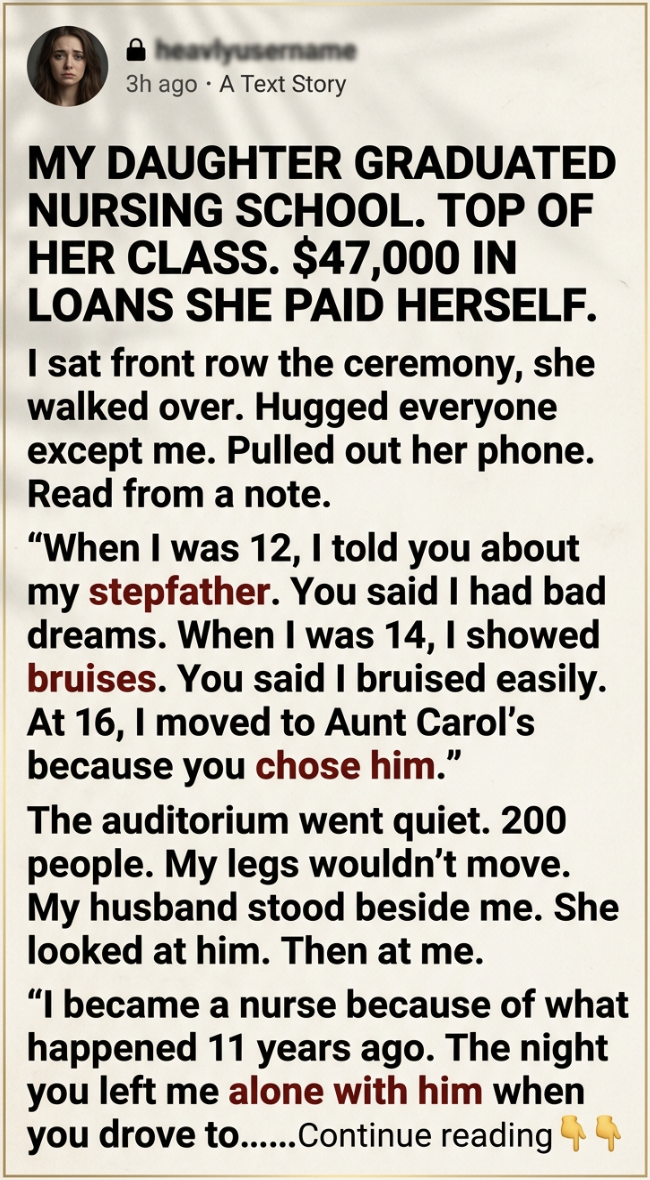
She graduated at the top of her class.
She had worked part-time jobs, earned scholarships, and slowly paid off nearly every dollar of her student loans herself.
I sat in the front row with tears already filling my eyes before her name was even called.
When she crossed the stage, the audience erupted in applause.
She smiled.
Accepted her diploma.
Then walked directly toward our family.
I stood up, arms open, ready to hug her.
She hugged her grandmother.
She hugged Aunt Carol.
She hugged two of her classmates.
Then she stopped in front of me.
She didn’t smile.
Instead, she reached into her graduation gown and unfolded a small piece of paper.
Her hands trembled slightly.
“So many people have congratulated me today,” she began.
“But before I celebrate, I need to tell the truth I’ve carried since I was twelve.”
The auditorium grew quiet.
She looked at me.
“When I was twelve, I told Mom I was afraid of my stepfather.”
“I needed her to believe me.”
“I needed her to listen.”
“I needed her to protect me.”
Her voice cracked.
“But she thought I was mistaken.”
“I felt alone.”
No one moved.
No one whispered.
Two hundred people sat in complete silence.
Then she looked at the man who had been my husband for years.
“I spent my teenage years believing my voice didn’t matter.”
She turned back toward me.
“But someone finally listened.”
She reached out and took Aunt Carol’s hand.
“When I was sixteen, Aunt Carol welcomed me into her home.”
“She didn’t ask me to prove my fear.”
“She simply believed I deserved to feel safe.”
I couldn’t breathe.
Tears blurred my vision.
She folded the paper.
“I became a nurse because I never wanted another frightened child to feel invisible.”
“I wanted every patient I cared for to know that their voice mattered.”
The audience remained silent for another long moment.
Then, slowly, people began to clap.
Not loudly.
Not triumphantly.
But respectfully.
It wasn’t applause for conflict.
It was applause for courage.
After the ceremony, my daughter quietly walked outside.
I followed at a distance.
She stood beneath a large oak tree, holding her diploma.
For several minutes, neither of us spoke.
Finally, I whispered,
“I’m sorry.”
She kept looking ahead.
“I know.”
“No,” I said, tears streaming down my face.
“I don’t mean I’m sorry you’re upset.”
“I’m sorry I failed you.”
She closed her eyes.
“I spent years hoping you’d say that.”
I admitted something I had never been brave enough to face.
“When you first came to me, I convinced myself there had to be another explanation.”
“I told myself everything was fine because I was terrified of believing our family could be falling apart.”
“I confused denial with protection.”
“And that mistake cost us years.”
She turned toward me for the first time.
“I didn’t need a perfect mother.”
“I just needed someone willing to hear me.”
Those words stayed with me long after that afternoon ended.
Within weeks, I filed for divorce.
Not because of public embarrassment.
But because I finally accepted that protecting appearances had mattered more to me than asking difficult questions.
That realization was painful.
It was also necessary.
Healing didn’t happen overnight.
Trust couldn’t be rebuilt with one apology.
So I stopped trying to defend my past.
Instead, I started changing my future.
I attended counseling.
I joined a support group for parents learning how to rebuild broken relationships.
Most importantly, I listened more than I spoke.
Months later, my daughter invited me to have coffee.
It was the first invitation she had extended in years.
She smiled gently.
“I can’t erase what happened.”
“Neither can you.”
“But I can decide whether we build something healthier from here.”
That afternoon wasn’t about forgetting.
It was about beginning again.
Several years later, I attended another ceremony.
This time, my daughter received an award for excellence in pediatric nursing.
When she stepped up to the microphone, she thanked her colleagues, her aunt, and her patients.
Then she looked at me.
“My mother once made mistakes that changed both our lives.”
She paused.
“But she also chose to face them.”
“She chose to listen.”
“And sometimes the bravest thing a parent can do isn’t pretending they’ve always been right.”
“It’s admitting when they were wrong and doing the work to become better.”
After the ceremony, she hugged me.
It wasn’t a dramatic movie moment.
It was quiet.
Gentle.
Real.
As we walked to the parking lot together, she slipped her hand through my arm, just as she had done when she was a little girl.
Looking back now, I understand something I wish I had learned much sooner.
Children don’t expect their parents to be perfect.
They hope their parents will make them feel heard, valued, and safe.
When they speak about fear or pain, they deserve to be met with patience, compassion, and careful attention—not assumptions.
Sometimes the most important words a parent can say are not, “I know what happened.”
They are, “I’m listening.”
Because listening with an open heart can change the course of a family’s future.
And while the past cannot be rewritten, honesty, accountability, and love can still write a different ending.