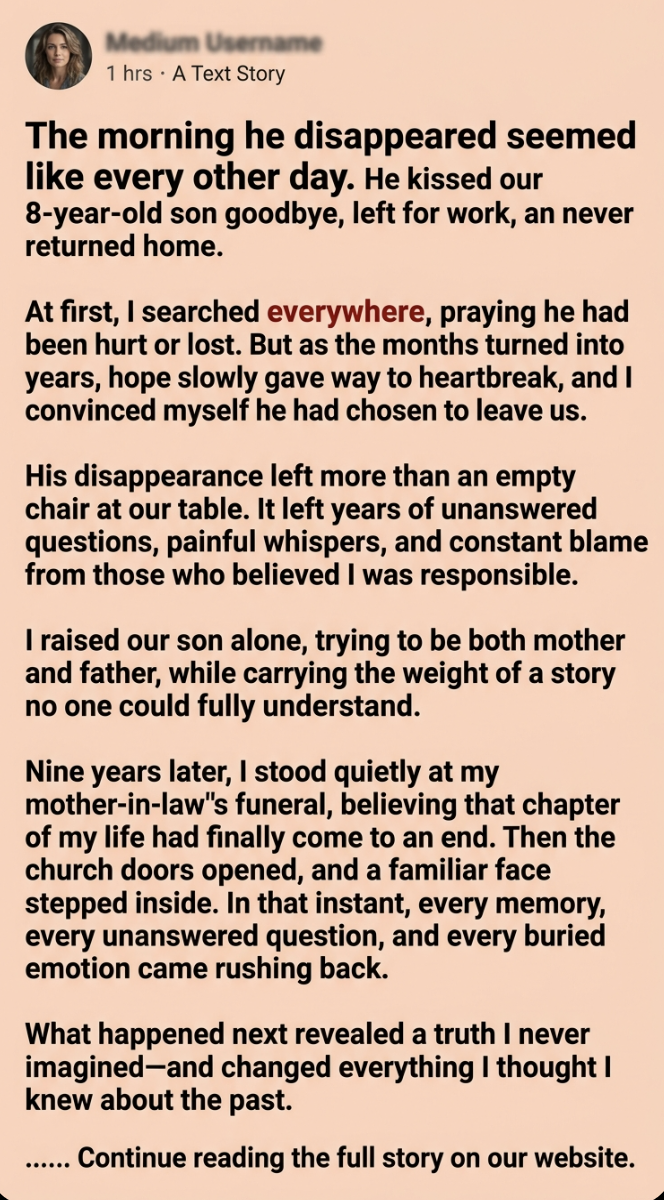
The morning my husband disappeared began like every other weekday.
He kissed our eight-year-old son on the forehead.
He smiled at me over a cup of coffee.
“Don’t forget,” he laughed, “I’ll be home early. We’ll order pizza tonight.”
It was the last thing he ever said to me.
He left for work.
His car never returned.
When evening came, I assumed he was working late.
By midnight, I called his phone over and over.
No answer.
The next morning, I contacted his office.
He had never arrived.
Panic replaced confusion.
I called hospitals.
Police stations.
Friends.
Relatives.
For weeks, I barely slept.
I searched everywhere, believing something terrible must have happened.
The police opened a missing-person investigation.
Months passed.
There were no sightings.
No financial activity.
No phone calls.
No letters.
Nothing.
Eventually, people stopped asking questions.
Some quietly assumed he had started a new life.
Others whispered that no good husband would simply disappear unless he wanted to.
Those whispers hurt.
But none hurt more than his mother’s words.
She blamed me for everything.
“If he left,” she said bitterly, “it’s because he wasn’t happy.”
Every holiday became another reminder of what I had lost.
I raised our son alone.
I worked two jobs.
I attended every school event by myself.
Whenever Father’s Day arrived, my son would pretend it didn’t bother him.
But I often found him quietly looking at old family photographs.
“Do you think Dad remembers me?” he once asked.
I smiled through tears.
“I believe he loves you.”
The truth was…
I didn’t know what to believe anymore.
Years passed.
My son grew into a respectful, hardworking teenager.
Life slowly became peaceful again.
Then one winter morning, I received a phone call.
My former mother-in-law had passed away.
Despite everything that had happened between us, I decided to attend the funeral.
She had once been family.
The church was filled with relatives I hadn’t seen in years.
Some greeted me warmly.
Others avoided eye contact.
The service had almost ended when the heavy wooden doors slowly opened.
Everyone turned.
A tall man walked quietly inside.
Older.
Much thinner.
Gray hair.
A beard.
But there was no mistaking who he was.
It was my husband.
For a moment, I couldn’t breathe.
Gasps echoed through the church.
Someone dropped a prayer book.
My son stared in disbelief.
“Dad?” he whispered.
The man looked at us with tears in his eyes.
“I know I don’t deserve forgiveness,” he said.
After the funeral, we sat together in a small room behind the church.
For several minutes, nobody spoke.
Finally, he broke the silence.
“The day I disappeared…”
He paused.
“I wasn’t running away.”
On his way to work nine years earlier, he had stopped to help at a serious highway accident.
While assisting injured people, another vehicle lost control and struck him.
He survived—but suffered a severe brain injury.
When he awoke weeks later in a rehabilitation hospital hundreds of miles away, he couldn’t remember his name.
He didn’t know where he lived.
He didn’t remember having a wife.
Or a son.
Doctors called it traumatic amnesia.
For years, fragments of memory came and went like pieces of a broken mirror.
He learned to walk again.
He learned to work again.
He built a quiet life while trying to discover who he had once been.
Then, months before his mother’s death, he found an old photograph tucked inside a donated jacket.
On the back was written:
“Our family. Summer at the lake.”
He recognized the little boy in the picture.
Then he recognized me.
Slowly, more memories returned.
He hired a private investigator.
By the time he found us, he had also learned his mother was dying.
She had begged him to come home.
Not only to say goodbye to her…
But to finally tell us the truth.
My son looked at him for a long time.
“So…”
“You didn’t leave us?”
His father shook his head as tears streamed down his face.
“Not for one single day.”
“I just lost the road back to you.”
Silence filled the room.
Then my son stood up.
He walked across the room and hugged the father he hadn’t seen in nearly a decade.
Neither of them could stop crying.
Healing wasn’t instant.
Trust wasn’t magically restored.
You cannot erase nine years of absence with one explanation.
There were difficult conversations.
Painful memories.
Moments of anger.
Moments of forgiveness.
But little by little, we rebuilt what had once been broken.
He attended our son’s high school graduation.
Later, he watched him graduate from college.
Years afterward, he proudly held his first grandchild.
One afternoon, while watching our grandchildren play in the backyard, he quietly said,
“I missed nine years.”
“I’ll spend the rest of my life being grateful for every day I still have.”
I looked at him and smiled.
Life had taught me something I never expected.
Sometimes people leave because they choose to.
Sometimes they leave because circumstances beyond anyone’s control pull them away.
The hardest part is that, in the middle of grief, we often don’t know which story is true.
That experience changed our family forever.
It reminded us not to let unanswered questions turn into permanent hatred.
Because sometimes the truth takes years to arrive.
And when it finally does, it asks us not only to understand…
but also to find the courage to begin again.