The day I told my parents I was going to marry Daniel, they didn’t congratulate me.
Instead, the room fell silent.
My father slowly took off his glasses and looked at me as though I had just destroyed my future.
“A welder?” he asked.
“After everything we’ve done for you?”
My mother tried to convince me that love wasn’t enough.
“You’ll spend your whole life struggling,” she warned.
My older sister didn’t even try to hide her smile.
A few months later, she became engaged to a wealthy businessman who owned several companies.
My family celebrated her engagement like a royal wedding.
Mine was barely mentioned.
On my wedding day, only a few relatives came.
My parents attended, but they left before the reception ended.
As I watched them drive away, I fought back tears.
Daniel gently squeezed my hand.
“We may not have much,” he whispered, “but I promise you’ll never face life alone.”
Those words became the foundation of our marriage.
Our first apartment was tiny.
The roof leaked when it rained.
Our furniture came from secondhand stores.
Sometimes we shared one meal because that was all we could afford.
Daniel worked long hours in factories, shipyards, and construction sites.
He came home exhausted.
His hands were rough from years of hard work.
His clothes often smelled of metal and smoke.
But every evening, he smiled and asked,
“How was your day?”
Never once did he complain.
Little by little, life improved.
He attended evening engineering classes after work.
On weekends, he repaired equipment for local businesses.
He studied whenever everyone else was sleeping.
People only saw a welder.
I saw a man building a future with patience and determination.
Meanwhile, my sister enjoyed a luxurious lifestyle.
She traveled overseas.
She posted photographs of expensive vacations and designer handbags.
Every family gathering became an opportunity to compare our lives.
“Your sister is doing so well.”
“You could have had this life too.”
I stopped arguing.
There was no point.
I learned that some people only recognize success when it shines.
They rarely notice the quiet work that creates it.
Years passed.
Daniel eventually became a specialist in industrial fabrication and manufacturing systems.
Then he and two friends started a small engineering company.
The beginning wasn’t easy.
There were months when they barely earned enough to pay salaries.
Still, they refused to quit.
Slowly, contracts became larger.
Their reputation grew.
Without realizing it, the man everyone had once called “just a welder” had become the owner of a respected engineering business.
Yet nothing about him changed.
He still greeted everyone politely.
He still fixed broken fences for elderly neighbors without charging them.
He still wore his old work boots whenever he visited the workshop.
One afternoon, an elegant invitation arrived.
It was for a prestigious business gala attended by executives, investors, and industry leaders.
I almost refused.
“I don’t belong there,” I told Daniel.
He smiled.
“You belong anywhere you’re respected.”
When we entered the ballroom, luxury surrounded us.
Crystal chandeliers.
Beautiful gowns.
Luxury cars parked outside.
Then I saw my sister.
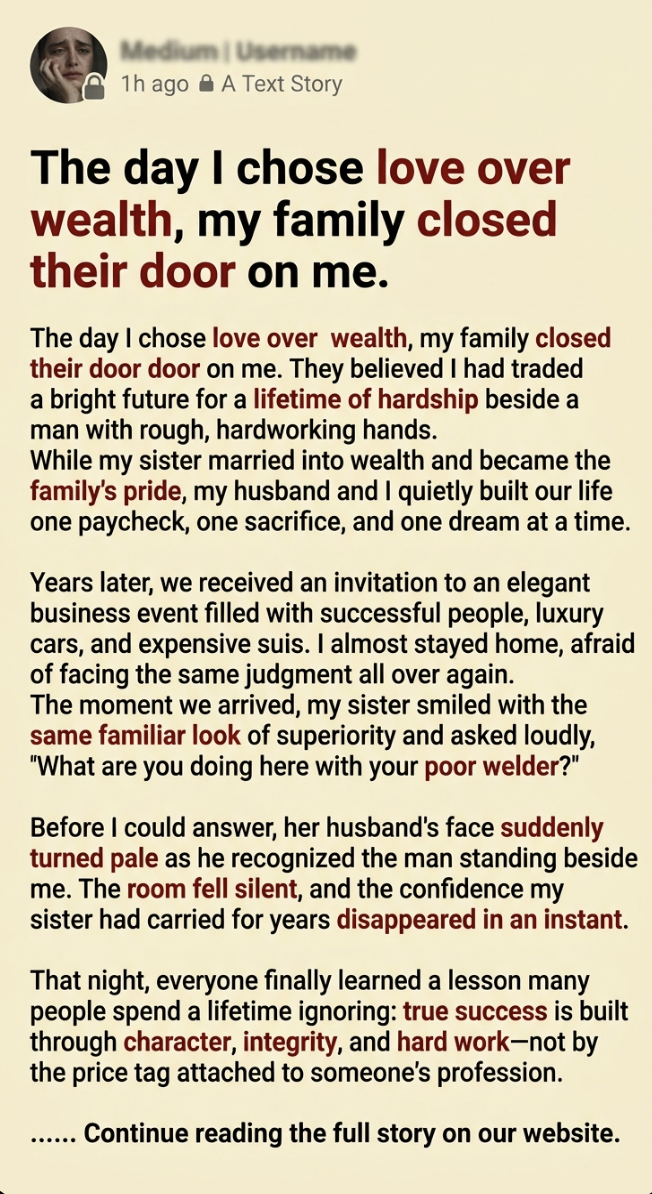
She looked me up and down before laughing softly.
“So,” she said loudly enough for nearby guests to hear,
“You finally decided to see how successful people live?”
Her eyes shifted toward Daniel.
“And you brought your poor welder.”
Several people turned toward us.
For a brief moment, I felt exactly as I had years earlier.
Small.
Embarrassed.
Unwelcome.
Before I could answer, my sister’s husband suddenly froze.
His expression changed completely.
He stared at Daniel.
“You…” he said quietly.
“I know you.”
Daniel smiled politely.
“We’ve met before.”
The businessman quickly extended both hands.
“Ladies and gentlemen,” he announced, “this is Daniel.”
“The company he founded designed and built the advanced manufacturing system our factories rely on today. We wouldn’t have completed our biggest expansion without his team.”
The room instantly filled with admiration.
People gathered around Daniel, asking questions, thanking him for his work, and praising his company’s achievements.
My sister stood speechless.
For the first time in years, she had nothing to say.
Later that evening, she quietly walked over to me.
“I judged both of you,” she admitted.
“I thought money made someone important.”
I looked at Daniel across the room.
He was laughing with a maintenance worker who had recognized him from years ago.
He hadn’t forgotten where he came from.
“Success doesn’t change who you are,” I said softly.
“It reveals who you’ve always been.”
A few weeks later, my parents came to visit.
There were no dramatic speeches.
No grand apologies.
My father simply looked at Daniel’s rough hands and said,
“I spent years seeing only your profession.”
“I never stopped to see your character.”
Daniel smiled.
“No hard feelings.”
That simple moment healed years of distance.
As we shared dinner together, I realized something that has stayed with me ever since.
A person’s value has never been measured by the softness of their hands, the title on a business card, or the size of a paycheck.
The strongest families are built on love, respect, honesty, and perseverance.
Money can buy comfort.
Status can earn attention.
But kindness, humility, and integrity earn something far more valuable—
the respect that lasts long after wealth and titles fade away.
And whenever someone asks me what my husband does for a living, I still smile proudly and answer the same way:
“My husband is a welder.”
Because before he built successful businesses…
he built a life, a home, and a family that never depended on anyone else’s approval.