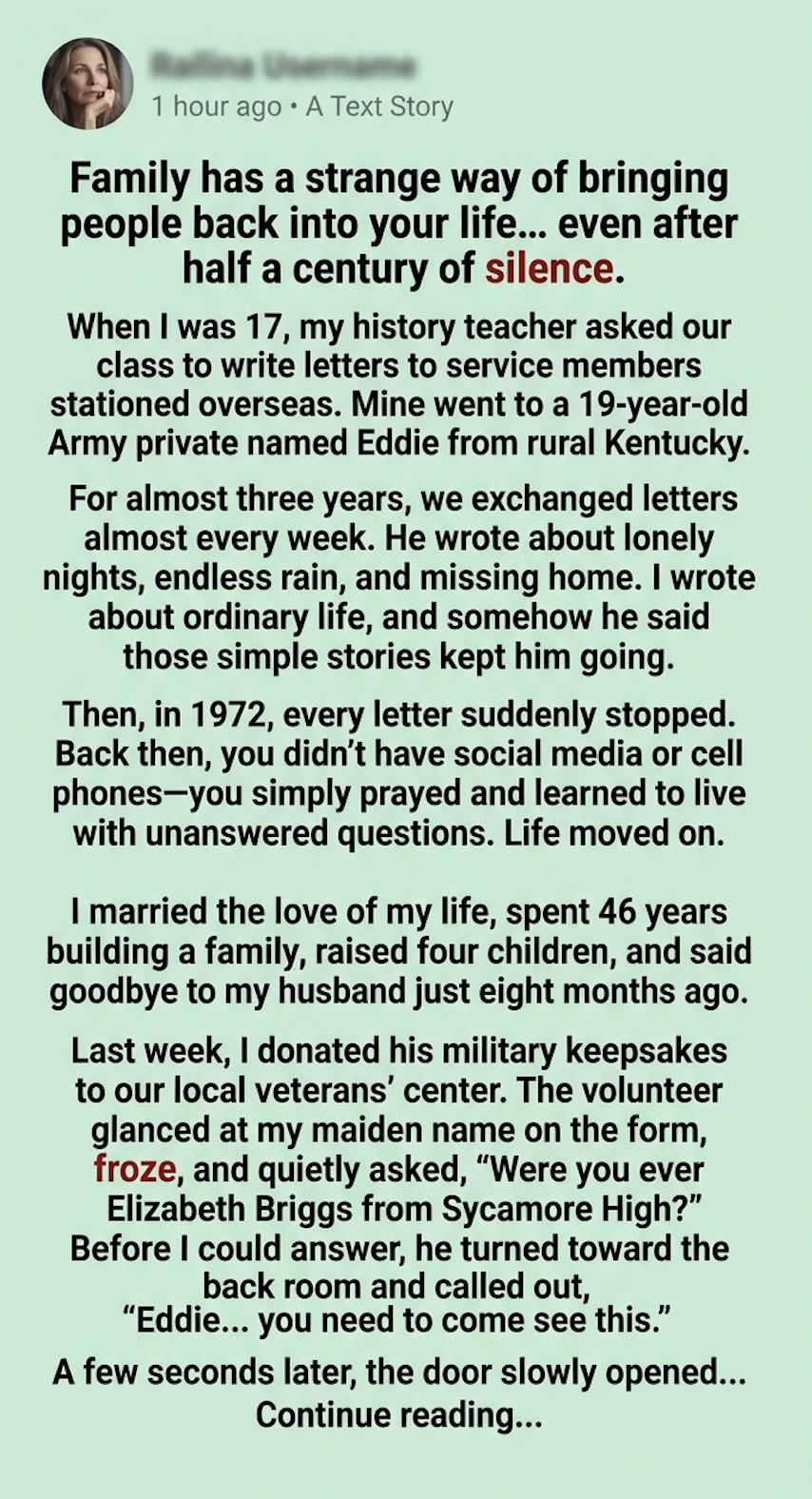
Family has a strange way of bringing people back into your life… even after half a century of silence.
Sometimes, the people we think we’ve lost forever are simply waiting for the right moment to return.
When I was 17 years old, my history teacher gave our class an assignment that seemed ordinary at the time.
“Choose a service member stationed overseas,” she said, “and write them a letter. They could use a friend.”
Most of my classmates treated it like homework.
I had no idea I was about to meet someone who would quietly change my life forever.
The name on my envelope belonged to a 19-year-old Army private named Eddie Walker, a farm boy from rural Kentucky.
He was stationed thousands of miles away during the Vietnam War.
A month later, I received my first reply.
His handwriting was neat but hesitant.
He thanked me for writing because, as he admitted, some weeks the only mail he received came from his mother.
That first letter became another.
Then another.
Soon we were writing nearly every week.
For almost three years.
He told me about endless rain that soaked everything.
The unbearable heat.
The constant sound of helicopters.
Friends who laughed one day and disappeared the next.
The loneliness that settled in after sunset.
I never asked about combat.
He never described it.
Instead, he wrote about the little things.
How much he missed homemade biscuits.
Watching baseball with his father.
Fishing with his younger brother.
The smell of freshly cut hay after summer rain.
I wrote back about my ordinary teenage life.
Football games.
School dances.
My little sister stealing my sweaters.
Our old golden retriever chasing squirrels.
The huge oak tree outside my bedroom window.
I worried my life sounded boring.
But Eddie always disagreed.
“You remind me what normal feels like,” he once wrote.
“When I read your letters, I can almost pretend I’m home.”
That sentence stayed with me for decades.
As graduation approached, I secretly wondered if we’d ever meet.
Not because we were in love.
Because we weren’t.
Our friendship was something different.
It was honest.
Gentle.
Safe.
Two strangers helping each other survive completely different lives.
Then, in the spring of 1972…
The letters stopped.
One week.
Then two.
Then a month.
I wrote again.
No reply.
Another letter.
Nothing.
Back then there were no cell phones.
No social media.
No email.
No search engines.
If someone disappeared, they simply disappeared.
I didn’t know whether he had been transferred.
Wounded.
Or worse.
After several months, I folded his letters into a small wooden box and tucked them into the back of my closet.
Life kept moving.
As it always does.
I met a kind man named Thomas during my first year of college.
He made me laugh.
He respected my dreams.
He never tried to change who I was.
We married two years later.
Together we built a beautiful life.
Four wonderful children.
Nine grandchildren.
Countless family vacations.
Birthdays.
Christmas mornings.
Late-night conversations over coffee.
Ordinary moments that became extraordinary memories.
Thomas served in the National Guard for several years after we married.
He understood military life better than I ever could.
One evening, nearly twenty years into our marriage, he found the old wooden box while cleaning the attic.
Inside were every letter Eddie had ever sent.
I became nervous.
I expected questions.
Jealousy.
Silence.
Instead, Thomas smiled.
“So this is the soldier who helped a teenage girl become such a thoughtful writer.”
I laughed.
He spent nearly an hour reading every letter.
When he finished, he closed the box carefully.
“I’m glad you answered him.”
“Some people probably survived because someone believed they mattered.”
That was my husband.
Always seeing the best in people.
Eight months ago…
I lost him.
Forty-six years of marriage ended with one final heartbeat.
People tell you grief gets easier.
They mean well.
But grief doesn’t disappear.
It simply changes shape.
The house became painfully quiet.
His favorite chair remained empty.
Sometimes I still caught myself setting out two coffee cups.
The silence was louder than words.
Last week, I finally decided to donate his military keepsakes to our local veterans’ center.
His uniforms.
His medals.
Old photographs.
Letters.
Items I knew deserved to be preserved rather than hidden inside boxes.
A volunteer greeted me warmly.
He handed me a donation form.
As he reviewed it, his eyes stopped on my maiden name.
Elizabeth Briggs.
He stared for several seconds.
Then looked back at me.
“Were you ever Elizabeth Briggs from Sycamore High School?”
I nodded slowly.
“Yes…”
His face changed completely.
Without another word, he turned toward the back hallway.
“Eddie…”
“You need to come see this.”
Everything around me seemed to stop.
The room fell silent.
A few seconds later…
The door slowly opened.
An older man stepped into the hallway.
Gray hair.
Gentle eyes.
A slight limp.
He looked directly at me.
Neither of us spoke.
Then he smiled.
“I’d know that smile anywhere.”
I covered my mouth.
“Eddie?”
He nodded.
“I’ve been hoping life would let me thank you.”
Neither of us cared that strangers were watching.
We hugged like old friends separated by time instead of distance.
After several minutes, we sat together with coffee.
The volunteer quietly excused himself.
Eddie reached into an old leather bag he carried everywhere.
Inside was a carefully tied bundle of faded envelopes.
Every letter I had ever written.
All of them.
He had saved every single one.
“I carried these through three different duty stations,” he said.
“My wife used to tease me that I guarded them better than my wallet.”
“You got married?” I asked with a smile.
He nodded.
“To a wonderful woman named Margaret.”
“We had two daughters.”
“We were married forty-eight years.”
His smile faded slightly.
“She passed away three years ago.”
For a moment…
Neither of us spoke.
We both understood that kind of silence.
Finally I asked the question that had lived inside me for fifty-four years.
“What happened in 1972?”
His eyes filled with tears.
“I was badly injured.”
He paused before continuing.
“I spent months recovering.”
“When I was finally discharged, I learned our family farm had been sold.”
“We moved.”
“My mother packed everything while I was still in the hospital.”
“When I asked about your address…”
He looked down.
“She admitted she accidentally threw away your last letter.”
“I tried finding you.”
“I wrote to the school.”
“They couldn’t release student records.”
“I even drove through Sycamore once years later.”
“But you were gone.”
“I thought maybe you’d forgotten me.”
I shook my head immediately.
“Never.”
“I wondered for decades if you were still alive.”
He smiled softly.
“So did I.”
For the next several hours, we shared the missing fifty-four years.
Photos of children.
Grandchildren.
Vacations.
Graduations.
Heartbreaks.
Successes.
Losses.
We laughed more than we cried.
Before I left, Eddie asked one question.
“Would your family mind if I met them someday?”
I laughed.
“They’ll probably insist you stay for dinner.”
The following Sunday, Eddie came to my house.
My children welcomed him like an uncle they’d somehow misplaced.
My grandchildren listened wide-eyed as he told stories about writing letters by flashlight in a tent halfway around the world.
Then my oldest grandson asked him something unexpected.
“Did those letters really help?”
Eddie looked at all of us gathered around the table.
Then he answered quietly.
“They didn’t just help.”
“They reminded me I still had a future.”
He reached into his wallet.
Inside was a tiny, worn photograph.
A faded senior picture.
Mine.
“I’ve carried this since 1970.”
My daughter began crying.
So did I.
Months passed.
Eddie became part of our family.
He attended birthdays.
School plays.
Thanksgiving dinners.
He taught my grandsons how to fish.
My granddaughters loved hearing stories about old-fashioned life before the internet.
One afternoon he admitted something he’d never told anyone.
“There were nights overseas when I was ready to give up.”
He looked at me.
“Then your letter arrived.”
“I promised myself I’d survive long enough to answer it.”
I couldn’t speak.
After everything life had taken from both of us…
It had quietly returned something priceless.
Not romance.
Not regret.
Something far rarer.
A lifelong friendship that simply needed fifty-four years to finish its journey.
Last Christmas, our entire family gathered for dinner.
As we prepared to eat, my youngest granddaughter asked,
“Grandpa Eddie, how are you related to us?”
He smiled.
He looked around the room filled with children, grandchildren, laughter, and photographs of people we loved and lost.
Then he answered with words none of us will ever forget.
“Sometimes family isn’t the people you’re born with.”
“Sometimes family is the person who answered a lonely soldier’s letter… and never stopped caring.”
That evening, I looked around the table.
Thomas’s picture stood beside a candle.
I smiled through tears.
I think he would have loved seeing Eddie there.
Perhaps life doesn’t always give us the ending we expect.
Sometimes…
It waits decades before finishing the story.
And when it finally does…
It reminds us that kindness is never wasted.
A single letter.
A simple act of compassion.
A friendship separated by fifty-four years.
It became a family.
And that, to me, is one of the greatest miracles life can offer.
The End.