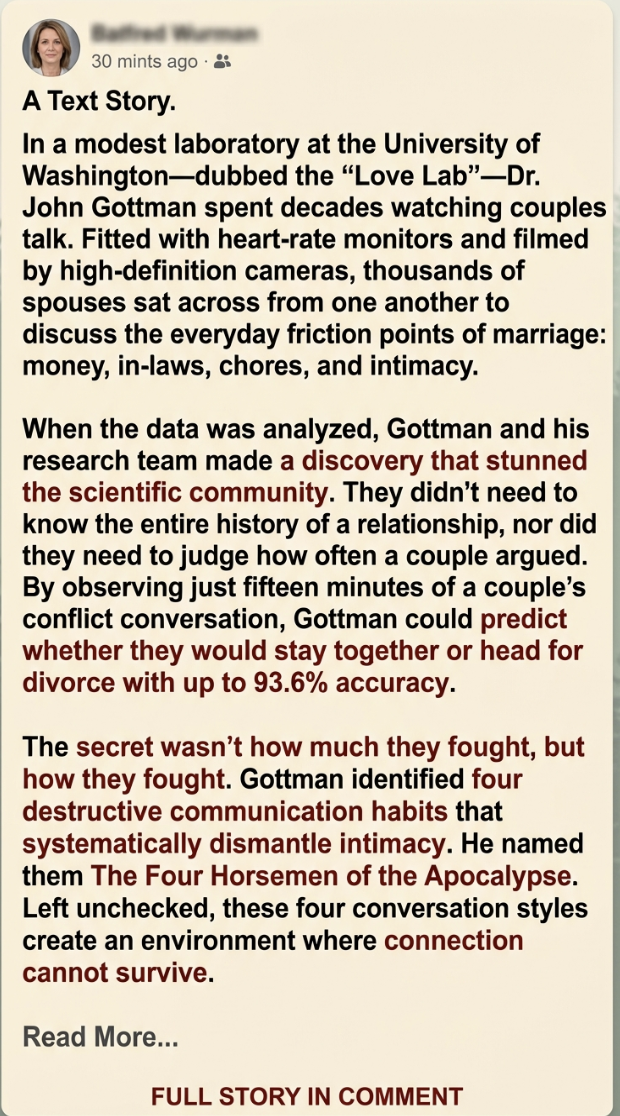
In a modest laboratory at the University of Washington—dubbed the “Love Lab”—Dr. John Gottman spent decades watching couples talk. Fitted with heart-rate monitors and filmed by high-definition cameras, thousands of spouses sat across from one another to discuss the everyday friction points of marriage: money, in-laws, chores, and intimacy.
When the data was analyzed, Gottman and his research team made a discovery that stunned the scientific community. They didn’t need to know the entire history of a relationship, nor did they need to judge how often a couple argued. By observing just fifteen minutes of a couple’s conflict conversation, Gottman could predict whether they would stay together or head for divorce with up to 93.6% accuracy.
The secret wasn’t how much they fought, but how they fought.
Gottman identified four destructive communication habits that systematically dismantle intimacy. He named them The Four Horsemen of the Apocalypse. Left unchecked, these four conversation styles create an environment where connection cannot survive.
1. Criticism: Attacking Who They Are, Not What They Did
Conflict is a normal part of any relationship, but there is a profound difference between a complaint and a criticism.
-
A Complaint targets a specific behavior or event. It focuses on how an action made you feel.
-
A Criticism targets your partner’s character, core traits, or personality. It transforms a single mistake into a global defect using absolute language like “always” or “never.”
| Complaint (Healthy) | Criticism (Toxic) |
| “I felt hurt when you forgot to pick up the groceries today.” | “You never think about anyone but yourself. You’re completely irresponsible.” |
| “We need to talk about how we manage our weekend schedule.” | “You’re always lazy and ruining our plans.” |
The Structural Trap: Criticism puts the receiving partner on the defensive, turning a problem-solving conversation into an attack on self-worth.
The Antidote: Gentle Start-Up
To defeat Criticism, use a Gentle Start-Up. Research shows that 96% of the time, the way a conversation starts determines how it will end. Express how you feel about a specific situation and state what you need without passing judgment.
-
Formula: *”I feel [emotion] about [specific situation], and I need [positive action].” *
2. Contempt: The Single Greatest Predictor of Divorce
If Criticism is a warning sign, Contempt is the nuclear option. Gottman identified Contempt as the single strongest predictor of relationship failure.
Contempt goes beyond anger or frustration; it stems from a position of moral superiority. It is designed to make your partner feel inferior, worthless, or degraded. It manifests through:
-
Mockery and condescending sarcasm
-
Name-calling and hostile humor
-
Eye-rolling, sneering, or a subtle one-sided smirk
Contempt destroys the immune system of a relationship—and literally weakens the physical immune system of the person receiving it. When contempt takes root, warmth and affection disappear.
Criticism ("You always ruin dinner")
       │
       ▼
Contempt ("You're useless. I can't believe I married someone like you.")
The Antidote: A Culture of Appreciation
Contempt cannot thrive in an environment where respect and gratitude are routinely expressed. The antidote is building a daily culture of appreciation and affection.
By actively hunting for the things your partner does right—rather than cataloging their flaws—you shift your internal narrative from disdain to admiration.
3. Defensiveness: Rebuffing Accountability
When a partner feels attacked by criticism or contempt, the natural human response is Defensiveness.
Defensiveness is a form of self-protection where you play the innocent victim or counter-attack. It essentially communicates: “The problem isn’t me—it’s you.”
Common defensive behaviors include:
-
Cross-complaining: Answering a complaint with an unrelated complaint (“You say I didn’t clean the kitchen? Well, you didn’t do the laundry!”).
-
Yes-butting: Agreeing on paper, but immediately invalidating it (“Yes, I know I was late, but traffic was insane and you didn’t remind me.”).
-
Playing the Victim: Turning the situation around to make the accuser feel guilty (“I guess I can’t do anything right in this house.”).
While defensiveness feels like self-preservation, it actually escalates conflict because it prevents accountability and signals to your partner that their feelings don’t matter.
The Antidote: Taking Responsibility
The antidote to defensiveness is accepting responsibility—even for just a small part of the problem.
-
Instead of: “It’s not my fault we’re late; you took forever to get ready!”
-
Try: “You’re right, I should have started getting ready earlier. I’m sorry.”
4. Stonewalling: The Complete Shutdown
Stonewalling typically occurs after the first three horsemen have created a environment of chronic stress. It happens when the listener completely withdraws from the interaction—turning away, staying silent, or emotionally tuning out.
[ Conflict Escalates ] ──> [ Heart Rate > 100 BPM ] ──> [ Physiological Flooding ] ──> [ Stonewalling ]
Stonewalling isn’t just “giving the silent treatment” out of spite. In most cases, it is a biological reaction to physiological flooding.
During severe conflict, a person’s heart rate can surge past 100 beats per minute, flooding their bloodstream with adrenaline. In this state, the brain enters a primal “fight or flight” mode, making creative problem-solving and emotional empathy physically impossible.
The Antidote: Physiological Self-Soothing
When someone is flooded and stonewalling, continuing the argument is pointless. The antidote is calling a time-out to practice physiological self-soothing.
-
Acknowledge the flood: “I’m feeling overwhelmed and I can’t hear you clearly right now.”
-
Take a 20-minute break: Step away from the discussion. It takes at least 20 minutes for the nervous system to return to a calm baseline.
-
Distract, don’t ruminate: Read, go for a walk, or listen to music—do not use the time to mentally rehearse counterarguments.
-
Return to the conversation: Re-engage once calm.
Summary of the Gottman Rule
To break the cycle of destructive conflict, replace the Four Horsemen with their evidence-based antidotes:
| The Horseman | What It Looks Like | The Antidote |
| 1. Criticism | Attacks character (“You’re selfish”) | Gentle Start-Up (“I feel… I need…”) |
| 2. Contempt | Speaks from superiority (Sarcasm, eye-rolling) | Culture of Appreciation (Express gratitude) |
| 3. Defensiveness | Denies blame (“It’s not my fault”) | Take Responsibility (“I see my part in this”) |
| 4. Stonewalling | Shutting down (Silence, walking away) | Physiological Self-Soothing (Take a 20-min break) |
The presence of these behaviors does not mean a relationship is doomed. Every couple experiences them occasionally. The critical factor—the difference between couples who stay together and those who split—is whether these horsemen become the permanent, uncorrected default mode of communication.