Chapter I: The Fifty-Fifty Fallacy
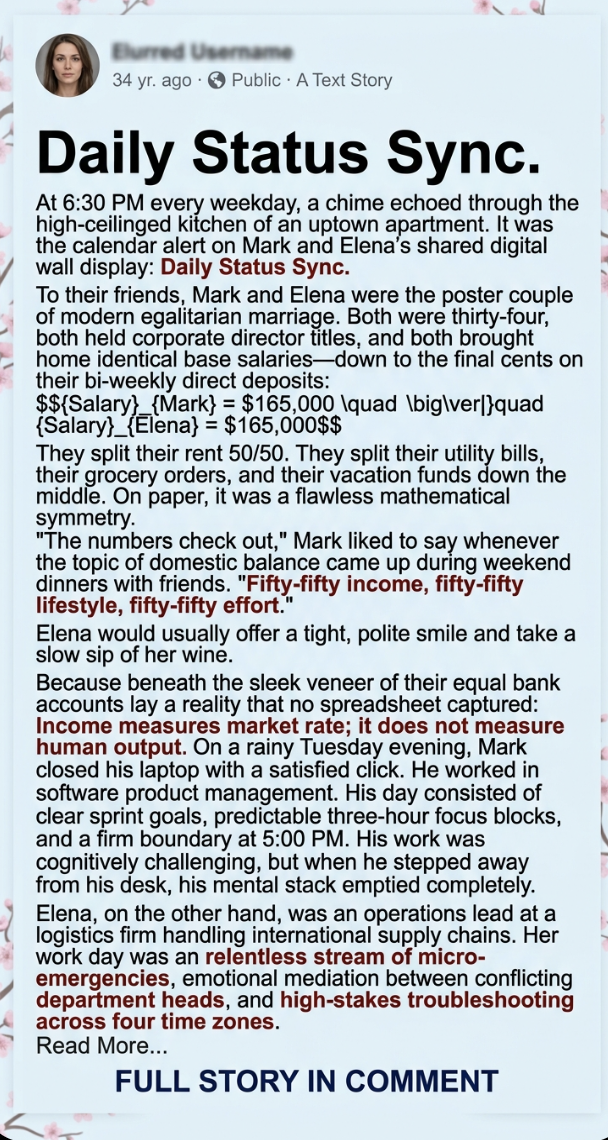
At 6:30 PM every weekday, a chime echoed through the high-ceilinged kitchen of an uptown apartment. It was the calendar alert on Mark and Elena’s shared digital wall display: Daily Status Sync.
To their friends, Mark and Elena were the poster couple of modern egalitarian marriage. Both were thirty-four, both held corporate director titles, and both brought home identical base salaries—down to the final cents on their bi-weekly direct deposits:
They split their rent 50/50. They split their utility bills, their grocery orders, and their vacation funds down the middle. On paper, it was a flawless mathematical symmetry.
“The numbers check out,” Mark liked to say whenever the topic of domestic balance came up during weekend dinners with friends. “Fifty-fifty income, fifty-fifty lifestyle, fifty-fifty effort.”
Elena would usually offer a tight, polite smile and take a slow sip of her wine.
Because beneath the sleek veneer of their equal bank accounts lay a reality that no spreadsheet captured: Income measures market rate; it does not measure human output.
On a rainy Tuesday evening, Mark closed his laptop with a satisfied click. He worked in software product management. His day consisted of clear sprint goals, predictable three-hour focus blocks, and a firm boundary at 5:00 PM. His work was cognitively challenging, but when he stepped away from his desk, his mental stack emptied completely.
Elena, on the other hand, was an operations lead at a logistics firm handling international supply chains. Her work day was an relentless stream of micro-emergencies, emotional mediation between conflicting department heads, and high-stakes troubleshooting across four time zones.
When Elena walked into the kitchen at 6:30 PM, her nervous system was vibrating at a frequency that felt like a quiet panic attack.
Mark was standing by the stove, stirring a pot of pasta.
“Hey!” he said cheerfully, checking his watch. “I started dinner right on time. If you take out the recycling and run the dishwasher, we’ll be totally caught up on our chores for the night.”
Elena stood in the doorway, her heels still on, her handbag weighted down with her laptop. She looked at Mark, then at the recycling bin, then at the sink.
“I can’t tonight, Mark,” she said, her voice barely above a whisper. “I’m exhausted.”
Mark frowned, holding the wooden spoon mid-air. “Elena, we agreed on the chore split. I cooked; you do the cleanup. We’re fifty-fifty.”
“My day was brutal,” she said, resting her forehead against the doorframe. “I spent eight hours putting out fires. I don’t have anything left.”
“I had a full day too,” Mark replied, his tone measured, reasonable, and utterly destructive. “We both work forty hours. We make the exact same money. Why should my evening be longer because your day felt harder?”
Chapter II: The Hidden Metric
The fatal flaw in Mark’s logic—and in the way millions of modern couples structure their lives—is the assumption that earning equal money means expending equal energy.
It is the Fifty-Fifty Fallacy: treating financial compensation as a direct proxy for physical, mental, and emotional drain.
+-------------------------------------------------------------------------+
|                  THE EQUAL INCOME / UNEQUAL DRAIN MATRIX               |
+-------------------------------------------------------------------------+
| DIMENSION           | MARK (Product Lead)      | ELENA (Ops Lead)       |
+---------------------+--------------------------+------------------------+
| Financial Output    | $165,000                 | $165,000               |
| Scheduled Hours     | 40 hours/week            | 40 hours/week          |
| Cognitive Load      | High (Structured)        | High (Volatile)        |
| Emotional Labor     | Low                      | Extreme                |
| Mental Residual     | Clears at 5:00 PM        | Follows her home       |
| Remaining Bandwidth | 70% at end of day        | 15% at end of day      |
+---------------------+--------------------------+------------------------+
Equal income does not account for:
-
Workplace Volatility: A high-stress job that requires constant emotional regulation leaves a person depleted in ways a quiet, structured job does not—even if both jobs pay the exact same salary.
-
The Invisible Second Shift: Elena was still the default manager of the home’s emotional infrastructure—tracking family birthdays, anticipating household shortages, and organizing social commitments.
-
Variable Human Bandwidth: Human energy is not a static currency like a dollar bill. It fluctuates based on health, stress, cognitive fatigue, and neurodiversity.
When a relationship measures fairness solely by financial contribution and physical chore counts, it replaces empathy with accounting.
Chapter III: The Breaking Point
The collapse came two months later over something trivial: a vacuum cleaner.
It was Saturday morning. Mark had drafted a weekend schedule that divided the apartment into four quadrants—two for him, two for Elena.
“If we both hit our quadrants for ninety minutes, we’ll be done by eleven,” Mark announced, holding out a microfiber cloth and a bottle of surface cleaner toward Elena.
Elena was sitting at the kitchen island, staring into a mug of black coffee. She hadn’t slept more than four hours a night all week due to a global inventory crisis at work. Her skin was pale, and the dark circles under her eyes were bruised and heavy.
She didn’t reach for the cloth.
“Mark,” she said quietly. “I need to rest today. Just today.”
Mark sighed, setting the cleaning bottle down with a sharp thud. “Elena, this is the third weekend in a row you’ve asked for an pass. It’s not fair. I work just as hard as you do. We earn the same living. Why am I doing sixty percent of the physical house maintenance?”
Elena looked up at him. Something in her posture shifted—the quiet, accommodating patience she had carried for three years finally evaporated.
“Because I am drowning,” she said, her voice chillingly steady.
“We’re both tired, Elena—”
“No,” she interrupted, raising a single finger. “Do not say ‘we.’ You are tired like a athlete after a good workout. I am tired like someone who has been hit by a car. You don’t see the difference because you’re too busy balancing a ledger that doesn’t exist.”
“It does exist!” Mark insisted, crossing his arms. “Egalitarian marriage means equal contribution! That’s what we agreed on when we got married!”
“Egalitarian marriage means equity, Mark, not arithmetic!” Elena stood up, her hands trembling slightly. “If I am at fifteen percent capacity and you are at seventy percent, fifty-fifty isn’t equality—it’s cruelty. It means you demand my last drop of energy so you can preserve your surplus!”
She didn’t scream. She didn’t throw anything. She simply walked into the bedroom, packed a small overnight bag, and left.
Chapter IV: The Audit of the Heart
For four days, the apartment was silent.
Mark kept the counters spotless. He ran the vacuum on schedule. He checked off every box on his quadrant list with surgical precision.
And yet, sitting alone in the immaculately clean living room on Tuesday evening, the victory felt entirely hollow. The apartment felt like a high-end hotel room—clean, organized, and devoid of warmth.
He opened his personal laptop and pulled up his habit tracker. He looked at the historical entries for his daily tasks. He looked at his savings goals. Everything was green. Everything was balanced.
Then he remembered Elena’s words: You demand my last drop of energy so you can preserve your surplus.
For the first time, Mark stopped looking at his home through the lens of a project manager and began looking through the lens of a partner.
He realized that over the past two years, whenever Elena had asked for help or grace, he hadn’t asked, “How much weight are you carrying today?” He had asked, “Did you pay your half?”
He had treated his wife like a co-founder in a small business, where every shareholder was expected to contribute identical capital and labor, regardless of external conditions. But a marriage wasn’t a business; it was an ecosystem.
When one tree in a forest is starving, the surrounding trees send nutrients through their root networks to keep it standing. They don’t withhold water because the struggling tree isn’t producing an equal number of leaves.
Chapter V: From 50/50 to 100/100
Elena returned on Wednesday evening to find Mark sitting at the dining table. The digital calendar display on the wall was turned off.
There were no chore charts on the table. Only two cups of fresh tea.
“You don’t have to clean anything,” Mark said quietly as she walked in. “The house is done. And it’s not a credit I’m holding over your head.”
Elena sat down across from him, cautious, holding her coat around herself like armor. “Mark, if we’re going to talk about going back to how things were—”
“We’re not,” Mark interrupted gently. “How things were was broken.”
He pushed a piece of paper across the table. It wasn’t a spreadsheet. It was a single handwritten line:
“I was obsessed with making sure our inputs were identical,” Mark said, looking at her directly. “I ignored the fact that your job drains your tank twice as fast as mine drains mine. I was measuring the hours, but I wasn’t measuring the cost.”
Elena looked at the paper, then back up at him, her defenses slowly softening.
“Equal income gave me an excuse to shut my eyes,” Mark continued. “I thought because we brought the same money to the bank, I was automatically a good, fair partner. But fairness isn’t about dividing the chores in half. It’s about making sure neither of us is left with zero at the end of the day.”
Epilogue: The New Balance
True equality in a relationship is not measured in dollars, clock ticks, or cleaned floor tiles. It is measured in capacity.
Six months later, Mark and Elena’s kitchen display was back on, but the interface was different.
Every evening during their 6:30 PM check-in, they no longer audited task lists. Instead, they asked each other a single, simple question:
“What percentage do you have left in your tank tonight?”
If Elena came home at 20%, Mark stepped up to cover 80% of the household labor—not as a favor, and not as a debt to be repaid later, but as a dynamic shift to protect their collective home.
On weeks when Mark was crushed by a product launch, Elena stepped up and carried the heavier lift.
Their income remained equal: $165,000 and $165,000.
But their understanding of effort had finally matured. They stopped treating their marriage like an accounting firm and started treating it like a sanctuary—where the ultimate goal wasn’t a perfectly balanced ledger, but a life where both partners had enough room left to breathe.