The mahogany tables in Courtroom 3B were buffed to a mirror shine, reflecting the fluorescent lights above and the sheer, unadulterated smugness on my ex-husband’s face.
Julian sat next to his high-priced attorney, wearing a bespoke charcoal suit that I had undoubtedly paid for during our marriage. He was dabbing at his eyes with a linen handkerchief, embodying the role of the aggrieved, discarded spouse.
According to his filing, Julian was a broken man. He claimed that our sudden divorce had left him financially destitute, unable to maintain the “accustomed standard of living” we enjoyed during our seven-year marriage. He was demanding a staggering $12,000 a month in permanent spousal support.
My attorney, Sarah, nudged my shoulder. “Don’t let him get to you. The numbers don’t lie, Clara.”
“I’m not nervous,” I whispered back, and it was the truth. I wasn’t nervous; I was furious.
The Master of “Strategic Unemployment”
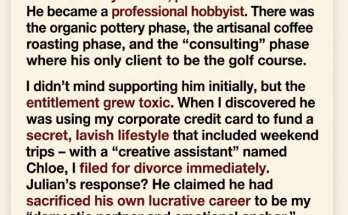
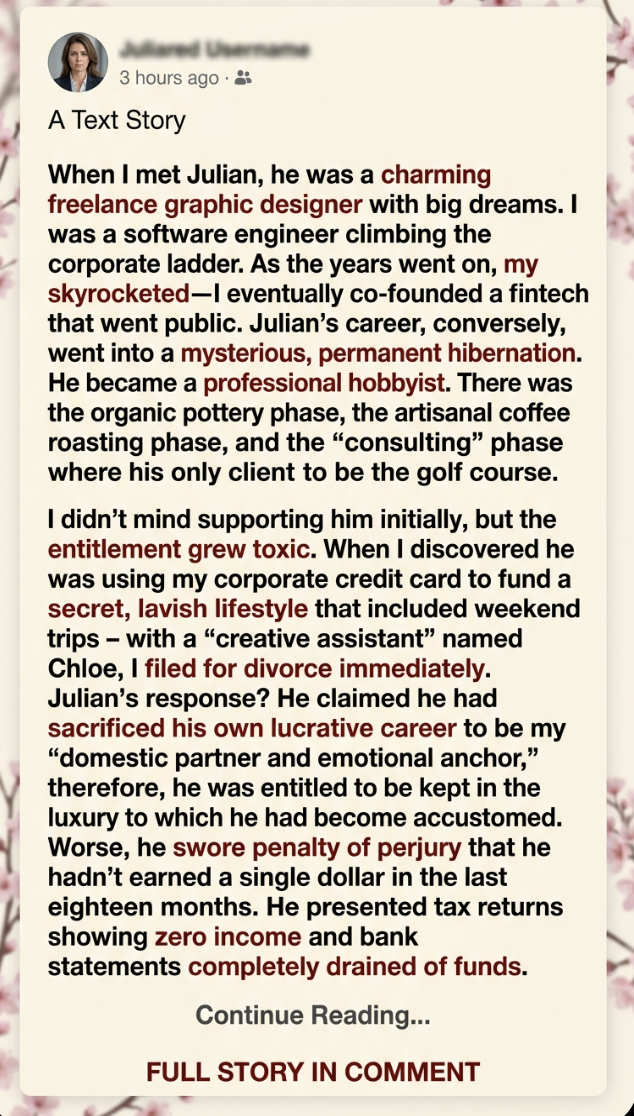
When I met Julian, he was a charming freelance graphic designer with big dreams. I was a software engineer climbing the corporate ladder. As the years went on, my career skyrocketed—I eventually co-founded a fintech startup that went public. Julian’s career, conversely, went into a mysterious, permanent hibernation.
He became a professional hobbyist. There was the organic pottery phase, the artisanal coffee roasting phase, and the “consulting” phase where his only client seemed to be the golf course. I didn’t mind supporting him initially, but the entitlement grew toxic. When I discovered he was using my corporate credit card to fund a secret, lavish lifestyle that included weekend trips with a “creative assistant” named Chloe, I filed for divorce immediately.
Julian’s response? He claimed he had sacrificed his own lucrative career to be my “domestic partner and emotional anchor,” and therefore, he was entitled to be kept in the luxury to which he had become accustomed.
Worse, he swore under penalty of perjury that he hadn’t earned a single dollar in the last eighteen months. He presented tax returns showing zero income and bank statements completely drained of funds.
The Bait is Taken
Julian’s attorney, a ruthless man named Vance, took the podium.
“Your Honor,” Vance boomed, looking pitifully at Julian. “My client gave the best years of his life to support the respondent’s meteoric rise. While Ms. Clara built an empire, Mr. Julian kept the home fires burning. Now, he is cast aside with no career, no income, and severe anxiety that prevents him from seeking meaningful employment. We possess physical evidence of his total financial dependency.”
The judge, a no-nonsense woman named Judge Alvarez, peered over her glasses. “And what evidence is that?”
Julian eagerly stood up, taking the microphone. “Your Honor, if I may. To prove the stark contrast between Clara’s thriving financial state and my own desperate situation, I have compiled a comprehensive ledger of my daily living expenses and the debts I’ve incurred just to survive since she locked me out of our accounts.”
Julian’s attorney looked briefly startled—clearly, Julian was going off-script to gloat. But Vance quickly recovered, handing a thick, bound binder to the bailiff, who passed it to the judge. A copy was dropped onto our table.
Sarah and I flipped it open. It was a meticulously detailed, 50-page financial affidavit. Julian had listed every single cup of coffee, every grocery bill, and every tank of gas, trying to paint a picture of a man drowning in poverty.
Then, my eyes caught a section titled: Appendix C: Asset and Liability Verifications.
Julian had included screenshots of his personal digital wallet and a private, encrypted cloud drive directory to “prove” he had no hidden offshore bank accounts. He wanted to show the court that he was an open book.
I stared at the screenshots. My heart skipped a beat. Then, a slow, cold smile spread across my face.
The Fatal Flaw
“Sarah,” I hissed, tapping the paper. “Look at the top right corner of his cloud drive screenshot.”
Sarah leaned in, her eyes narrowing.
In the screenshot of Julian’s supposedly empty Google Drive, a small, circular profile icon was visible in the upper right-hand corner. It wasn’t his usual email. It was an icon for a company called “Aura Design Logistics.”
Furthermore, in the address bar of the browser screenshot he had proudly submitted to prove he had no secret funds, the active URL read: aura-logistics.internal/dashboard/analytics/revenue_share.
Julian had been so focused on showing the folders named “No Assets” and “Debt Records” that he forgot to crop out his active browser tabs and his corporate login session.
I opened my laptop, my fingers flying across the keyboard. Because I am a software engineer and data architect, I didn’t just look at the surface. I looked up the registry for “Aura Design Logistics.” It was a shell company registered in Delaware. The registered agent? Julian’s brother. The primary digital architect and contract holder? Julian himself.
But it got better. Oh, so much better.
The Ambush
Sarah stood up, her voice ringing clear through the courtroom. “Your Honor, if it pleases the court, we would like to cross-examine the petitioner regarding the financial affidavit he just submitted.”
“Proceed,” Judge Alvarez said.
Julian took the stand, adjusting his tie, looking like a man who had already won.
“Mr. Julian,” Sarah began, walking toward him with his own binder. “You swore under oath that you have had zero income for the past eighteen months, correct?”
“Yes,” Julian said, his voice trembling with manufactured emotion. “It’s been a humiliating struggle.”
“And you swore that you have no affiliation with any active business entities?”
“None. My design business closed in 2024.”
“Fascinating,” Sarah said, turning a page. “Then could you explain Appendix C, Page 42? This is a screenshot you provided of your personal cloud drive to prove you aren’t hiding assets. Can you read the name of the active corporate profile logged in at the top right?”
Julian blinked. He leaned forward. The color began to drain from his cheeks. “Uh. That’s… that’s just an old freelance client’s portal. I must have left it logged in.”
“An old client portal?” Sarah smiled like a shark that had just caught the scent of blood. “Your Honor, we have just pulled the public corporate registry and the cryptographic ledger linked to ‘Aura Design Logistics.’ It turns out, this ‘old client’ is a shell company that manages international design contracts for European tech firms.”
“I… I don’t know anything about that,” Julian stammered, looking frantically at his lawyer. Vance was now sitting up very straight, his pen frozen mid-air.
“You don’t?” Sarah asked innocently. “Because according to the public blockchain ledger linked to the digital wallet address clearly visible in your own screenshot on page 44, Aura Design Logistics routed a payment of $450,000 into a cryptocurrency hardware wallet just three weeks ago.”
The Dominoes Fall
The courtroom fell dead silent.
“Moreover,” Sarah continued, her voice cutting through the air like a knife, “cross-referencing the IP login addresses listed in the metadata of the files you provided shows they match the IP address of the luxury penthouse in Miami where you stayed last month. The one you claimed was a ‘charity stay’ provided by a friend.”
Julian opened his mouth, but only a squeaking sound came out. He looked like he was suffocating.
“Mr. Julian,” Judge Alvarez interrupted, her voice dangerously calm. “Are you telling this court that you submitted evidence containing your own active logins to an undisclosed corporate entity holding nearly half a million dollars in unreported income?”
“Your Honor, I—it’s a misunderstanding—my brother handles that—”
“Your brother?” Sarah countered. “Then why is your digital signature on the software licensing agreements signed last month, yielding a monthly recurring revenue of $35,000?”
Julian turned his head slowly to look at his attorney. Vance looked back at him with an expression of pure, unadulterated horror. Vance slowly closed his briefcase, realizing his client had not only lied to him, but had handed the rope to his own executioner.
The Verdict
Judge Alvarez didn’t just deny Julian’s request for alimony; she practically obliterated him.
From the Bench: “The petitioner has engaged in a calculated, malicious attempt to defraud this court. Not only has he completely fabricated his financial distress, but he has also actively hidden substantial corporate assets and committed blatant perjury. This is no longer just a family law matter.”
The consequences were swift and devastating for Julian:
-
Alimony: Denied permanently.
-
Legal Fees: Julian was ordered to pay 100% of my legal fees, totaling over $85,000.
-
Sanctions & Investigation: The judge referred the case to the state prosecutor for criminal perjury and tax evasion.
As we walked out of the courtroom, Julian was slumped over the defense table, his head in his hands, while his attorney aggressively lectured him in whispers.
Sarah and I walked out into the bright afternoon sun.
“You know,” I said, adjusting my sunglasses, “I almost want to thank him. If he hadn’t been so greedy and sued me for alimony, I might never have discovered he was hiding that $450,000. Now the IRS is going to find the rest.”
Sarah laughed, opening the door to our celebratory lunch. “Never interrupt your enemy when he is making a mistake, Clara. Especially when he formats it into a handy, 50-page binder.”