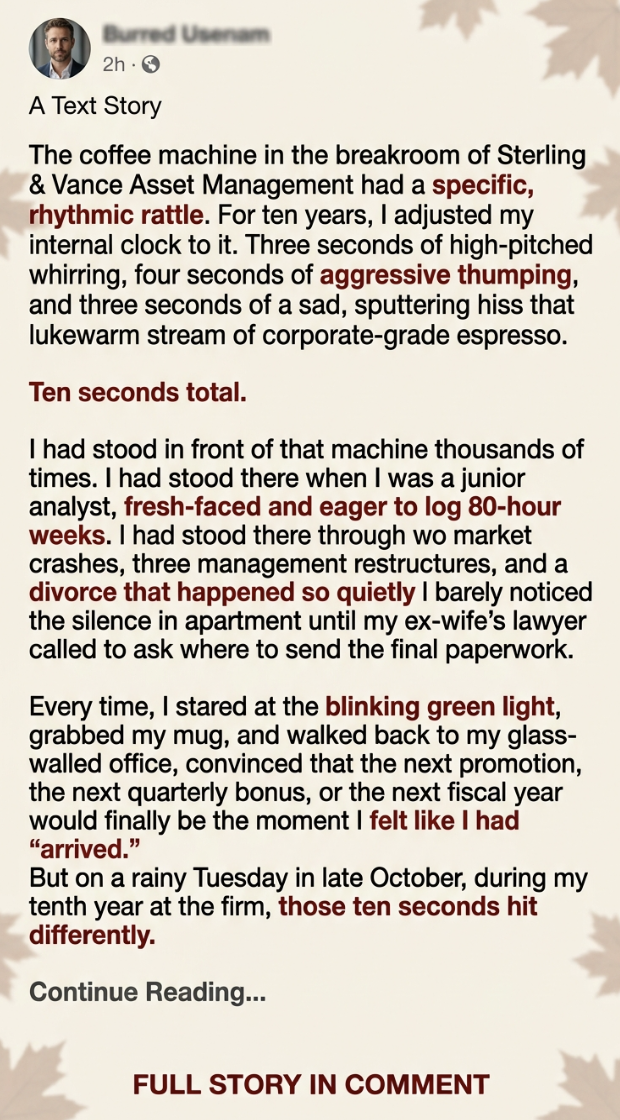
The coffee machine in the breakroom of Sterling & Vance Asset Management had a specific, rhythmic rattle. For ten years, I adjusted my internal clock to it. Three seconds of high-pitched whirring, four seconds of aggressive thumping, and three seconds of a sad, sputtering hiss that culminated in a lukewarm stream of corporate-grade espresso.
Ten seconds total.
I had stood in front of that machine thousands of times. I had stood there when I was a junior analyst, fresh-faced and eager to log 80-hour weeks. I had stood there through two market crashes, three management restructures, and a divorce that happened so quietly I barely noticed the silence in my apartment until my ex-wife’s lawyer called to ask where to send the final paperwork.
Every time, I stared at the blinking green light, grabbed my mug, and walked back to my glass-walled office, convinced that the next promotion, the next quarterly bonus, or the next fiscal year would finally be the moment I felt like I had “arrived.”
But on a rainy Tuesday in late October, during my tenth year at the firm, those ten seconds hit differently.
The Weight of a Decade
To understand how a man unpacks a decade of his life in the span of a breath, you have to understand what those ten years cost.
I arrived at Sterling & Vance at twenty-five, armed with an Ivy League degree, a severe case of imposter syndrome, and an insatiable desire to prove I belonged. Marcus Vance, the founding partner, was a mythic figure who smelled of expensive tobacco and spoke in brief, terrifyingly precise directives. The day he hired me, he shook my hand and said, “Give me your youth, Julian, and I’ll give you the world.”
I took the deal.
For the first five years, it felt like a fair trade. I climbed from Analyst to Associate, then to Senior Portfolio Manager. My bank account swelled, and I bought the requisite accoutrements of success: a sleek apartment overlooking the river, a tailored wardrobe, and a watch that cost more than my father’s first car.
But somewhere around year seven, the trade-off began to sour. The “world” Marcus promised felt increasingly like a highly polished cage. My days were an endless loop of Excel spreadsheets, adversarial board meetings, and the perpetual, low-grade anxiety of maintaining a multi-million-dollar portfolio.
My mother’s health started failing in year eight. I missed her 70th birthday because a tech stock we shorted suddenly rallied, forcing me to pull a 48-hour shift. When she passed away six months later, I took exactly three days of bereavement leave before Marcus called me, his voice a smooth mix of artificial sympathy and corporate urgency.
“We need you back, Julian. The market doesn’t mourn.”
I went back. I buried the grief under a mountain of data, telling myself that this was the sacrifice required for greatness. I stayed because of inertia. I stayed because “Senior Portfolio Manager” had become my entire identity. If I wasn’t the guy who saved the Q3 margins, who was I?
The Ten-Second Epiphany
The Tuesday in question began like any other. I arrived at 6:15 AM. The sky outside was a bruised purple, weeping a cold, relentless rain against the floor-to-ceiling windows.
By 3:00 PM, my brain was a mush of numbers. We were prepping for the annual Q4 investor presentation, and Marcus was in fine form, tearing apart slide decks and berating VPs like a dictator on a tirade. I felt a familiar, dull throb beginning behind my left eye—the onset of a stress migraine I had come to accept as a permanent roommate.
I needed air, or at least a caffeine-induced simulation of life. I walked down the quiet, carpeted hallway to the executive breakroom.
I placed my mug under the spout of the industrial espresso machine and pressed the button.
The ten seconds began.
Seconds 1–3: The Whir. The machine roared to life, a sharp, piercing sound. In that moment, Marcus walked into the breakroom. He didn’t look at me. He walked straight to the premium water dispenser, filled a glass, and sighed.
“Julian,” he said, staring through the glass at the rainy skyline. “The compliance team tells me you’re hesitating on signing off on the offshore restructuring for the Vanguard account.”
“It’s a gray area, Marcus,” I said, my voice sounding incredibly tired even to my own ears. “It pushes the legal boundaries of the new tax codes. If it goes wrong, the fallout lands entirely on the management team. On me.”
Seconds 4–7: The Thump. The machine began its violent, rhythmic shaking, vibrating the counter. Marcus turned to face me. The artificial light caught the sharp lines of his face. He looked older, colder. He offered a dismissive, patronizing smile—the exact same smile he used on clients he intended to bleed dry.
“We don’t pay you to worry about ‘gray areas,’ Julian. We pay you to execute. You’ve been here ten years. You know how this machinery works. You’re a cog, a vital one, but a cog nonetheless. Don’t start developing a conscience now; it’s bad for the yield.”
He took a sip of water, turned on his heel, and walked out, leaving the heavy glass door to swing shut behind him.
A cog.
Ten years of missed birthdays, a failed marriage, ruined health, and a buried mother, all summarized in a single, casual sentence by a man I had spent a decade trying to please.
Seconds 8–10: The Hiss. The machine let out its final, sputtering gasp. A lukewarm, dark liquid pooled into the bottom of my white ceramic mug.
I looked at the coffee. I looked at the closed door.
And just like that, the illusion shattered. It didn’t happen with a bang or a dramatic outburst. It was a profound, terrifyingly quiet realization. The fear that had kept me trapped in that building for a decade—the fear of irrelevance, the fear of losing my status, the fear of the unknown—evaporated in a single heartbeat.
I didn’t hate Marcus. I didn’t even hate the firm. I just realized, with absolute, crystalline certainty, that I was entirely, irrevocably done.
The Clean Break
I didn’t drink the coffee. I left the mug sitting on the counter, a tiny monument to a decade of compliance.
I walked back to my office, closed the door, and sat down at my desk. My hands weren’t shaking; in fact, for the first time in ten years, the phantom tremor in my right index finger had completely stopped. My mind was sharper than it had ever been during a market rally.
I opened a blank Word document.
To: Marcus Vance, Managing Partner
From: Julian Vance (No Relation)
Date: October 24

Please accept this document as formal notice of my resignation from my position as Senior Portfolio Manager, effective immediately.

Thank you for the opportunities over the past decade. I wish the firm the best.

Sincerely,
Julian
I printed it out, signed it in blue ink, and walked it over to HR. The HR director, a woman named Sarah who had seen hundreds of people burn out, looked at the paper, then looked up at me. She expected tears, or anger, or a speech.
Instead, I just smiled. “Where do I leave my badge?”
“You… you can leave it with me, Julian. But Marcus is going to be furious. You have a non-compete. You have unvested stock options worth over half a million dollars.”
“Let him keep them,” I said softly. “They’re his anyway.”
I walked back to my office one last time. I didn’t pack up the pictures of my old life, or the corporate awards, or the expensive desk toys. I took my coat, my keys, and my wallet. I left the laptop open, the Excel sheets still calculating data that no longer mattered to me.
The First Breath
When I stepped out of the lobby of the Sterling & Vance building, the cold October rain hit my face.
In the past, I would have immediately pulled up an app to hail a black car, anxious about ruining my wool coat or being late for a conference call. But that afternoon, I just stood on the sidewalk, took a deep breath of the damp, city air, and let the water ruin my expensive hair.
I started walking toward the subway. My phone began to vibrate violently in my pocket—Marcus, no doubt, realizing that his most reliable cog had just uncoupled itself from the machine.
I pulled the phone out, looked at the flashing name, and did something I hadn’t done since I was twenty-five years old.
I turned it off.
It had taken me ten long, grueling years to build a prison out of gold and expectations. But as I watched my reflection vanish into the crowd of the subway station, I smiled. It had only taken ten seconds to find the key, unlock the door, and walk out into the rain.