The autumn wind off the coast was unforgiving, carrying the bitter scent of wet earth and salt. I stood at the edge of the open plot, my borrowed black dress damp at the hem, my cheap shoes slowly sinking into the mud of the municipal cemetery. I hadn’t slept in forty-eight hours. My throat burned with a grief so heavy it felt like swallowed stone, but I couldn’t cry. Not in front of them.
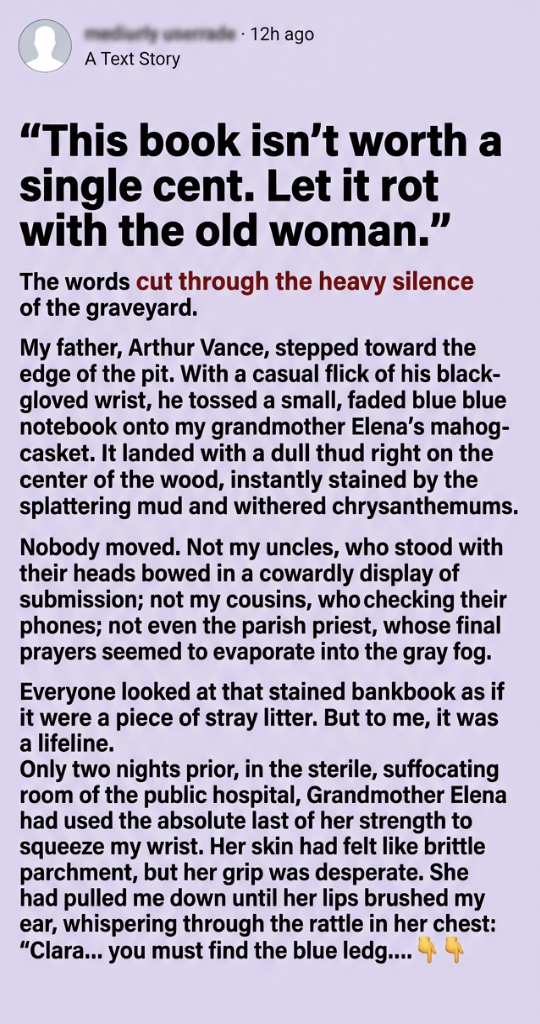
“This book isn’t worth a single cent. Let it rot with the old woman.”
The words cut through the heavy silence of the graveyard. My father, Arthur Vance, stepped toward the edge of the pit. With a casual flick of his black-gloved wrist, he tossed a small, faded blue notebook onto my grandmother Elena’s mahogany casket. It landed with a dull thud right on the center of the wood, instantly stained by the splattering mud and withered chrysanthemums.
Nobody moved. Not my uncles, who stood with their heads bowed in a cowardly display of submission; not my cousins, who were already checking their phones; not even the parish priest, whose final prayers seemed to evaporate into the gray fog. Everyone looked at that stained bankbook as if it were a piece of stray litter.
But to me, it was a lifeline.
Only two nights prior, in the sterile, suffocating room of the public hospital, Grandmother Elena had used the absolute last of her strength to squeeze my wrist. Her skin had felt like brittle parchment, but her grip was desperate. She had pulled me down until her lips brushed my ear, whispering through the rattle in her chest:
“Clara… you must find the blue ledger. Do not let Arthur see it. Whatever you do, do not let your father find it.”
Arthur Vance was a man built out of cold calculations and sharp angles. Standing there by the grave, he adjusted his designer coat and flashed a sharp, triumphant smile. I knew that smile intimately. It was the exact expression he wore when he told me my childhood tears were merely a play for attention. It was the smile he wore when he quietly emptied the bank account containing my hard-earned college scholarship money, claiming it was “rent” for the privilege of living under his roof. It was the same smile he used whenever Grandmother Elena had to physically step between his raging temper and my fragile frame.
“There’s your grand inheritance, Clara,” Arthur said, gesturing toward the deep grave with a mock bow. “An old, empty notebook. No estate, no real estate portfolios, no hidden fortunes. The old lady spent her entire life playing the mysterious matriarch, and in the end, she leaves us a bill for the funeral.”
Behind her oversized dark glasses, my stepmother, Evelyn, let out a sharp, delicate giggle. “Oh, bless her heart,” she murmured, adjusting her silk scarf. “Our poor Clara actually believed the old woman had a secret treasure chest hidden away. How delightfully naive.”
My half-brother, Julian, leaned into my shoulder, his voice dripping with smug amusement. “Hey, if there turns out to be fifty bucks left in that piece of trash, the street tacos are on you tonight.”
A few of my cousins snickered under their breaths. I kept my jaw clenched, my eyes fixed entirely on the mud-speckled blue cover below.
They didn’t understand. To them, Grandmother Elena was just an eccentric old woman who lived on the periphery of their grand ambitions. But I remembered the truth. I remembered the fierce woman who kept that blue ledger wrapped meticulously in an embroidered linen napkin, tucked away inside a rusted vintage cookie tin beneath her floorboards. I remembered watching her sit by the amber glow of a prayer candle every single month, adjusting her spectacles as she carefully recorded her meager earnings.
“This little book is for your future, Clara,” she used to whisper to me when I was a little girl, her rough thumbs wiping flour from my cheeks after a long day of baking. “But it must remain our secret. Only you can hold the key when the time comes.”
I had never understood the sheer weight of her secrecy. Not until this very moment. Not until I watched my father go through the elaborate theatrical display of public contempt for an item he claimed had no value. If it truly meant nothing, he wouldn’t have gone out of his way to destroy it.
As the cemetery workers began to shovel the heavy, wet clay over the casket, a horrific realization washed over me. Arthur wasn’t just burying his mother; he was burying evidence.
When the rest of the family began their slow march back toward the fleet of warm cars, Evelyn paused, tapping my shoulder with the tip of her manicured fingernail. “Move it, Clara. Your father has a lunch meeting, and he isn’t going to wait around for you to finish brooding.”
I didn’t turn around. “Go ahead without me. I want to stay until they finish.”
From a few paces down the gravel path, my father’s booming voice echoed back. “Leave her, Evelyn. She always did love playing the long-suffering victim for the crowd. Let her walk back in the rain.”
I stood perfectly still as the sound of their leather shoes faded away, replaced eventually by the distant roar of luxury engines firing up and exiting the gates. Soon, there was nothing left but the howling wind, the oppressive gray sky, and the fresh, jagged mound of dirt covering the only person who had ever truly loved me.
The moment the cemetery workers walked away to take their midday break, I dropped to my knees.
With entirely bare hands, I began to claw at the damp earth. I didn’t think about the mud caking beneath my fingernails or the ruined black fabric of my dress. I dug with a manic, primal desperation, scooping away heavy clods of dirt until my fingers struck the cold, rigid plastic of the ledger’s protective sleeve.
I pulled it free, cradling it against my ribs like a rescued child. It was freezing cold, dripping with grave mud. I used the hem of my dress to wipe away the grime from the cover, exposing the elegant, trembling script of my grandmother’s handwriting: Elena Salazar Vance.
But directly beneath her name, pressed firmly into the paper with stark blue ink, was a message that made my heart stop entirely:
“If Arthur tells you this book holds nothing, it is only because he has already tried to burn the vault. Do not trust the family. Do not trust his shadow.”
A cold sweat broke out across my neck. I tucked the ledger deep inside my coat, ran past the rows of towering gray tombstones, and didn’t stop running until I reached the safety of the tiny, cramped studio apartment I rented near the city market.
Safely inside, I pushed a heavy wooden chair tightly against the door handle. Under the harsh, flickering amber light of a single bare bulb, I opened the ledger.
The early pages were exactly what I expected—a heartbreakingly meticulous record of a woman scraping by on the margins of life. Small deposits. Two hundred pesos from selling artisanal tamales. One hundred and fifty pesos for washing the linens of affluent neighbors who looked right through her. Four hundred pesos for sewing intricate hems on dresses she could never afford to buy. Decades of unremitting, backbreaking labor condensed into neat columns.
But as I flipped toward the final pages, the narrative of the ledger took a terrifying, inexplicable turn.
The modest, handwritten entries abruptly stopped. In their place were massive, machine-printed automated transfers. Numbers that made my head spin. Five hundred thousand. Two million. Six million pesos. And next to every single one of these staggering sums, a recurring set of typed initials: A.V.
Arthur Vance. My father had been funneling astronomical amounts of money through my grandmother’s unassuming, low-tier account for years.
Then, my fingers caught on a crisp piece of paper folded into a tiny square, tucked deep within the spine of the booklet. I opened it carefully. The scent of lavender and old paper drifted into the room. It was a letter, written in my grandmother’s unmistakable, sharp cursive:
“My dearest Clara, if you are reading these words, it means the earth has taken me, and you have found the courage to dig for the truth. Forgive me for the silence I kept, but a lamb cannot fight a wolf until its teeth are grown. Your father did not just exploit my name to hide his stolen corporate wealth from the regulators. He has spent the last two decades hiding something far greater. He has been concealing the rightful legacy left to you by your maternal grandfather—an estate he legally signed over to you the day you were born.
Arthur believes he has successfully drained it. He believes I am a fool. But he does not know about the final protocol. Do not go to the police yet. Do not confront him. Go directly to the central branch downtown. Present this book and demand to see the account protected by the Crimson Seal.”
I turned to the final page of the book. There, stamped violently into the bottom right corner, was a thick, textured wax seal of deep crimson red, bearing an embossed alphanumeric code that looked like a specialized legal vault sequence.
I didn’t close my eyes for the rest of the night. Every creak of the floorboards, every distant car horn on the street below sounded like my father’s security team coming to reclaim what I had stolen from the earth.
At exactly eight o’clock the following morning, I walked through the towering glass doors of the central bank branch downtown. I wore the very same black dress, the faint outline of dried cemetery mud still clinging to the fabric. The ledger was hidden inside a worn canvas shopping bag, wrapped securely in a hand towel.
The branch was bustling with mundane life. Elderly citizens were waiting in neat rows to collect their monthly pensions; a businessman was loudly lecturing a customer service agent over a blocked corporate card; a toddler was crying for a juice box. To everyone else, it was just another Wednesday morning. To me, it felt like walking up the steps of a scaffold.
When my number was finally called, I walked up to a secure window. A young teller with a tidy bun gave me a standard, mechanical smile. “Good morning, welcome. How can I assist you today?”
My hands shook as I reached into the bag, unwrapped the towel, and slid the faded, blue ledger across the marble counter.
“This belonged to my grandmother, Elena Vance,” I said, my voice barely above a whisper. “She passed away two days ago. She told me I needed to bring this here immediately.”
The teller picked up the book with a casual nod, flipping it open to the primary account number page. She began to type the numbers into her terminal, her fingers moving with a swift, rhythmic confidence.
Then, the rhythm stopped.
The teller’s eyes went completely wide. She stopped blinking entirely. Her fingers froze over the mechanical keyboard as she stared intently at the glowing monitor. She looked down at the physical ledger, then back up at the screen, her breathing suddenly turning shallow. Every single ounce of color drained from her face, leaving her a ghostly, translucent pale.
“Ma’am…” her voice cracked slightly. “Are you… are you a direct, blood relative of the primary account holder listed here?”
“I am her granddaughter,” I replied, my chest tightening until it hurt.
“Your legal name, please?”
“Clara Vance.”
The teller swallowed hard, her throat visibly constricting. She typed a final, singular command into her computer. The moment the screen refreshed, her entire left hand began to visibly tremble against the desk. Without making eye contact with me again, she rose from her chair with deliberate, unhurried slowness—a desperate attempt to appear calm—and picked up the secure internal telephone line.
She turned her back to the glass, whispering frantically into the receiver. “Manager… you need to come to station four immediately. Bring the senior compliance officer. And… please initiate a silent lock on the front doors. Call security.”
The air in the room turned instantly freezing. Panic exploded in my veins. “What is going on? Is there a problem with the account?”
The teller didn’t answer me. She couldn’t even look at me.
Within less than sixty seconds, a tall man in a flawlessly tailored gray suit hurried out from the back executive offices. His tie was slightly askew, his expression an intense mix of profound shock and absolute gravity. Two armed security guards moved quietly into position near the exit doors behind me.
The manager stepped into the teller’s booth, slid the glass barrier fully shut, and snatched the blue ledger. He flipped directly to the back page, his thumb brushing over the textured, raised surface of the crimson red seal. He checked the handwritten alphanumeric code, then compared it directly to a secure, encrypted document flashing on his personal tablet.
He looked at my identification card, then raised his eyes to study my face, mapping my features against whatever profile was burning on his screen.
“Miss Clara,” the manager said, his voice dropped to a low, authoritative rumble that commanded absolute compliance. “I am going to ask you to step into our private executive conference room immediately. Do not leave the building.”
“Why?” I demanded, backing away from the counter, my heart hammering against my ribs like a trapped bird. “Just tell me what is wrong with my grandmother’s book!”
The manager didn’t answer right away. He gripped the faded blue notebook with both hands, holding it with a level of reverence and fear usually reserved for live ammunition.
And then, through the small audio slit in the security glass, I heard the pale teller whisper trembling words to the executive behind him:
“Sir, it’s really her… It’s the missing girl from the twenty-year-old federal asset-seizure case file.”